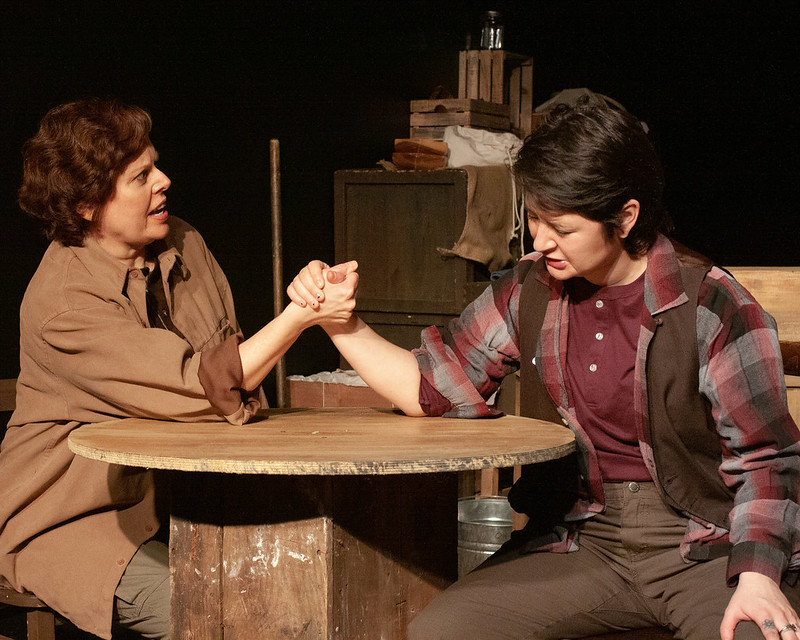
Cameron Feagin and Teri Talo in “A Town Called Progress” at Promethean Theatre Ensemble/Photo: Airan Wright
In the middle of nowhere lies a town called Progress. It’s a very small town, population two, and is little more than a well, a small café and a few houses surrounded by arid desert. But that’s okay, because the town motto is “Things being easy is a trap!”
This is the world of “A Town Called Progress,” a new comedy written by Trina Kakacek and directed by Anna C. Bahow. Full of wit and conscience, the play explores a hypothetical scenario in which communism, feminism and utopianism are given an honest chance at success. Free of the shackles of paternalism and capitalism, how are the residents of Progress getting along?
Turns out, not so good. The rough and tough mayor of Progress, Ida (Cameron Feagin), stares dejectedly at the town’s only source of water, a well gone impotent. On top of that, their only truck has fallen in a ditch and is too heavy for Ida to pull out. But all that is okay, because as Ida likes to say, “Things being easy…”

Kali Skatchke, Cameron Feagin, Chris Woolsey/Photo: Airan Wright
On a platform behind her sits Vivian (Kali Skatchke), a petite young woman whose only real job is to find a male sperm donor, get pregnant and increase the town’s population. But the pregnancy will be on her terms, thanks to a “safety belt” which Ida assures her “keeps the keys to reproductive freedom in our own hands.”
In rolls a man in a tumbleweed costume—and I mean literally rolls in! His name is, in fact, Weed (Chris Woolsey), a handsome young man and the epitome of a touchy-feely hipster raised by flower-child parents. (His siblings’ names are Seed, Lake, River, Sunflower and Soybean.) Accompanying Weed is Slim (Teri Talo), a stocky individual with a wealth of practical knowhow. Ida is unwelcoming, that is, until Slim fixes the pump and Weed lifts the truck out of the ditch.
Three towns surround Progress—Naked, Backwards and Conspiratorial. These towns use money, favor materialism and contain gender archetypes, everything the town of Progress is against. Yet the allure of capitalism proves too strong as Slim convinces Ida to allow Conspiratorial to purchase water from their well and to let Vivian and Slim to sell empanadas to Naked and Backwards; meanwhile, Weed impregnates Vivian, although Vivian is actually in love with Slim, and Weed has feelings for Ida.
Of course, when dealing with towns with names such as those, the plan backfires. All of their water gets bought, leaving them none and without water the demand for empanadas cannot be filled.
The answer to the problem? Capitalism even harder!
Slim can just build a second well and use the profits from the café to buy the business, thus abolishing the communal ownership and instituting private property rights and a money economy. A happy ending ensues where everyone gets everything that they want and live happily ever after.
This is where I experience cognitive dissonance. If a second well could have been dug this whole time, why wasn’t it? How did Weed, a man of average build, lift an entire truck? Why name a town Conspiratorial and Backwards if they are to become the moral and economic archetype which the residents of Progress adopt? How is it a rejection of female archetypes to have a woman whose only job is to get pregnant?
In the end, the protagonists’ code of ethics is dashed to smithereens. Life becomes easier, thanks to money and capital. The conspiratorial and backwards way of life is affirmed.
“A Town Called Progress” begins with an interesting premise that gets fleshed out by a cast that plays their comedic roles with satisfying, deadpan commitment. The direction by Bahow is full of mirth, action and heart. If all you are looking for is great acting and good laughs, this is the show for you. But if you are looking for a story that makes sense, I would hardly call a return to the status quo a sign of progress.
Promethean Theatre Ensemble’s “A Town Called Progress” at The Den Theatre, 1331 North Milwaukee, (773)697-3830, prometheantheatre.org. Through April 15.