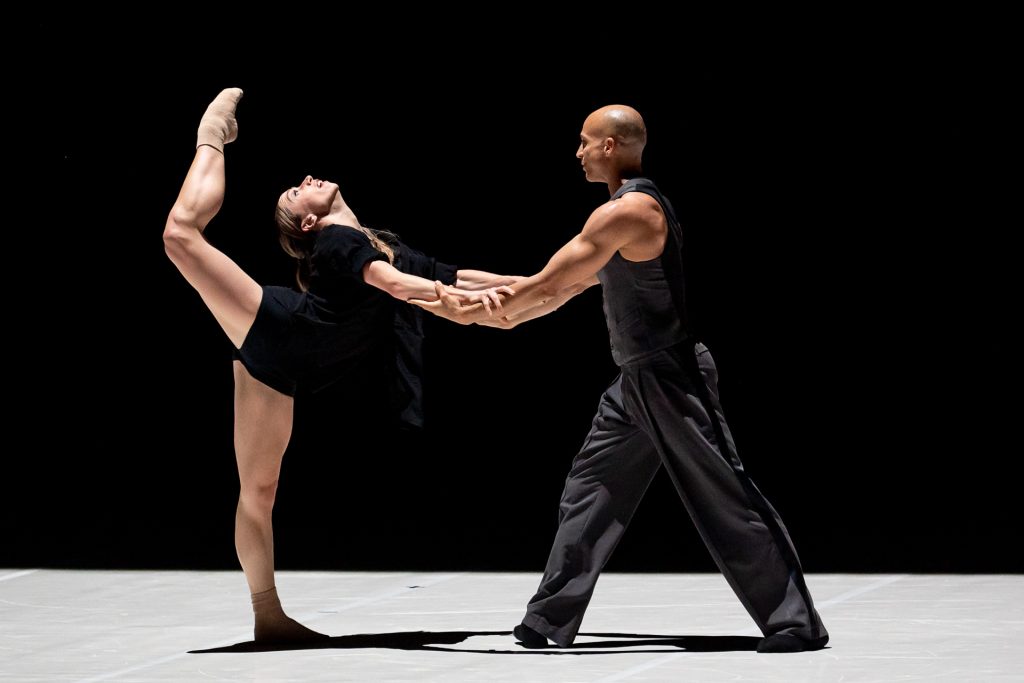
Akram Khan’s “Jungle Book reimagined.”/Photo: Ambra Vernuccio
London-based choreographer Akram Khan isn’t afraid to venture into the dark corners of fantastic realms. The last Chicagoans saw of his work was English National Ballet’s production of “Creature,” a post-apocalyptic Frankenstein-cum-“Interstellar” tale set in a subterranean bunker where the military is preparing to flee a frozen Earth. Khan brings his company to the Harris Theater for the first time November 9-11, with a near-future version of Rudyard Kipling’s “The Jungle Book” set in a rewilded and sinking city, where a female climate refugee, Mowgli, learns an urgent lesson from the animals reigning there. Khan spoke with Newcity about human hubris, the importance of gray areas and the outsized role his then-eight-year-old daughter played in the creation of “Jungle Book reimagined.”
What is your personal connection to this story?
I grew up nostalgic about “The Jungle Book,” because it was the first time I’d seen a brown boy like me represented on television, on Disney. I grew up watching Thor, Spider-man, Batman. But with “Jungle Book” I saw me. When I was ten, I played Mowgli in an Indian classical dance production. I was among some of the great Indian classical dancers. When I began making my own work I knew I’d return to it, but I also knew Kipling is very complex. As you grow up you realize the politics in art and storytelling—whose stories we’re telling and how. When I decided to do it, it was because of my daughter’s love of “The Jungle Book.” She saw the movie when she was four.
I think we’re repeating ourselves. If I say no to something because the author is wrong on so many levels, then what I’m doing is what colonial people did: erasing history. Funnily enough, Rudyard Kipling was hugely inspired by Indian myths. Of course, we also know he’s a lover of empire. The only name that’s real in the stories is Shere Khan. When he was around, the Muslims were giving the colonialists a hard time, so you can see why he’d decide to name the baddie Khan.
I remember people saying to me, “Don’t do this story,” and I was like, “Fuck it. I want to talk about it. I’m going to explore the problems in it and what’s good about it.” Because we live in a world where you have right or wrong, Republican or Democrat. In social media you have like or dislike; they’re your only options. There’s no gray area, no layers of complexity. I wanted to take “Jungle Book” with all its complexities and retackle it.
My daughter played a huge part in it. She was eight years old at the time. We’d built a loft during lockdown. She’s half-Japanese and half-Bangladeshi and both of those love gossip. She would hang out in the loft and eavesdrop on the meetings I had via Zoom on “Jungle Book” and gave her feedback.
The title is “reimagined.” Did you consider using “reclaimed”?
Reclaimed is more political. I didn’t want to bring politics in it for children. I wanted the story to be about climate change. The viewpoint is from the animals’ perspective, so it’s very much inverted. Mowgli does not speak. You hear the entire story from animals saying, “How weird are human beings? They keep making the same fucking mistake.”
I’m really nervous because we’re in a world where I’m constantly being asked to pick a side. People are afraid to talk. That’s another form of dictatorship—putting people into two different sides. No new generation is better than the old generation. They’re only better if they remember the mistakes of the past. Reading about World War I and World War II I never thought we would be in this place again, where the world is unravelling at an alarming rate.
To claim something is also dangerous for me. That’s what happened in India, right? The Brits came, stuck a pole in the ground and said, “We claim this land.”
Your theme of climate change is very much in line with the dangers of claiming. Man claiming ownership of the entire world.
Man claiming ownership over the world is old news. Now it’s the universe. We’re so entitled. We’re the only species that have destroyed other species at such a fast rate. Other species only kill to survive. Our species does it to dominate and control. Our children are inheriting all the problems we’ve set up. The whole capitalist system is another reimagined word for empire. It’s the few that control the majority.
Your story is set in a sinking city that animals have taken over. Last month flooding in New York was so severe a sea lion temporarily escaped her pen in the Central Park Zoo. So this isn’t some far-fetched, distant future.
And lockdown was really fuel for us to discuss nature reclaiming cities. We started to see fish in Venice, even in Thames, within a few months of non-human activity. It’s staggering, the damage we can do and the good we can do if we just step back.
My daughter had a big part to play in this. She said my solo “Xenos” was problematic because we were shipping huge sets, and that carbon footprint. That concept of “we want change” she revealed to me. We all want change, but we want everyone to change around us. We ourselves don’t want to change.
So I spoke to the team and we figured out how to tour [“Jungle Book reimagined”] without big sets. Each city provides cardboard boxes for the set and we return them to the city when we’re done. We worked with animation, which was a huge undertaking. Adam [Smith, director of animation at YeastCulture] was the captain of the team, but it was a team effort.
The other thing was, my daughter said, “Why can’t Mowgli be a girl?” I said, “Why?” and she said, “So I can see myself in it.” And I said, “Fine.” It was by default. She just happened to be there every day sitting on the floor. Her voice is very important because she represents a generation we’re telling the story to.
What about the costumes, and did your daughter have a say in them?
No. They’re simple and uniform. There are some pantomime-y versions of “Jungle Book” where Baloo wears a bear outfit. I didn’t want to go there. I think children can handle metaphor. The physicalization of the performer has to convince me that that’s a bear.
How did you go about choreographing animal characters?
We worked with the script [by Tariq Jordan] and with actors who read the script. That was our score. The music [by Jocelyn Pook] that was created—which is stunning—was like music that would be for movies. The dancers and I had a methodology where we could go on YouTube and constantly study animals. When the story came, we transformed those qualities into something poetic.
What do you hope audiences will take away?
Change. That’s what all artists hope for. That in some way we can move them and change how they see the world. Change happens for four different reasons in four different seasons: one is people change when they hurt enough they have to, second is they receive enough they’re able to, third is they see enough they’re inspired to, and fourth is they learn enough they want to. Change happens over time when consistent and persistent awareness is met with deep discussion, or art.
“Jungle Book reimagined” at the Harris Theater, 205 East Randolph. November 9-11, Thursday and Friday at 7:30pm, Saturday at 2pm. $20-$180. Tickets at harristheater.org.