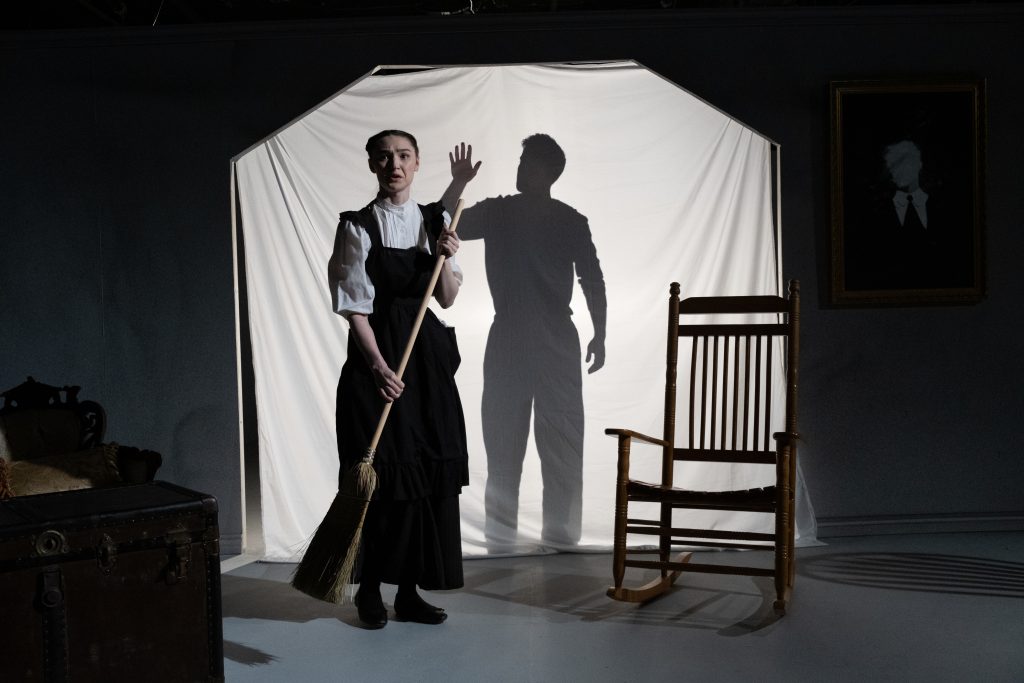
Gwydion Theatre’s “Can’t Pay! Won’t Pay!”
I don’t envy the director charged with adapting “Can’t Pay? Won’t Pay!”—a political farce written in 1974 by Nobel Prize-winning Italian playwright Dario Fo—to American taste and frame of reference. It’s set in a highly specific time and place: the inflation-wracked Italy of the 1970s, when housewives, outraged by ever-rising prices, mobbed grocery stores, grabbing food off the shelves and paying only what they thought the items were worth. These spontaneous actions—referred to as “autoriduzione,” or self-propelled price cuts—created shock waves, leading to police reprisals and condemnation even from Italy’s then-powerful Communist Party, which at the time sought respectability and cabinet seats, rather than the chaos of street-level revolution. Anarchist Fo, meanwhile, celebrated the women’s spunky spirit of resistance to capitalist profiteering.
The theme of budget-busting inflation is all too relevant right now in the United States. That said, it’s no easy task updating and transposing Fo’s almost fifty-year-old tale of the inside-baseball conflict between the Italian Far Left and Very Far Left. I imagine it would take months to master the underlying politics, create relatable characters, master Fo’s commedia dell’arte-inspired clownish technique, and establish a theatrical tone and energy that’s simultaneously antic, provocative and dramatically engaging.
Director Nena Martins and the young and promising Gwydion Theatre Company didn’t have the time necessary to explore and extract whatever universal messages are hidden within this highly topical work. The result is a farce that never finds its rhythm and flow, built around a situation that never seems either believable or quite comprehensible. What’s more, Ember Sappington’s new translation manages to convey a nowhere-land dramatic universe where the expressive quality of Italian speech is swamped by American linguistic crudeness.
The script comes off so slight and silly one begins to wonder whether the play is salvageable at all—and also whether farce, with its relentless frivolity, is the right vehicle for a social fable about poverty, oppression and class conflict. Fo, who died in 2016, was in his own time considered a dangerous subversive, denounced by the Vatican and U.S. State Department alike for authoring and staging such irreverent, anti-establishment comedies as “Accidental Death of an Anarchist” and “Mistero Buffo.” But this production never fully captures the gadfly quality that made Fo (and his wife and lifelong collaborator Franca Rame) so loved and hated in their native country.
The story centers on Antonia (Audrey Busbee), a fast-thinking, tall-tale-spewing woman who, as the play opens, has taken part in the first of the supermarket insurrections in her working-class neighborhood. She’s by no means ashamed of what she’s done, declaring that, “For the first time, we were all together!” But she’s terrified that her husband Giovanni (Caleb Petre), a by-the-book Communist union member, will find out about her impulsive liberation of the groceries, which include a package of frozen rabbit heads and other unsavories. Unloading some of the contraband on her neighbor Margherita (Ellie Thomson), who’s married to Giovanni’s buddy Luigi (Jason Pavlovich), she hides the rest of the loot under the bed that dominates the realistically shabby set (designed by Grayson Kennedy, Jack Kennedy and Maddie Hillock).

Gwydion Theatre’s “Can’t Pay! Won’t Pay!”
The rest of the play consists of cascading fibs by the loquacious Antonia, which go mostly unchallenged by her gullible husband, as well as standard-issue farcical business involving fake pregnancies, fake miracles, a possibly fake police officer and a fake body hidden in a coffin. With its two young, working-class couples engaging in zany, high-speed hijinks, the show comes to resemble an episode of “The Honeymooners” scripted by Emma Goldman—but without Jackie Gleason’s impeccable timing and Falstaffian humanity. And unlike the sitcom, the play goes on for two rather long hours, including intermission.
The plot contains its share of implausibilities: Can a man capable of dressing himself and going to work possibly be as childishly naïve as Giovanni? Could the income of an employed union worker be so low that no bills get paid and no (edible) food gets bought? Could the nimble Antonia really be frightened of her slow-witted, easily manipulated husband? These unlikely details, combined with the characters’ flatness and sameness, drain the story of impact. The overall cartoonlike feel is reinforced by the too-much, too-loud acting, which starts in a near-hysterical register (especially on the part of Busbee) and has nowhere to go. One wishes that everyone involved—including the playwright—had worried less about keeping us laughing and more about getting us thinking. One of the better scenes involves an examination of the taboo against small-scale theft in a society where politicians, police and big business routinely connect in networks of large-scale corruption. There should be more such moments.
Andrew Shipman gives the evening’s best performance, playing no fewer than four roles, including a low-level cop (who turns out to be more radical than the officious, literal-minded Giovanni) and a suspicious detective who keep the other characters jumping. Shipman’s characterizations have a nice gestural physicality differentiating the parts. The other performers too often lack the improvisational quality and playfulness of classic commedia, substituting effort for inspiration.
Gwydion made a luminous local debut a couple of months ago with Edward Albee’s “The Zoo Story.” This production reveals the fledgling company’s limitations—but also its theatrical ambition and sheer guts. The intention here is a good one, and if the execution doesn’t quite match, that can be chalked up to experience. I look forward to Gwydion’s next offering.
“Can’t Pay? Won’t Pay!” is presented by Gwydion Theatre Company at the Greenhouse, 2257 North Lincoln, through December 17. Tickets, $22 at (773)404-7336 or greenhousetheater.org.