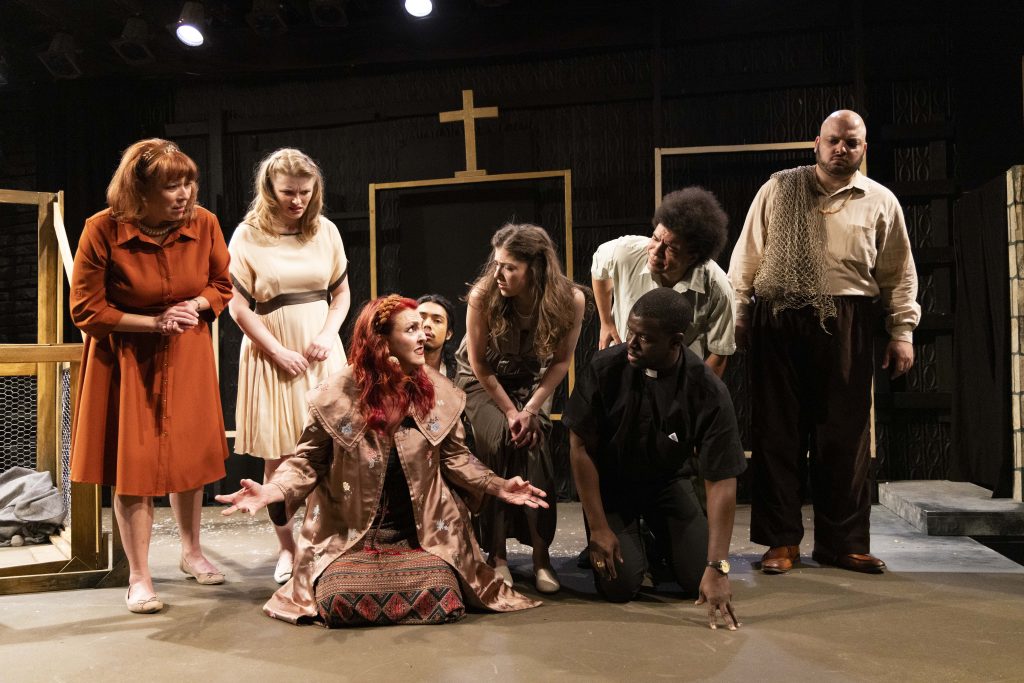
Trap Door’s “Mother Courage and Her Children,” with Rashaad A. Bond, Holly Cerney, Joan Nahid, Caleb Lee Jenkins/Photo: J. Michael Griggs
RECOMMENDED
A bloody, seemingly endless battle between closely related religious and ethnic factions with an underlying core of imperial geopolitics and petty personal ambition; brutal, indiscriminate attacks on civilian populations, verging on genocide; sizable profits accruing to the merchants of death who both enable and feed off the conflict.
Sound familiar?
What I’m referring to is the Thirty Years War, the great seventeenth-century bloodletting in Central Europe, which was sparked by Protestant-Catholic rivalry and led to the devastation of much of present-day Germany. It’s the background of German playwright Bertolt Brecht’s antiwar masterpiece, “Mother Courage and Her Children,” now playing at Trap Door Theatre under the thoughtful direction of Max Truax, who leads a well-chosen, capable cast.
If the description reminded you of some other wars—perhaps going on at this very moment—well, that’s what Brecht would want you to think. His point is that whatever the century or continent, war is war, a beast that destroys everything it touches and that turns on those who try to tame it for their own ends.
Brecht was no fan of either war or capitalism, and in creating the character of Anna Fierling, aka Mother Courage (she earned the epithet by driving her cart across a raging battlefield to sell bread before it went stale), he brought together what he would consider the worst of both worlds. She is a war profiteer, a dealer in provisions and supplies to the hungry armies laying waste to once-prosperous towns and villages. She and her three children, all by different fathers, are in harness, pulling her heavy wagon as the play opens. For years, the war has provided her with both captive customers and high prices for her goods, and she cannot imagine a world without it. It defines her, and she incarnates it.
Mercenary to her bones, utterly without sentiment or compassion or idealism, Mother Courage—who experiences terrible personal loss while remaining avid for monetary gain—is nonetheless one of the great female roles. Actress Holly Cerney makes it her own, lending the character a youthful sassiness and brassiness that buffers her harsh, unapologetic selfishness. Cerney’s full-flavored performance gives the show body and leavens the tragic inevitability of the tale, signaled from the start.
Director Truax wisely allows Cerney to dominate Trap Door’s compact stage, showing us a vibrant, canny businesswoman who revels in her ability to both outsmart and entice men. The question that haunts this play is how, as a mother, she can protect her children—the rough, warlike Eilif (Bill Gordon), the honest but obtuse Swiss Cheese (Rashaad Bond) and the innocent, kindhearted, mute Katrin (Joan Nahid)—from a war that, as a merchant, she embraces. Early on, another character exposes the impossibility of Mother Courage’s situation: “You want to live off war and keep you and yours out of it… One day, it will claim its return.”

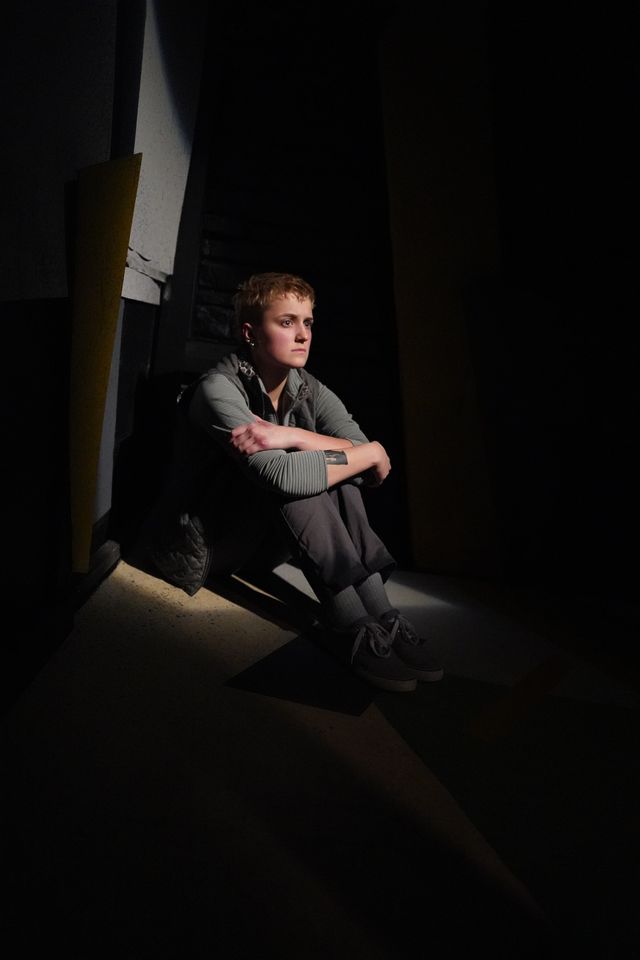
Trap Door’s “Mother Courage and Her Children,” with Bill Gordon/Photo: J. Michael Griggs
The cast of eight hasn’t a single weak link; all are comfortable with the challenge of Brechtian performance style, which is not about crafting a rounded, lifelike character that the audience can identify with, but instead a deliberately flattened representation of a social type, with neither backstory nor character arc. Caleb Lee Jenkins and Kevin Webb give solid, understated performances as, respectively, the army chaplain and cook who are romantic rivals for Mother Courage; Nena Martins is fresh and affecting as Yvette, the trampy camp follower who in her own way tries to cash in on the war; and Tricia Rogers is suitably ice-cold and rigid in her portrayal of various officers who treat humanity with withering contempt.
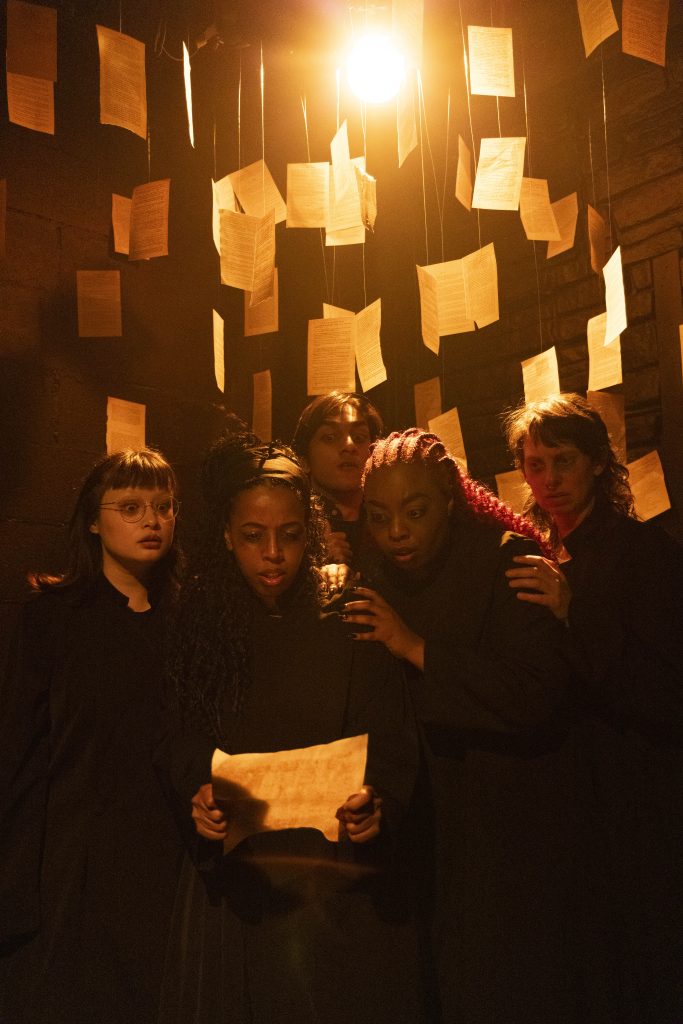
Together with his design team—including J. Michael Griggs (set), Richard Norwood (lighting), Rachel Sypniewski (costumes), Dan Poppen (sound) and Jonathan Quigley (who did the flickering, silent movie-like titles that punctuate the action)—director Truax has produced a tightly integrated sensory experience, enfolding viewers into the cramped, jumbled, randomly noisy chaos of an army camp during wartime. Anchoring the set is the canteen wagon, which serves as Mother Courage’s home and office. As realized by prop designer David Lovejoy, it’s a drab gray box without wheels, as fixed and ugly as the war itself.
The Brechtian universe is a morally murky, mostly unheroic one—as Mother Courage points out, “In a good country, virtues aren’t necessary,” as one can get by being perfectly ordinary—without complex, overheated dramatics. A low-key approach is what’s called for, and that’s what we get from director Truax. His pacing is steady and relaxed, with crisis points alternating with scenes of reflection and rumination, as the characters kill time, shoot the bull, open up about themselves and forge relationships with each other, always shadowed by the contingencies of war. The show packs plenty of narrative into its nearly two-hour length, with no intermission. It includes moments of savage irony and desolating sadness, as well as humor, mostly of a darker hue. But it never flags. The audience was rapt from the start, and at the end seemed not so much entertained as profoundly moved, almost to silence.
Quibbles: The songs (with tunes composed by Jonathan Guillen and sung partly by him and Sarah Hamilton) don’t always work, in part due to the limitations of recorded music within a live performance, but more because the songs aren’t as essential to “Mother Courage” as they are to some of Brecht’s other plays with music, such as “The Threepenny Opera.” And the use of mock rifles and pistols as just about the only props—substituting for bottles, belts and other wartime necessities—is a touch too self-consciously clever in an otherwise straightforward, unaffected staging.
There’s much to like about this production, from the richness of its acting to its evocative design to its potent anti-war message, as meaningful now as it was when the play premiered in Zurich in 1941. But what I most admire about the staging here is that it respects Brecht’s artistic intentions. Truax understands that, unlike most plays, “Mother Courage” isn’t really about its protagonist. It’s about war, and what war does to people, how it wounds and deforms and hardens them, creating myriad Mother Courages out of the plasticity of human nature.
This is one of the finest productions of a Brecht play I’ve seen in Chicago, or anywhere else for that matter. It’s a signal accomplishment by the small-budgeted but big-hearted Trap Door troupe. It deserves to be seen, especially now, in a world where war and commerce, as always bound tightly together, continue to make a killing.
Trap Door Theatre, 1655 West Cortland, (773)384-0494, trapdoortheatre.com. Tickets are $30 with two-for-one admission on Thursday. Through March 9.