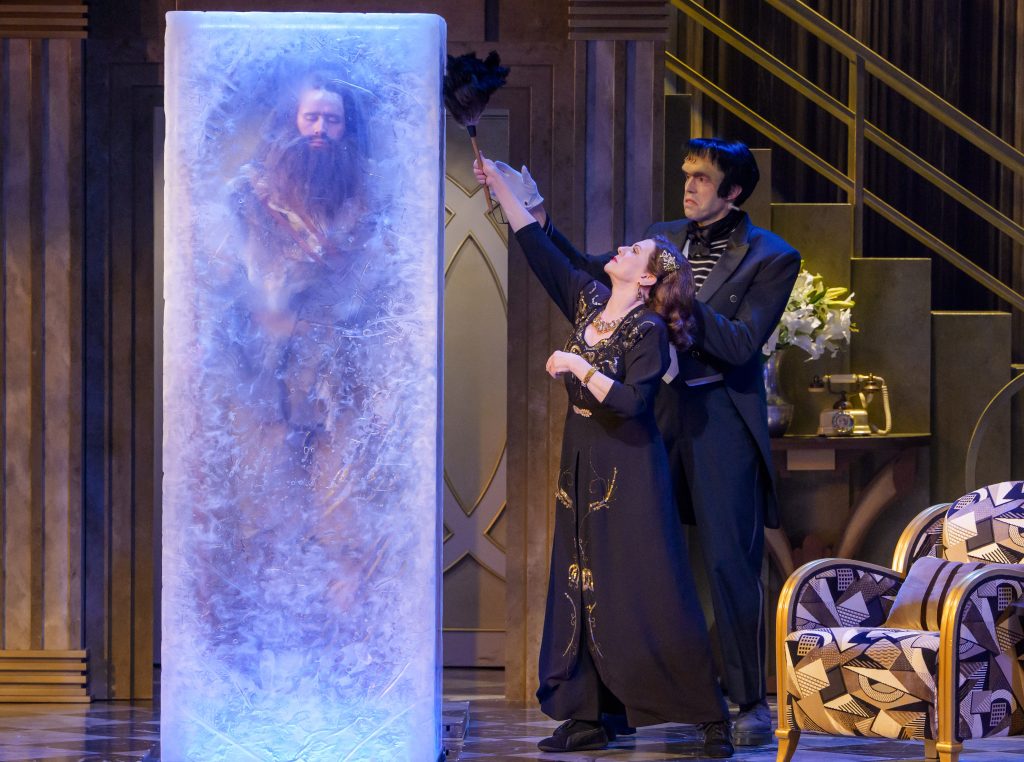
Goodman’s “The Matchbox Magic Flute,” with Tina Muñoz Pandya, Lauren Molina, Monica West, Russell Mernagh, Billy Rude/Photo: Liz Lauren
Twenty-eight years ago, a Chicago Opera Theater then-in-transition had the idea to do a production of Mozart’s “The Magic Flute” with Mary Zimmerman. This was a decade before Peter Gelb would come calling to recruit the Goodman Theatre director over to the Met, and it turned out to be the first opera Zimmerman had ever directed. I covered that production; I can even recall the discussions surrounding why Zimmerman should do the piece.
Zimmerman notes in the program book to “The Matchbox Magic Flute” that because the costumes and design were from a rented revival, she never felt that the Chicago Opera Theater production was her own.
When new Goodman artistic director Susan V. Booth asked Zimmerman what she might want to do this season, a small-scale rethinking of “The Magic Flute” was the response.
That means of course, in typical Zimmerman fashion, that every aspect of the beloved opera would be rethought.

Goodman’s “The Matchbox Magic Flute,” with Russell Mernagh, Dave Belden, Emily Rohm/Photo: Liz Lauren
Zimmerman makes clear that her intentions are to make “The Magic Flute” a family-friendly opera. Papageno (Shawn Pfautsch) is never in danger of committing suicide here. The trials of Act Two are silently hosted by The Spirit (Reese Parish), with descriptive cards for the audience as if they’re part of a game show. There is no real danger that Pamina (Marlene Fernandez) will leave Tamino (Billy Rude) over his ignoring her. Sarastro (Keanon Kyles) is warm and fuzzy. Even the usually ferocious Queen of Night (Emily Rohm) seems merely to be having a bad day.
There are no subtitles here—every spoken and sung line is in contemporary English that has been “adapted” by Zimmerman herself. There is even a reference to Lake Shore Drive.
The piano-dominant orchestration comes off largely as piano-only accompaniment with some additional standalone musical elements such as flute, glockenspiel, solo violin, et al. The orchestra needed for “The Magic Flute” has always been a small one—why truncate it?
True, in the world of musicals, keyboardists often conduct while playing as here, but having “Keyboard I” and “Keyboard II” as in a Broadway-like pit would allow for a more varied and denser sound. It also doesn’t work in your favor if you choose to cast show voices singing Mozart—as is mostly done here—when they are doing so in such a completely unexposed manner and often in surprisingly slow tempos.
Still, there’s no question that Zimmerman is onto something here that could really catch fire for smaller opera companies and children’s theater companies.
Through March 24 at Goodman Theatre, 170 North Dearborn. Tickets are available at goodmantheatre.org.