Members of QDF pose after their performance at Circus Performing Arts Festival 2024 (left to right) L’Raven (she), Megan Davis (they), Mash Bandouil (they), Virginia VanLieshout (they), Ray Post (they), Ryan Eykholt (they), Patty Roache (they), Dawn Heilung (they)/Photo: Grace Gershenfeld
“Facts don’t care about your feelings” is a perplexing argument that has gained popularity among dogmatic ideologues.
Of course, facts do care about your feelings. Take, for example, drag shows, the modern version of which originated in the nineteenth century and has since produced a spectrum of offshoots—from G-rated story hours for young children to risqué burlesque at speakeasy-themed nightclubs. For many, drag shows are a fun pastime with variations suitable for a wide audience; for others, who feel that dressing as a different gender is inherently sexual, no drag show is appropriate.
How we feel determines whether we see drag shows as an amusing cultural byproduct or a coordinated attack on “traditional” values. Ignorance of queer art leads to fear and hatred; recently, legislation to outlaw public drag performances has been proposed in at least twelve states.
But prejudice (i.e., an opinion without judgment) can be ameliorated with education. To be able to evaluate queer art, we must understand what it means to create art through a queer lens. Drag only scratches the surface of queer art—a rejection of heteronormative binaries regarding gender and sexuality in the various branches of creative activity.

The full company of Queer Dance Freakout performing their closing number, “In the Lap of the Gods”
No company in Chicago better exhibits a queer aesthetic and philosophy than Gender Fucked Productions (GFP), a nonprofit that produces performances, programs and workshops for queer and trans artists with a focus on organizational sustainability, equitable pay and intersectional collaboration.
Dawn Heilung, founder and artistic director, chose a name that is purposefully provocative, aware that when young trans and non-binary artists hear “Gender Fucked,” they know they’ve found a safe space. “We knew that the name would get that point across,” says Heilung. “Plus, in the community, a lot of people use that language to talk about their art, or their drag, or their life, or to express their feelings.”
The first step toward understanding contemporary queer performance art is to accept it as inherently activistic. “It’s funny because, legally as a 501(c)(3), we can’t be political or make political stances; but our lives are made political by the way that trans people are being outlawed and pushed out of places.”
Using storytelling as activism, GFP’s goal is to help artists to affirm their gender and sexuality through their work; paradoxically, there is also a desire to negate an artist’s gender identity. The balance of affirmation/negation is perfectly exemplified in GFP’s flagship performance company, Queer Dance Freakout, a collection of actors, singers, musicians, sketch comedians and professional dancers who perform a mashup of short, collaborative works.
An example of the affirmation/negation paradox is embodied in “Double Slit,” a work by choreographer Mash Bandouil. The piece shows Bandouil observing an experiment: An explanation of basic quantum mechanics delivered by a disembodied voice is converted into abstract movement as bodies form waves of particles that float, ripple and collide within a vacuum.
Bandouil, who works in a biology lab, says the main objective is to get people interested in science, but the inherent politicization of the trans/non-binary body is present. “Science leads to bigger questions of what it’s like to be observed, or to observe other people and what kind of realities that creates. In the scheme of transphobia, or being trans, it’s very much about how you are being observed versus how you perceive yourself.”
The gaze of the observer is not limited to the public, and is present among peers in the creative arts. “A lot of dance companies in Chicago don’t really know what to do with people like me,” says Bandouil. “It’s like, ‘Okay, you’re not a boy or a girl… How are we going to cast you? What are you going to wear?’ Dancing with Queer Dance Freakout, you don’t have to ask any of those questions or advocate for yourself constantly. I can just be.”
-

- Patty Roache (they) performing their piece “The Data Speaks for Itself: Live at the QDF Show” during April 2024 showcase
-

- Amethyst Rose (they) performing their solo “And I Will Always Love Him” at QDF’s Spring Fling show.
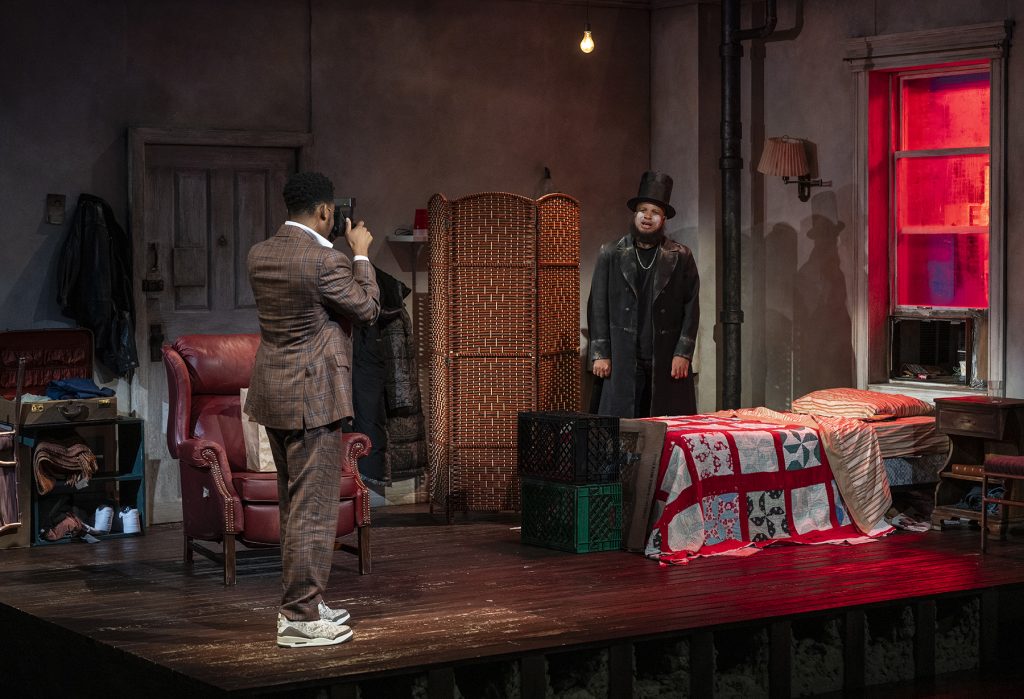
Trans Voices Cabaret (TVC)—an independent musical theater cabaret variety show—is now under the GFP umbrella as an example of both companies’ commitment to supporting organizations with parallel missions. Together, they are preparing for an upcoming performance at the Steppenwolf Theatre on June 1.
The goal of TVC is to show casting directors and producers the different ways that trans actors can be used in a show. The show tunes are unaltered; instead, the very essence of the characters whom the artists inhabit are expanded in new and interesting ways. “Trans actors are just as castable as anyone else,” says Larry Trice, the artistic director for TVC, “and adding trans actors to stories enhances them in ways that I don’t think people understand yet.”
An example is the casting of Black trans woman Mj Rodriguez as Audrey in “Little Shop of Horrors” (2019) at the Pasadena Playhouse in California. During “Suddenly Seymour,” Audrey talks about the “girl that I’m becoming,” which takes on a whole new meaning when spoken by a trans woman. The inclusion of Rodriguez doesn’t change the story, but enhances it with a depth that can only come by having a trans actor portray that role.
Many queer and trans actors have a hard time not being cast to type. “You don’t have to cast trans actors as only trans characters,” says Trice. “You can cast a trans person in a cis role and still treat it as a cis role. There’s so much creativity in casting that is lacking, because they’re not looking at the full spectrum of humanity and what can be used in the show.”

Dancers rehearsing “Unmasc” by Patty Roache. From left: L’Raven (she), Megan Davis (they), Dawn Heilung (they), Patty Roache (they), Amethyst Rose (they), Virginia VanLieshout (they)/Photo: Grace Gershenfeld
Queer, trans and non-binary artists imbue artistic works with nigh-infinite perspectives of gender expression and sexuality. They create unique theatrical roles and enhance classic characters in exciting new ways. They teach us how to pierce the veil of the socially constructed gender binary to see the true person underneath. Art through a queer lens is bigger, bolder, riskier, paradoxical and surprising—in short, queer art is art that gives you more by artists who don’t ask for much.
“We often have conversations about what it means to be a queer and trans company,” says Heilung. “A lot of folks that we work with in the community are not welcomed in regular art spaces or are not seen for the whole version of themselves; what we try to do with Gender Fucked is create spaces where that wholeness of ourselves can be seen beyond our gender.”
Trans Voices Cabaret returns to Steppenwolf Theatre, 1650 North Halsted, as part of the LookOut Series on June 1 at 8pm. For more on Gender Fucked Productions—including Queer Dance Freakout, Trans Voices Cabaret, It’s Alive! (New Works Series) and the schedule of classes for We Are Dance Collective, visit genderfucked.org.