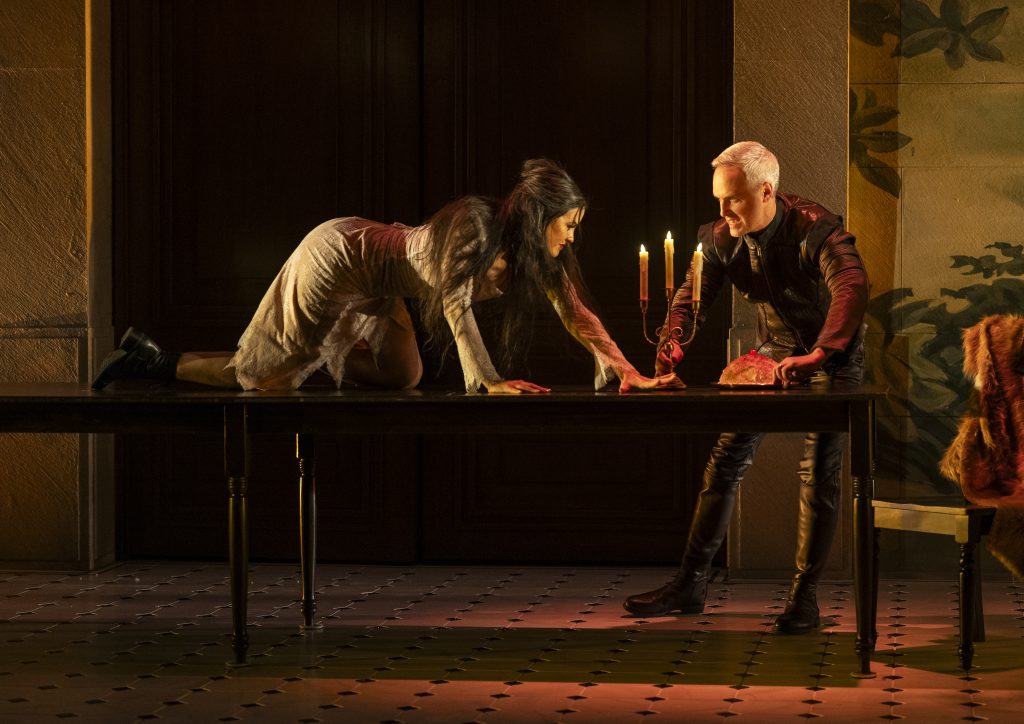
Court Theatre’s “Stokely: The Unfinished Revolution,” with Melanie Brezill, Kelvin Roston Jr., Anthony Irons and Dee Dee Batteast/Photo: Michael Brosilow
RECOMMENDED
The term “Black Power” is often misunderstood and branded as a synonym for Black nationalism. In reality, Black Power is an assertion that Black people should be in control of decisions and policies that affect the Black community.
The struggle for equality is indicative of the life story of one of its greatest proponents, Stokely Carmichael, who later changed his name to Kwame Ture, an organizer during the civil rights movement in the United States and advocate for the global pan-African movement. In Court Theatre’s “Stokely: The Unfinished Revolution,” we see the ideology of Black Power develop during his lifetime, from childhood to death.
Carmichael/Ture (Anthony Irons) is dying of prostate cancer in his home in Guinea, West Africa. Before he dies, he wants to record the events of his life, hoping that his story will continue to organize the world’s African-descended population after his death. He invites his mother, Mabel Charles (Wandachristine), to help him remember. The click of a handheld tape recorder sends them into the past as they recall moments of pain, elation and repressed dark memories.
The pacing of the performance is Olympian. (click) They’re transported to the Carmichael home in Trinidad in the 1950s, where adolescent Stokely learns the difference between “colored” (good) and “Black” (bad). A minute later, (click) he is in the Bronx with his father, Adolphus Carmichael (Kelvin Roston Jr.), who berates his son for denying admission to Harvard University to attend the historically Black college, Howard University. (click) It’s the 1960s, and Carmichael is being chastised by his partner, Cecilia Carmichael (Dee Dee Batteast), for misogynist comments he made at a meeting of the Student Nonviolent Coordinating Committee (SNCC). (click) He’s again a child in Trinidad crying into the arms of his Tante Elaine (Melanie Brezill) after being abandoned by his parents, who moved to the United States without him.

Court Theatre’s “Stokely: The Unfinished Revolution,” with Anthony Irons/Photo: Michael Brosilow
Every click of the tape recorder is a leap back and forth through time, complete with changes in scenery, lighting, characters and costumes. Actors change from West Indian to New York accents in the same breath. Every ensemble member besides Irons fills multiple roles, including the personifications of the most prolific Black civil rights leaders—Dr. Martin Luther King, Diane Nash, Bayard Rustin, Fannie Lou Hamer, James Baldwin and more. Occasionally, the ensemble breaks out in beautiful five-part harmony singing gospel hymns turned civil rights anthems—”I’ll fly away, Oh Glory, I’ll fly away; (in the morning) When I die, Hallelujah, by and by, I’ll fly away.”
Director Tasia A. Jones packs the ninety-minute runtime with a ton of Ture’s history and leaves viewers who don’t know much about this historical figure a lot to chew on.
Those who are well-versed in the history of Carmichael/Ture may find their knowledge detrimental to enjoying the show. Ture’s philosophical and political views are so rich, eloquent and thoughtful, yet are barely explored; instead, playwright Nambi E. Kelley chooses to focus on his interpersonal relationships, often capturing Ture’s most poignant propositions in one or two sentences before… (click). Those expecting a deep dive into Ture’s philosophies will find only a mere outline.
But if you want to understand Ture’s political positions, take his advice and read one of his books.
“Stokely: The Unfinished Revolution” provides insight and background into one of U.S. history’s most towering and misunderstood revolutionaries. After suffering abandonment, vicious attacks, imprisonment and a vision not yet realized, Ture’s message is still one of hope, and his story is as relevant today as it was during his lifetime.
“Stokely: The Unfinished Revolution” runs through June 16 at Court Theatre, 5535 South Ellis. Showtimes are Wednesday-Friday, at 7:30pm; Saturday-Sunday at 2pm and 7:30pm. Accessible performances (audio description and ASL interpretation) June 15; open captioning June 16 at 2pm. Tickets are $56-$88 at courttheatre.org, or by calling the box office at (773)753-4472.