Anthony Freud/Photo: Todd Rosenberg
They say the opera ain’t over until the fat lady sings, a colloquial reference to the vocal power and physical stature of a traditional Wagnerian soprano singing the finale of Wagner’s four-opera “Ring” cycle. For Anthony Freud, the fat lady has sung. Or as Canio says at the end of Leoncavallo’s “Pagliacci,” “La commedia è finita!” After thirty years of being an opera administrator in the U.K. and the United States, Anthony Freud has left the building. For the last thirteen seasons, that building has been the Lyric Opera House.
Freud has been the general director of Lyric Opera since 2011—the titles of president and CEO were added in 2015—the first person recruited from outside of the company to run it in its seventy-year history. That fact alone would likely mean that the Freud era would be greatly different from the administrations of his predecessors Carol Fox (1954-1980), Ardis Krainik (1981-1997) and William Mason (1997-2011). But under Freud, Lyric has experienced more change than under the administrations of any of the previous three, perhaps all three combined.
Some view Freud as a hero for navigating turbulent waters of challenging times and managing to keep the company afloat when it might well otherwise have gone under. Others see him as having reduced the company to a shadow of its once former glory.
How does Freud himself see it? We were invited to spend an afternoon with him while he was still on the job to find out.
It’s a beautiful late-April afternoon with summer-like temperatures. It had been well before the pandemic since I’d been in the fourth-floor office of the general director at Lyric Opera. It’s a corner office within the company’s administrative floors, accessed through a hallway of front offices.
Anthony Freud is standing in that hall, casually dressed in a button-down shirt and dark sweater, wide-eyed and grinning like a school kid chatting about what he had done that late spring weekend.
“It was like a festival event,” says Freud. “We went to the National Theatre Live ‘The Motive and The Cue’ on Saturday and then Eddie Izzard’s ‘Hamlet’ on Sunday. ‘The Motive and the Cue’ is a play about the production of ‘Hamlet’ that Richard Burton did on Broadway in the sixties directed by John Gielgud. It’s a wonderful play, directed by Sam Mendes. It was at the National but I missed it in London. It’s essentially about the relationship between Burton and Gielgud but it’s all about the play, too. So to see the play about the rehearsal of ‘Hamlet’ on Saturday and then the very unusual version of ‘Hamlet’ on Sunday was great, actually. It was like a festival weekend.
“The Izzard ‘Hamlet’ is not what you would think. It’s actually in some ways very understated. It’s all text-based and he has a marvelous voice. Actors with marvelous voices are quite few and far between these days. And he doesn’t exaggerate the characterizations. I thought it was remarkable. He’s amazing.
“Anyway, please come in!”

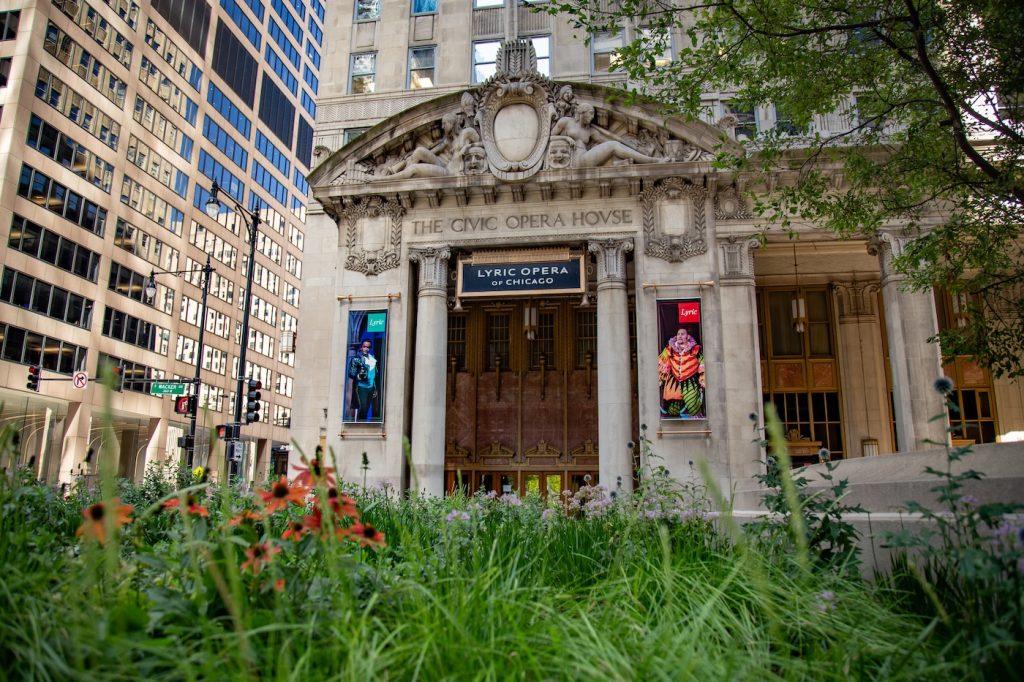
Updated exterior/Photo courtesy Lyric Opera of Chicago
The way is unfamiliar as so much has been redone and brightened since my last visit. But the office space itself with its corner desk and large conference table dominating a wooded room with framed opera posters, photographs and memorabilia feels very familiar, very much recalling the office of Freud’s legendary predecessor, Ardis Krainik. When Freud is asked if this is the same office occupied by the Grand Dame, as recently departed Lyric music director emeritus Sir Andrew Davis liked to refer to Krainik, Freud says, “Not quite. Let me tell you the story.
“Ardis’ office was in this very spot, but on the eighth floor. Lyric occupies two and one-half complete floors. Ardis was taken ill at the time that this office was being prepared and she was never well enough to occupy it. But I believe it looks exactly the same as it did.”
Indeed it does. Krainik would be at her desk, offering guests colorful jelly beans from a glass jar on her desk that she explained had belonged to company founding Lyric general director, Carol Fox. The chair had also belonged to Fox and was rather regal. “This chair was new to me,” says Freud, as he walks over to the conference table, motioning with his hand for me to sit at its head. Taking a seat, you can’t help but feel the weight of the myriad artistic discussions and decisions that have been made here.
“I was so privileged and fortunate to have been able to spend some time with Ardis because I became a general director for the first time in 1994 at Welsh National Opera. Thirty years ago. That year, Carlo Rizzi, who was the music director of WNO, was conducting ‘Barbiere [di Siviglia], and I came over to spend time with him.
“I’d met Ardis once or twice before and she was always very welcoming. But because I had just become a general director and was a complete rookie, I contacted her and said, ‘Would you be able to spend some time with me?’ And she did. And she introduced me to Danny Newman.” Newman was Lyric’s legendary public relations counsel from the start of the company.
“Well, you know, fast-forward twenty years and it was kind of extraordinary that when I got this job, I was able to, I think, benefit from the fact that I’d had a personal connection with these two legends of Lyric. Ardis was so warm and generous with her time. It was, I don’t know, it has a significance maybe disproportionate to anything objective. It just feels to me to have been important and I felt that from day one.
“And, of course, I knew Bill [Mason, Krainik’s successor and Freud’s predecessor] from well before those days. And when he became general director, I was [general director] in Houston and in regular contact with him because the ‘Hansel and Gretel’ was a Houston co-production with Lyric. Lyric had created its own enlarged version of the Houston ‘Cavalleria’ and ‘Pagliacci’ so Bill and I knew each other forever. And so when I was appointed to this job, I felt as though I had a deep personal connection to Lyric through my friendship with Bill and my acquaintance with Ardis and Danny. I don’t know, it just felt very meant.”
Both William Mason and Ardis Krainik ended up leading Lyric Opera due to unique circumstances: Krainik because Carol Fox had been forced out in 1980 as the company was on the brink of financial ruin and Mason due to Krainik’s ill health in 1997. Neither had necessarily set out to go into management. Nor had Freud.
“I’m of a generation that never went to an arts administration training course. I was a barrister, an attorney, very, very lapsed, but I had a passion for the arts. I enjoyed my time at the law, but I felt that I was surrounded by people with a vocation that I didn’t share. I felt that my vocation was opera, in particular, because by that point, I had been going to the opera for years and was completely hooked on it. So I learned on the job.
“I was lucky enough to work for two bosses in my first two jobs in the arts who were incredibly conscientious mentors and gave me a start, both at Sadler’s Wells Theatre with Stephen Remington and at Welsh National Opera with Brian McMaster. That was infinitely better, I think, than any arts-administration course would have been. And they were generous enough to invest time and took the trouble to ensure that not only did I do the job they wanted me to do, but they gave me opportunities to learn and grow and develop. That was the foundation from which I then built my career.
“I’m grateful for my training as a barrister every single day—not because I have any up-to-date knowledge of the law—but because it trains you how to think, how to analyze, how to present an argument on both sides of an issue and to understand the difference between an objective judgment and a subjective judgment.
“I always think of myself as a kind of missionary for opera. I always have. I want to persuade as many people as possible to experience the transformational power of live performance that I experienced a long time ago now, fifty years ago or more.”
Music director emeritus Sir Andrew Davis had passed away a few days before our meeting, and condolences were expressed to Freud.
“It was a huge sadness, I must say. The timing of it was really shocking. I’ve known that Andrew had been seriously ill as he told me about his leukemia diagnosis about a year and a half ago. I had known that the ultimate prognosis was not good, but he seemed to be doing incredibly well. We were texting just a few days ago. He was in the hospital for a week and they let him go home, which cheered him up to no end. He knew he had to go back in for blood tests, and I think that’s when they kept him in. He was hoping that the latest round of chemotherapy would put him into remission. Clearly, it didn’t.
“I don’t know all the final details but it was very quick and very sudden in the end. I can’t quite believe he’s gone. Such a force of—well, more than—a force of nature, I mean, he was just so full of life.
“One of the last conversations we had he said, ‘You know, there’s really no piece I haven’t done that I’m dying to do. I’m happy to revisit some of the ones that I’ve done, but I’m not actually sitting here longing.’ He and I had agreed that one of our favorite operas was ‘Hansel and Gretel’ but he had never done it at Lyric. I’m so thrilled that it worked out for him to do it here in the end. He was already unwell.”

Lyric Opera of Chicago’s “Hansel and Gretel” with Samantha Hankey as Heidi Stober/Photo: Cory Weaver
It was certainly not obvious that Davis was ill when he conducted “Hansel and Gretel” in early 2023. He seemed his usual jovial self.
“No, you couldn’t tell. And, of course, we didn’t say anything to anybody, but he had been diagnosed some months earlier. It just happened to fall into a good period when he was—I don’t know if clinically he was in remission, but he was in good shape. He did all the rehearsals and all of that. And the joy of those performances and the lightness and the vitality was very special. It couldn’t have been a more perfect last project for him.
“I must tell you. My first actual meeting with Andrew was when I was a candidate for this job. I’d known Andrew as a performer for years at the BBC Symphony Orchestra and we’d met once or twice. But we had never had a real conversation.
“I’m sure you remember [late Lyric Opera president and CEO] Ken Pigott. He was the chair of the search committee that led to my appointment and at that time, was already board chair-designate. I came to Chicago multiple times and spent time with Ken and with other board members. Ken’s office was on the corner of Clark and Wacker and most of our meetings were held there because everything was being kept quiet, successfully for most of the time. So that’s where I basically hung out.
“You know, that was quite a process. Neither the company nor the candidates wanted the process to be particularly known. That was normal. So my meetings were all in Ken’s office and one of them was with Andrew. Ken said, ‘I’m just going to leave the two of you to it.’ Three hours later, we stopped! Both being Brits, we had points of common reference and we had a similar sense of humor. We could make references to obscure, eccentric British people and events that nobody else would understand.
“We also shared our core repertoire dreams at that point. A new ‘Ring’ was absolutely one of them. And ‘The Trojans,’ partly because Andrew had been scheduled to conduct it here some years before and it was canceled.” In the wake of 9/11, the epic Berlioz grand opera was deemed too costly by then-general director William Mason and replaced with a Gilbert and Sullivan operetta. “Eventually, we managed to do ‘The Trojans’ here and that was very meaningful to Andrew. We talked a lot about ‘Don Carlos,’ which has now happened, but with [current music director] Enrique [Mazzola] rather than with Andrew.

Enrique Mazzola, Anthony Freud and Sir Andrew Davis/Photo: Kyle Flubacker
“Andrew’s repertoire was so vast and he seemed to be extraordinarily specific to every piece he was conducting. I mean, his Mozart couldn’t have been more Mozartean. His Wagner couldn’t have been more eloquent. That’s what was such a privilege about working with him so closely for ten years.
“If you think of him conducting ‘Rusalka,’ ‘The Merry Widow,’ ‘The Passenger,’ ‘Tannhäuser,’ ‘Meistersinger,’ ‘Parsifal,’ the first three ‘Ring’ operas, ‘Boccanegra,’ ‘Turandot,’ ‘Don Giovanni,’ ‘Clemenza,’ ‘Idomeneo,’ ‘Magic Flute,’ the new piece ‘Bel Canto,’ extraordinary. Extraordinary.”
And many of those were first-ever performances for Davis.
“Right. And at no point did I ever think Andrew was a visitor to any of those pieces. He was never a tourist. He always got to the heart of every piece he did in a very unassuming, understated way that just was full of integrity.
“I’ve always loved my relationship with Andrew and with the music directors that I’ve worked with. I think that in some ways, the relationship between a general director and a music director in an opera company is the key relationship. If that goes well, other things go well. If that doesn’t go well, nothing else can really make up for it. I’ve loved the music-director relationships I’ve had at Welsh National Opera, Houston Grand Opera and here both with Andrew, and now with Enrique.
“And while I was very excited about the possibility of coming here, until I actually met with Andrew and we found out whether we had a connection, ultimately I didn’t know if I wanted to come here. After that first three-hour meeting, that was that. I realized that this was going to be a very warm, close, transparent relationship.”
How did Freud feel about the fact that when he was hired, he was to become the first person outside of Lyric Opera to lead the company? Did he see that as a plus or a minus?
“I was indeed very much the first person to be appointed to this job from outside the organization. And I think that was very intentional on Ken’s part and on the board’s part.
“My brief was really very clear. They wanted to explore how to take the company in new directions without ever losing appreciation for its foundation, for its tradition and for its history. But at the same time, acknowledging that the world was changing, fast. They realized that they needed Lyric to think differently and evolve in new directions. That was very clearly the brief I was given by the board when I was recruited.
“I’m not someone who arrives with preconceived ideas. I do believe that someone coming into a job like mine needs to spend months listening, not talking.
“Obviously, I had ideas and a vision, but that needed to be enmeshed in the specific qualities and opportunities and challenges of this institution in this city. I’ve never believed in the idea of a generic opera company serving a generic city. I loved my time at Welsh National Opera, I loved my time in Houston. I didn’t arrive in Chicago thinking, ‘Great, I know what to do.’ I didn’t know what to do, particularly with Lyric being what I would describe as a legacy company.
“That’s a rather ephemeral concept in my mind because curiously, Lyric and Houston Grand Opera are exactly the same age. But, of course, the history of opera in Chicago goes back to the 1870s. The fact that Lyric is not more than a hundred years old is a matter of the business fragility of the arts in Chicago. To that extent, Lyric has a sense of being a legacy company and being a legacy company far older than its actual corporate years, do you know what I mean?
“I love theaters and opera houses. I love the fact that this is a building that opened in 1929 with everything that an opera house could hope to have.” Infamously, just six days after the Wall Street crash. “Which is why Samuel Insull’s dream didn’t work out.”

Updated exterior/Photo courtesy Lyric Opera of Chicago
Samuel Insull was the Chicago electrical innovator and entrepreneur who envisioned and built what was then called the Civic Opera House as the new home for the Chicago Civic Opera, which did not survive the aftermath of the Crash of 1929. Opera companies came and went until Lyric Theater of Chicago—later Lyric Opera of Chicago—set up at the Civic Opera House in 1954.
After nearly forty years of renting the space, Lyric purchased the theater and backstage area in 1993 and in the midst of a substantial multi-year hundred-million-dollar renovation campaign spearheaded by Krainik, changed the name of the venue to the Lyric Opera House.
“You know, in my job, you have the opportunity to wander through an empty opera house whenever I want. And there’s nothing more magical than an empty opera house, thinking and feeling the ghosts of those who have performed in this house.
“Anyway, I didn’t come to Lyric thinking, here are the answers. I came to Lyric thinking, what an extraordinary institution, what an extraordinary tradition. And what an extraordinary energizing challenge to try and work in an institution to map out how a legacy company can adapt, change and develop in a completely different environment that makes demands on it that are not inherent in its DNA.
“Historically, because of its extraordinary success for many years, Lyric was able to look inwards rather than outwards. We were selling out on subscription. But we stopped selling out on subscription long before we acknowledged that new approaches were required. That was quite a long time before me.
“We were still selling, we still are selling. We benefit from a subscriber base that is unusually large and still ahead of most organizations in the sector. Forty-seven percent of our audience is made up of subscribers, but it had been 103 percent. By the time I started, it had long since stopped being a literal reality. Therefore, we had some catching up to do.
“Lyric, for years, had had education projects but in my mind, the need to look outwards and understand how a cultural service provider like a great opera company can truly be of relevance to a city was something that needed to be rethought and reviewed. That’s where Lyric Unlimited came from. Since we had stopped selling out on subscription, we had an opportunity to work to change our audience, to grow our audience, to develop our audience. To attract single-ticket buyers who, when we were selling out on subscription, had been discouraged.”

Lyric subscriber event 2019/Photo: Kyle Flubacker
That would be anathema to Lyric’s legendary public relations counsel Danny Newman, who literally wrote the book—“Subscribe Now!”—on the innovative idea of arts organizations selling annual subscriptions to an entire season of plays, operas, ballets or concerts, et al, as a way to ensure company financial stability and longevity. Subscriptions were marketed to audience members as ensuring their access to popular performances that would otherwise sell out and to do so by investing in the diversity and eclecticism of the variety of repertoire, styles and artists of an entire season. “Don’t take the raisins from our cake!” was Newman’s plea to would-be single-ticket buyers.
“What I would love to know is what Danny would have said in the context of today’s reality. He was an extraordinary entrepreneur, and he broke new ground in inventing subscription. What I don’t know is how he would have digested the current environment and what he would have prescribed for it. We’ll never know that.
“In terms of repertoire, in terms of production, in terms of how we communicate about the art, all of that was something that I was really excited about developing. If you took a snapshot of Lyric twenty years ago and compared it with a snapshot of Lyric today, the two snapshots would be very different. But I hope and believe that at no point did we ever throw the baby out with the bathwater.”
There was considerable consciousness among Freud’s predecessors that opera had failed many times in Chicago. Companies would start to get off the ground but weren’t financially sustainable over the long run.
After twenty-five years, the same thing almost happened to Lyric Opera when company founder Carol Fox was removed by her own board in 1980. Had it not been for Ardis Krainik being willing to step in and attempt to rescue the company, as it were, Lyric would have ceased to be.
“Yes,” agrees Freud.

Lyric Opera of Chicago’s “The Daughter of the Regiment” with Lisette Oropesa and the Company/Photo: Michael Brosilow
There was also an increasing awareness that by and large, Lyric audiences were experiencing opera only at Lyric. That necessitated attention being paid to a much wider array of operas because if Lyric wasn’t presenting all corners of the repertoire, the Midwest was not going to hear those works.
“When we did ‘The Daughter of the Regiment’ this past season, we had not done it for fifty years, for a half a century. But I come to this from an entirely positive perspective.
“Firstly, I think one of our great strengths is that we’re large enough to do the biggest pieces at the highest level, and we’re small enough to be in with a chance of making everything we do special. And I think that’s a powerful mix. Chicago is a large enough city to deliver everything you would hope for from a major city. But small enough to enable a single organization like Lyric to have an incredible depth of impact, which would be impossible in a New York, or in a London scenario.
“I think it’s a fantastic part of our responsibility that the large majority of our audiences see opera only here. I’m very conscious of that. It means that when we do a piece for the first time, it’s like the local world premiere of a piece. So, ‘Count Ory’ was totally new to our audiences.
“When we do a piece for the first time in twenty years, thirty years, forty years, which given how comparatively small a repertoire we’re able to do each year, it is in effect like a local world premiere because the large majority of our audience will have never seen it before. That, to me, is a fantastic creative and artistic opportunity that I find very exciting.
“That means that when we do these pieces, we’re not playing to an audience that has been jaded, you know? ‘Oh, we don’t need to see another “Aida.”’ Except that we haven’t done it for twelve years! To me, that’s a really exciting part of the artistic opportunity that Lyric presents and I’ve always been excited by that.
“One of the things I’m proud of is that in my time here we gave thirty-two Lyric premieres. And that includes everything from the world premieres all the way through to the first ‘Count Ory’ or the first ‘Ariodante’ or the first French ‘Don Carlos.’”
“

“Proximity”at Lyric Opera of Chicago/Photo: Kyle Flubacker
,” “Factotum” and “Proximity” were world premieres during the Freud regime. “Fire Shut Up In My Bones” and “Champion” were co-productions with the Metropolitan Opera. But the most memorable opera for many of us presented during the Freud era was the haunting Holocaust opera, “The Passenger.” Does Freud agree?
“These things are not for me to judge. They’re for other people to judge.
“When [director] David Pountney did ‘The Passenger’ for the first time in Bregenzer in 2010, that was the world stage premiere. I was blown away by it. I programmed it in Houston, but had already come here when it happened in Houston. Houston took it to the Lincoln Center Festival and to the [Park Avenue] Armory. I was still in Houston when those conversations began. Then I programmed it here, and I was thrilled that Andrew was excited to conduct it. It has since gone on to Detroit and Miami, which had nothing to do with me, of course.
“I feel a little parental toward ‘The Passenger’ because I think I gave it its start in the U.S. I believe in it as a great piece that deserves a life, and now it’s having a life. It’s had multiple productions in Europe as well.”
Are there other particular favorite operas either that Freud brought here for the first time or that he looks back on with particular pride that happened on his watch?
“It’s invidious, to a certain extent, to pick things. I commissioned ‘The Queen of Spades’ production at Welsh National Opera, I programmed it in Houston, and I programmed it here. When we did it here, which was right before COVID with Andrew and with a wonderful cast, it just blossomed. I adore that piece, and I adore that production.
“I was really proud of ‘Don Carlos,’ even though it was the 1886 standard five-act French version rather than the bit that was an hour or so longer, which in the end, we couldn’t afford.
“‘Ariodante’ was controversial but I stand by every second of it. I thought it was remarkable and I loved the piece. That was also a Lyric premiere. I know your love of Handel, and I share it. I wish we could do it more often. To me, ’Ariodante’ is, well, it’s stupid to say it’s Handel’s greatest opera, but I think it’s certainly up there with his best.

The cast of “Ariodante” at Lyric Opera of Chicago/Photo: Cory Weaver
“I loved the fact that we were able to do ‘Puritani.’ I love the piece. I think it’s great, and I think a combination of Enrique [Mazzola, before he was named music director], Albina Shagimuratova and Larry Brownlee, I think that was as good as it gets.
“I don’t know. I’m hesitant to pick a particular favorite. But if you look at my wall, that kind of tells the story.”
We walk over to the wall facing Freud’s desk which is covered with framed photos from productions. Freud points to them as he reminisces about them.
“The ‘Electra,’ both the first time around with Andrew and Christine Goerke, and that time with Donald Runnicles and Nina Stemme.
“The ‘Siegfried,’ I mean, the whole of the ‘Ring,’ but you know, Eric [Owens] singing Wotan for the only time so far in his career. And although we never did the cycles, he sang the whole role in all three operas.
“Sondra [Radvanovsky] in ‘Macbeth,’ on the bottom left, I think that was an extraordinary production of a wonderful piece. I think it was marvelous musically. [Director Sir David] McVicar and [set designer] John Macfarlane created something special.
“That moment from [set designer] John Macfarlane is one of the greatest moments of any production I’ve ever experienced for what he achieved. This is the very end of Act One, the wedding has just ended. Everything was incredibly vibrant and full of life but then the way he changed it. That was the milk going over the crowd. Such a powerful moment.
“These are Welsh National Opera productions. That was Katie Mitchell’s production of ‘Jephtha’ with Mark Padmore. This was a wonderful production of Gluck’s ‘Orfeo ed Euridice’ which was not the version we did here. It was the Viardot-Berlioz version with Katarina Karneús.
“Do you remember Susan Chilcott? She was an extraordinary British soprano who was emerging on the international scene. I think she did ‘A Midsummer Night’s Dream’ at the Met, she was Helena. That’s her as ‘Jenufa.’ She was the original Liza in the Richard Jones ‘Queen of Spades’ that we did in Wales. She had breast cancer and she died at the age of forty.
“There’s the Michael Grandage production of ‘Butterfly,’ which we brought here. In the middle was a Neil Armfield ‘Peter Grimes,’ part of a whole series of Britten operas we did in Houston. And that was our ‘Streetcar Named Desire’ with Renée [Fleming] and Teddy Tahu Rhodes. That’s Anthony Dean Griffey and that’s Ana María Martínez. So, you know, everything on this wall is kind of significant to me.”

Lyric Opera presents “The Second City Guide to the Opera”/Photo: Todd Rosenberg
Stepping to another wall, Freud says, “This was, for me, a great moment. That was the day on which we both announced Andrew’s retirement and Enrique’s appointment. This was our Second City collaboration with Renée and Patrick Stewart, ‘The Second City Guide to the Opera.’ We went on to do a cabaret version of it and then a Wagner show with Second City, ‘Longer! Louder! Wagner!’
“That was Ken [Pigott], of course. Over here is a fantastic combination of repertoire. This was ‘Walküre,’ so there’s Christine [Goerke] and Eric [Owens] and Brandon [Jovanovich]. But there was also ‘Rigoletto’ with Quinn [Kelsey] and Matthew [Polenzani]. Here is the John Neumeier ‘Orphée et Eurydice’ with a Canadian Ryan Opera Center alum, Andriana Chuchman. She also sang Zerlina when the Bob Falls ‘Don Giovanni’ was new with Andrew.”
There is a poster on another wall that shows legendary soprano Birgit Nilsson as Isolde that reads, “All Chicago Thrills to Lyric Opera.”
“One of my most vivid Covent Garden memories when I was a student was ‘Elektra’ with Nilsson, Carlos Kleiber conducting and Gwyneth Jones as Chrysothemis, the two ladies in full flood!”
When the press release that announced Freud’s retirement went out listing his various accomplishments at Lyric, no mention was made of the planned and three-quarter-delivered “Ring” before the final production and three complete cycles were lost to the pandemic. I asked Freud about it at the press conference announcing the 2024-25 season. He seemed to have been broadsided then but has since spoken of it more freely.
“If you wanted me to name the low point of my thirty years as a general director, March 13, 2020 would be it. Obviously, as a general director and as a company, we did not have the luxury of being able to mourn for very long which is why we changed gear. We decided that whatever COVID would bring at the time—and we had no idea what it would bring—we wouldn’t hibernate.
“It got worse and worse with the cancellation of the musical and then the cancellation of the entire 2021 season. It still hurts me to think that that was how we were going to celebrate Andrew’s tenure because the ‘Ring,’ the new George Benjamin piece, ‘The Rake’s Progress’ and ‘Figaro’ were how we were going to do that and were all lost.
“For a company to do a new ‘Ring’ is really a ten-year planning cycle. Obviously, our ‘Ring’ exists. Even ‘Götterdämmerung.’ It was fully rehearsed. But it has never had a performance.”

Lyric Opera presents Wagner’s epic “Ring” cycle/Photo: Todd Rosenberg
Many of us took the loss of “Götterdämmerung” and the “Ring” cycles and their not having been rescheduled quite hard. More so now with Freud leaving and the conductor it was created for, Sir Andrew Davis, no longer here.
“What I think would have been irresponsible, frankly, would have been for me to say that we need to do the ‘Ring’ and that we should plan it in four years’ time knowing the operational strain, the scheduling strain, the financial strain that it would have put on the company. And then to realize three years later that actually, we can’t deliver it because we couldn’t afford it.
“I think it’s really important for us to do the ‘Ring.’ But I think the point at which you decide to plan the ‘Ring’ has to be the point at which you believe that you can responsibly deliver it. The volatility and the uncertainty of the post-pandemic landscape has meant that up to now, we haven’t reached the point of being able to say that we know we can deliver it. I, of course, hope my successor will use the productions and plan a ‘Ring’ before too long.
“Here’s a very specific Andrew memory. He was sitting there. I was sitting here. The phone was on speaker. And together, we were calling David Pountney to see if he would be interested in directing a new ‘Ring’ for us. I had known David for a long time and worked with him in Wales and in Houston. He’s not an overly sentimental person. Andrew knew him a little bit, but not extensively. They did a ‘Cunning Little Vixen,’ I think, at La Scala together.
“So, I said, ‘Andrew and I are here and we’d very much like to talk to you about the idea of doing a new ‘Ring.’ There was silence at the other end of the phone. Finally David said, ‘You know, only the other day I thought I would get to the end of my career never doing a ‘Ring.’” And this is someone who’d done everything. He said, ‘I’ve had two full starts.’ Years ago, there was a ‘Ring’ project in Australia at what was then the Australian Opera, now Opera Australia. Then, I remember very well, there was an ENO [English National Opera] project that started with ‘Walküre’ that happened and then was abandoned because the company couldn’t afford to do the entire ‘Ring.’ David said he would love to do a ‘Ring’ here.
“Then we started talking about the approach and at the time with the [Robert] Lepage production and others, the ‘Ring’ had kind of been overtaken by technology. What I said to David is that I wanted us to reclaim the ‘Ring’ for the theater. What was wonderful—and both Andrew and I were thrilled about this—was that David took me literally. I never imagined that the whole thing would be set in the skeleton of a theater!
“What a new production of the ‘Ring’ represented is hard to replicate with anything equivalent. I’m just grateful for the fact that we had full runs of all three [of the four] operas of them.”
Leaving Lyric aside, is there any place Freud could imagine taking on the Sir David Pountney “Ring?” Why would a company want to take the immense time and expense of coming up with an all-new “Ring” when there’s already an excellent one in existence that hasn’t been fully seen?
“Exactly. Maybe there will be interest. I don’t think we would be precious about it opening elsewhere.”
Perhaps the way it was so tailored to the Lyric Opera House is both a curse and a blessing in that another venue is not likely to be as interested in a production meant for the Lyric stage. Freud and I vow to meet up wherever that happens, if it happens, whether back at Lyric or anywhere else.
Despite the “Ring” being an immense piece of unfinished business of the Freud era, Freud steadfastly defends his position that it wouldn’t have been responsible to take the position that come hell or high water, we’ve got to do the “Ring.”
“That’s not how you navigate volatile landscapes successfully, in my opinion. Come hell or high water feels a very antiquated expression as a lesson to responsibly run an organization like Lyric. I mean, the pandemic was a global catastrophe and I don’t mean to minimize that. But I do think that navigating it as we did, we learned some very important, very useful and, hopefully, long-lasting lessons in terms of understanding that we needed to be more flexible, we needed to be more nimble, we needed to understand that assumptions that used to be very reliable are no longer worth anything. What seems right on Monday may well be wrong on Tuesday. The world has changed. I don’t think it’s clear yet what the longer-term, post-pandemic new world will be.
“But I do think we are incredibly well-positioned to rise to its challenges and benefit from its opportunities. And I think we’re much more aware of the world around us than the historic Lyric DNA allowed for. I’m actually very confident about the future and very optimistic about the future. My decision to retire was because I think thirty years as a general director is a good moment to step back.”

Anthony Freud/Photo: Todd Rosenberg
So it wasn’t necessarily anything to do with Lyric that motivated Freud’s departure, but where Freud felt that he was personally?
“First and foremost, it was that. It was a personal decision for a new chapter in my life. But, I care deeply about the company and its future. And it feels to me to be a strong moment for a transition at Lyric in terms of where Lyric is.”
Obviously when Freud signed his most recent five-year contract in 2021—which was to run through 2026—he didn’t think so.
“One thing to be clear on, I’m not breaching my contract. My contract allows for me to give a year’s notice. Remember, that contract was for years eleven through fifteen. I didn’t think there was any magic in my third five-year contract having to be five years at the end of the day.
“Each of my contracts has been a five-year contract, and this was contract number three. We have newly positioned five-year labor agreements with our three big unions and our five-year growth plan that I think is really coherent and really strong.
“If you think of how 2025-26 will be year three of the five-year growth plan, I think it’s really important that the person leading the organization and planning that year will be the person who leads the company through the end of that five-year growth plan and beyond. I feel it’s a very strong, appropriate moment in which the board can have every confidence that it can recruit a really superb successor. So it was really a combination of my personal feeling and my belief that it’s a strong time for a transition at Lyric that led me to my decision.”
It seems puzzling to some of us that music director Enrique Mazzola has been signed to another five-year contract through 2031 when he has only completed three years of his initial contract and with so little having yet been heard from him in that role.
“For two years he was music director-designate, conducting here every year.”
In title, yes, But Mazzola only conducted one opera in the 2019-20 season and the 2020-21 season was canceled due to the pandemic. He conducted two operas in his initial 2021-22 season. A third contemporary chamber opera he was to do, Missy Mazzoli’s “Proving Up,” was canceled and never rescheduled.
“To me, Enrique’s tenure has been incredibly successful, both in terms of his work in the pit but also his commitment to the company, his commitment to our Lyric Unlimited civic engagement work, his relationship with the board and his relationship with sponsors. It’s working like a dream, so far as I’m concerned.
“And I think his work in the pit, the way he has established a wonderful relationship with the orchestra, with the chorus, the way he works with singers and his curiosity about repertoire are exemplary. I mean, what’s interesting is that ‘Aida’ was his hundredth opera.”

The company of Verdi’s “Aida,” Lyric Opera/Photo: Todd Rosenberg Photography 2024
It seemed paradoxical at best, contradictory at worst, for Lyric promotional materials to characterize Mazzola on the one hand as Lyric’s resident Verdi expert, but on the other hand, spotlighting that he was about to conduct “Aida,” Verdi’s signature opera, for the first time.
“Well, I find that interesting, because you would have expected an experienced Verdian to have done it. But he came to that piece not as an inexperienced Verdian, but as an extraordinarily experienced Verdian, and that, to me, is interesting. And the combination of him conducting ‘Champion’ and ‘Aida,’ I think, was particularly remarkable. You made the point earlier that when Andrew was conducting operas at Lyric, very often they were his first performances of those works. So I think that’s something to be excited about. This was year three of his five-year contract.”
Of the eight operas Mazzola has conducted as music director, six have been Italian operas: “Macbeth” and “The Elixir of Love” in 2021-22, “Ernani,” “Don Carlos” and “Count Ory” in 2022-23 and “Aida” in 2023-24. “The Flying Dutchman” and “Champion” from this past season are the first and only non-Italian operas he has done here. Does this offer an indication of what a Mazzola future at Lyric might look like? A return to the early days of Lyric when Italian repertoire was so spotlighted that it became known as “La Scala West”?

Lyric Opera of Chicago’s “Flying Dutchman” with Tomasz Konieczny/Photo: Lyric Opera of Chicago
That leaves aside the issue of the quality of Mazzola Lyric performances thus far, which some of us have found uneven. Mazzola’s first-ever foray into Wagner, “The Flying Dutchman,” seemed particularly problematic and not just the production. It just didn’t seem like Wagner is in Mazzola’s blood yet though that doesn’t mean that might not occur over time. But for those of us that love the Wagnerian repertoire and the big Richard Strauss operas, having a music director who is a neophyte in that repertoire doesn’t provide optimism for the future of those pieces at Lyric.
“As is obvious from the fact that [Royal Opera House music director designate] Jakub Hruša conducted ‘Jenufa’ here, Enrique is very keen to welcome very distinguished guest conductors. When you think about repertoire that Enrique may not conduct himself, I think there’s every opportunity to then engage some very exciting guests like Edward Gardner who conducted ‘Rosenkavalier’ the last time we did it [in 2016, before Mazzola was music director]. I remember my conversation with Andrew who conducted ‘Rosenkavalier’ here after conducting ‘Rosenkavalier’ everywhere. And he said, ‘You know, I’ve done that enough.’ And he and I both really admired Ed Gardner and that seemed like a perfect fit.”
When “Jenufa” was produced at Lyric last November, it had not been done in over twenty years.
“I think what we have to remember is that even when we were doing eight operas a year, let alone six, there is a limit to what you can cover every year. And as I’ve always said, I think you have to look at Lyric seasons over a six- to eight-year planning period rather than on an annual season-by-season basis. Over a period of six or eight seasons, I think it’s important to be able to point to the right breadth and variety of repertoire being performed.”
But opera seasons are only announced one season at a time, on an annual basis.
“That’s changing, I think. It will ultimately be for my successor to decide, but even over the last two or three years, the idea of a big reveal about a season has changed significantly. And I could see a time in which it would make sense to say, ‘Here’s how we view the next three years.’ Clearly, what you don’t want to do is make an announcement about something that then doesn’t happen. At least you shouldn’t do that too often.
“Perhaps given your comment about how you don’t see Wagner or Strauss often enough, one way of responding to that is, let’s look at the next three years. Let’s look at how we are addressing the variety and spread of repertoire over a period longer than one season. I think that’s useful.”

Enrique Mazzola and Sir Andrew Davis/Photo: Kyle Flubacker
Freud has such confidence in Enrique Mazzola’s three-year music directorship to date that despite Freud’s own departure, Mazzola has been signed to another five-year contract. That leaves Freud’s successor tied to a music director for seven years rather than have the opportunity to recruit his or her own music director.
“I’m thrilled with what Enrique has done. To me, he’s a dream music director. And I’m not alone in that view in that as I said, he has a wonderful relationship with the orchestra and a wonderful relationship with the chorus. That, to me, is essential, and not always the case. And given that, I think the company would be very ill-advised not to celebrate that and not to cement that. At the end of the day, for a music director of a company like this to be here anything less than ten years would be perceived as not a success.
“My sense is that for my successor to already have a music director is an extraordinary strength. Firstly, Enrique’s relationship with the company is so successful that surely someone coming into the organization as general director would want to celebrate that and nurture it rather than try and unsettle it.
“Secondly, let me put it this way: I would not have wanted the responsibility of recruiting a new music director three years after I arrived here! I was thrilled to bits that Andrew was happy to continue for as long as he did. Also, when you look around the country at the moment and you look at the number of organizations recruiting new music directors, I think for us to be able to celebrate a very successful tenure is a real strength.”
A persistent criticism of Freud and what many think his tenure will be most remembered for are the substantial cuts that have occurred on his watch, most noticeably the reduction of the number of operas presented as well as the reduction of the number of performances that are done of them. Times have changed, to be sure. Is Freud’s defense along the lines of, cuts are a necessary lifeboat needed when waters are rough?
“No. I see it as entirely positive. I see it as a demonstration of our strength, not as an indication of weakness. We constantly have to juggle the goal of world-class artistic quality, innovation, risk-taking, relevance and fiscal responsibility. Of course, I would love to do a nine-opera season, as from what you have told me, Ardis did years ago.”
Indeed, Krainik experimented with trying to program nine operas in the late 1980s, but the status quo of eight operas returned. Under Freud, that decades-long template has been reduced to six operas, five, if one of them is a musical as happened in 2022-23.
“On the other hand, if doing nine operas isn’t sustainable, to do nine operas anyway becomes, to go back to one of your previous expressions, come hell or high water. That is a very unhealthy approach for an organization like this to take.
“My priority has been to actually understand both opportunities and challenges and find a way of juggling issues to come to a solution that I think represents strength, not weakness.

Lyric Opera of Chicago’s “Elektra” with Christine Goerke/Photo: Robert Kusel
“So, if you look at the six operas we’ve just done, if you look at the six operas we did last season, we didn’t ignore world premieres. We didn’t ignore ‘Aida’ and ‘Don Carlos’ because they were too big or too high-risk. We took a view as to how many productions we felt we could afford at a quality that we would be proud of and that we believed would excite our stakeholders. How many performances of each production did we feel we could sell? I think there’s no glory in scheduling ten performances of a title that actually you can only sell seven performances of.
“One of the things that I said earlier I think is really true: we have the ability to adjust our scale to the optimum in the environment in which we are operating. We have a five-year growth plan which I think is a very coherent plan to grow activity. And that’s not fixed in stone because clearly, the plan is only worth having if you are flexible enough to react to what you believe is tenable.
“So here are a few statistics that I have in my head. This year our audience grew by fifteen percent over last year. Last year, our audience grew by I think it’s twenty-seven percent over the year before. This year something like thirty-seven percent of our audience over the season was new to Lyric. That’s fantastic, in my opinion. Contributed revenue has exceeded pre-COVID levels. So I think there is every reason to actually be confident that over the course of this five-year growth plan, we’re very strong in being able to actually take advantage of opportunities for growth.
“But if it’s coherent for that growth to be a five-year plan and not a two-year plan, it seems to me to be an indication of strength that we have the confidence to take five years, not try and think, well, we have to push the gas pedal to an extent that will make the engine run out of gas prematurely. I think that’s a position of strength. I’m actually very proud of how we as an institution are navigating the volatile, post-pandemic landscape.”
It has been privately reported that the five-year growth plan is for Lyric to return to doing eight operas a season by the end of that time, which will be 2027-28. Can Freud confirm that?
“Yes. That’s the goal.”
That hasn’t been emphasized. Has that been deliberate?
“You know, I think it is deliberate because our ability to get back to doing eight operas will depend on our being able to afford to do eight operas. I don’t want to over-promise.
“I also think that the relationship between quality and quantity is a very delicate one. Of course, I advocate to do the maximum amount of activity we possibly can, but I am very protective of the fact that—well, you and I probably don’t agree in our assessment of every production we’ve done this season and every production we’ve done last season—but I believe that the consistency and excellence has been impressive. And when you juxtapose quality and quantity, I think there are times when you prioritize quality over quantity.

Lyric Opera of Chicago’s “Champion” with the Company/Photo: Michael Brosilow
“Our ability to do ‘Dutchman,’ ‘Jenufa,’ ‘Champion’ and ‘Aida’ in the same season means that we can’t do eight operas. If we did do eight operas, those large pieces would be unaffordable. It’s a dynamic equation that we’re constantly examining.
“So my point is that juggling the relationship between quantity and quality, yes, self-evidently, we did do six operas this season. But I don’t accept that that is inherently a problem. I actually think there is a strength in getting the mix right.”
So the idea is to pull the reins back for a time but not be too public about the fact that Lyric is hoping and planning to be able to let them be loose again?
“But the only reins we’re pulling back are quantity.”
Perhaps Freud would have been less vilified for cutbacks if the strategy and ultimate goals had been made more transparent?
“You know, people have to say what they have to say. I’m trying to explain to you where I’m coming from and why I regard our ability to plan and scale what we do in a way that tries to achieve a win-win as a strength, not a weakness.”
There was so much hope in the initial 2021 announcement that Joffrey Ballet was making Lyric Opera its new home. There was an inaugural collaboration between the two companies, but nothing since. There was the hope that in “Aida,” for instance, that there might be a Joffrey-performed ballet since the ballet that is usually cut was being restored. The imagination ran wild with a resident ballet company in the house as Lyric has never done the ballet in “Faust,” for instance. It seems like it has ended up the worst of all possible worlds for both companies in that both have to alternate the use of the opera house for only one month at a time.
“For you to describe it as the worst of both worlds, I don’t even begin to understand.”
There is the feeling that Lyric Opera has become even more of a part-time opera company because there are two operas one month and then a ballet the next. The only connection is that Freud cleverly worked out that the Lyric Opera Orchestra plays Joffrey performances to help compensate for the reduction in the number of operas and opera performances. But there isn’t a sense that Lyric Opera audiences and Joffrey Ballet audiences have much to do with one another.
“It’s a worldwide reality that the overlap between an opera audience and a ballet audience is surprisingly small. On the other hand, having large opera audiences and large ballet audiences in the opera house and collaborating as closely as the two companies do, allows us to try and buck the trend, and we are trying to buck the trend.”
But the collaboration seems to be one of not bumping into each other’s schedules.

The Joffrey Ballet with Dmitry Korchak/Photo: Stefany Phillips
“Well, again, you’re putting it very negatively. Each company has its own schedule. Our intention in forming this partnership was to provide the Joffrey with an ideal performing home in their home city. We demonstrated in the John Neumeier ‘Orphée’ production that from time to time—and yes, it has been a while—we can reimagine our schedules and bring the two companies together. Ashley [Wheater, Joffrey artistic director] and I have been talking all the time about wouldn’t it be great to find another creative project that blends the two companies? But, you know, the Joffrey is a very busy company, rehearsing and performing both in Chicago and on tour. I don’t think it makes sense for them to reimagine their schedule in order to take part in ‘Aida.’
“And if you think about repertoire, there are almost no examples, besides the Gluck that we did, of pieces in which dance and song have equal importance. So maybe one day, we even have talked about this, we should commission an opera-ballet.”
The practical reality has become that Lyric starts its season in September with two operas, then long silence while Joffrey opens its season in October. Then long pause for Joffrey, Lyric does two operas in November and long pause for Lyric while Joffrey does “The Nutcracker” through December. Lyric starts again in January, and so on.
“Well, you say long silence, we’re talking about three weeks. The inevitability of ‘The Nutcracker,’ there’s the difference. But it also means that people who don’t want to come to an opera a week can spread their opera-going across a whole season.
“I mean, you know, I suppose I would say this, wouldn’t I? But I approach this from a glass half-full perspective, not a glass half-empty perspective. If you look at the great opera houses of the world, if you look at London and Paris and Munich and Vienna, et cetera, there are seasons made up of opera and ballet in a mix. I actually think that what we offer the city—now—as an opera house that presents constant opera and ballet puts us in line with those great opera houses.
“I think it’s very important for us to really understand the opportunities that are open to us and to take advantage of them. That fluctuates, and will continue to fluctuate. What we have now is not carved in stone. What we have now is what we think represents an optimum mix and balance, an optimum use of the resources that we have. We are ambitious. We’re ambitious to grow. We’re ambitious to evolve. And I imagine that my successor will have new ideas and want to take the company in new directions. I certainly hope so.”
Did Freud know Chicago well before moving here?
“I’d been here a few times, but for short trips, I had never spent a long time here.”
What was his biggest surprise?
“The beauty. I’m lucky enough to live close to the Lake, and the quality of life that that brings is extraordinary. And I’ll miss it very much. I’m lucky enough to live three minutes’ walk from the Lakefront, and you know how sometimes you live in a place and you think I wish I had taken more advantage of it? Actually, I’ve taken huge advantage of it.
“The weekend we just had, the number of times I’ve been to Orchestra Hall, both for the CSO and for visiting orchestras. One of the great pleasures is the Sunday afternoon piano recital series there, which I just love. And then there’s the Art Institute, and then there’s Chicago Shakespeare and Goodman and Steppenwolf. It’s a wonderful city to immerse yourself in. I can’t imagine anywhere offering a better quality of life.”
Does Freud envision having a future in Chicago? Is he going to come back and see the operas that he planned?
“Of course. I hope so. From time to time. But I don’t want to hover over my successor’s shoulder. I think it’s important not to. I’ve said consistently that I don’t want to be in the way, but I also don’t want to lose my relationship with Lyric or with Chicago. I have nothing but extraordinary affection and passion for Lyric. I want my legacy to empower my successor to take the company to even greater places.”
What’s next for Freud?
“I don’t know, but that’s the point. I want to find out. After forty-four years of being able to answer that question very definitively, I take great pleasure and excitement from actually and honestly being able to say, I don’t know. I’m not looking for another full-time job like this. I’m very open to see what happens. Being able to prioritize my time and do something that seems interesting and not do something that doesn’t seem interesting is a luxury I’ve never had in my professional life.”
Reports have indicated that Freud and his husband Colin Ure are heading back to the U.K. Is heading back to Wales their destination?
“We’re going to London, which is where I’m from. But I haven’t lived in London for forty years! So it really isn’t going back home. It’s going somewhere to rediscover.”
Does Freud still stay in touch with his predecessor William Mason?
“Yes. We’re always in touch. Bill comes to most dress rehearsals. He’s always been incredibly supportive.
“Here’s another unforgettable memory, because Bill was very encouraging back to when I was being recruited for the job. On the day of the press conference that announced my appointment, I was staying at the Renaissance on Wacker Drive. Bill was kind enough to pick me up in his car and gave me a ride here. And as we were driving up Madison this way, he said, ‘I’m really thrilled to be handing over to you the keys of this Rolls Royce.’ I’ll never forget that. He’s a wonderful man. And, you know, he’s never made me feel that I have to tread on eggshells around him. He’s never been hovering, and I want to model my post-Lyric transition on him.”
So maybe Freud will have a car ride with his successor?
“If I’m around when my successor is starting, I would love to do that. Bill has been incredibly generous and supportive and encouraging, and we chat whenever he’s here.
“I suppose at the end of the day, someone doing my job hopes to leave a company stronger, fitter, better than it was when we arrived. That is for others to judge, but I’m proud of the last thirteen years of what we as a large organization achieved in that time. We’ve talked about some specifics, but I think when you put those specifics together, they accumulate into something really substantial. And, you know, I look back on my time here with incredible gratitude and pleasure. It’s been the thrill of my life.”
John Magnum, executive director and CEO of the Houston Symphony and former director of artistic planning of the San Francisco Symphony who also had administrative stints at the New York Philharmonic and the Los Angeles Philharmonic and Hollywood Bowl, was announced as Anthony Freud’s successor on July 31, Freud’s last day on the job. Lyric Opera’s 2024-25 season opens on September 14 with Verdi’s “Rigoletto” conducted by music director Enrique Mazzola. lyricopera.com.