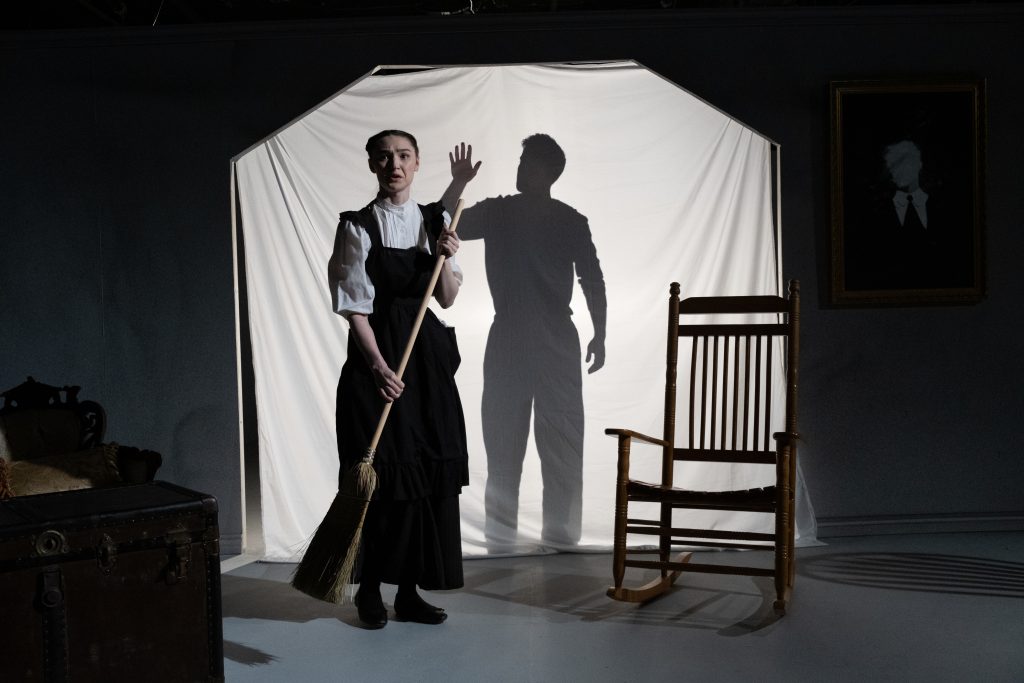
Gwydion Theatre Company’s “Perfect Pie”/Photo: Gwydion Theatre Company
RECOMMENDED
Judith Thompson’s “Perfect Pie”—a 2000 play being given its Chicago premiere by the Gwydion Theatre Company—is one of those dramas that at first glance seems straightforward, even a touch obvious. It’s only in retrospect that questions begin to arise about what you’ve just seen, and what plot points should and should not be taken literally. What seems to be a simple, twist-free tale about friendship and memory, set in the stolid confines of rural Ontario, turns out to have an understated element of mystery, leaving an aftertaste of doubt and ambiguity.
Well-known in her native Canada, but rarely produced in the United States, playwright Thompson looks at how trauma affects memory, sharpening certain incidents and details while also creating blank spots and discontinuities, and perhaps even false recollections. As crisply directed by Maddie Hillock, and movingly and believably portrayed by Gwydion’s four-person cast, “Perfect Pie” is a play that quietly yet implacably gets under one’s skin. Written in flashback form, it moves backward and forward to a shattering climax that, in the manner of classical tragedy, shapes the two characters’ fates and reveals the nature of their world.
Patsy and Marie—who changes her name in adulthood to Francesca—are bosom friends in childhood and adolescence who seem to be bound together by their differences, but whose paths come to diverge. Patsy—played with a pitch-perfect blend of strained optimism and nervousness by Tricia Rogers as an adult, and with a cheerful ingenue quality by Ellory Jezuit as a child—is the straight-arrow, parent-respecting good girl who has grown up to be a devoted wife and mother. As the play opens, she’s living on the dairy farm that’s been in her family for nearly two-hundred years.

Gwydion Theatre Company’s “Perfect Pie”/Photo: Gwydion Theatre Company
Marie/Francesca—given vivid life by Sydney Feldman as a girl and teenager, and played as a grownup with a more subdued, veiled quality by Talia Langman—is a poor girl from an abusive family, a low-caste Catholic in a chauvinistically Protestant village, who serves as the butt of her fellow students’ considerable cruelty. The otherwise lonely Marie craves Patsy’s affectionate attention, while Patsy—whose “perfect” family life conceals a cold core of harshness and rigidity—enjoys Marie’s admiration and her relative freedom from middle-class rectitude and inhibition. When we first meet Francesca, she has escaped her small-town roots, having become a successful actress as well as something of a free spirit.
“Perfect Pie”—a reference to Patsy’s prize-winning rhubarb pastries, which are taken for granted by her family but relished by her old friend—centers on Francesca’s first visit with Patsy in many years. Over the course of the play’s two back-and-forth, past-and-present acts, we learn the reason for Francesca’s deep aversion to her hometown, rooted in a horrific but not altogether clear occurrence that also involved Patsy.
The play is on the talky side. Too much is conveyed by words and not enough by gesture or expression as the two characters catch up with one another and weigh their own life choices and fidelity to youthful dreams in light of the other’s happiness. The play gushes with exposition, and the plot doesn’t so much push forward as tack gently toward resolution.
But what is the resolution, exactly? That will be for the viewers to decide. The play, which has its moments of high drama—including a recounted episode of savage violence and a harrowing description of an epileptic fit—ends quietly, as the two old friends, having come together for a couple of hours, go their very separate ways. Throughout the play, though, are sprinkled subtle clues that their meeting may have been not so much a visit as a visitation.

Gwydion Theatre Company’s “Perfect Pie”/Photo: Gwydion Theatre Company
The acting is universally top-notch, pulling us into the lives of these once-intimate friends who have developed in such diametrically different ways. It’s not easy to be fully plausible and highly dramatic, but both sets of performers manage it, mainly by being so closely attuned to the other. Together, the actors draw a convincing portrait of a scary and repressed past, rendered all the more chilling by the outwardly placid, “Rebecca of Sunnybrook Farm” setting.
Slow-moving, convoluted and internalized, “Perfect Pie” is really a mood piece, with its constant flashbacks involving radical shifts not just in time but in atmosphere too. Designer Grayson Kennedy’s set, featuring skeletal walls of lath without plaster, has just the right touch of semi-spooky unreality. Complemented by Sam Bessler’s low, orange-tinted, autumnal lighting, which makes everything slightly murky, the setting evokes a haunted space where time is disrupted.
All in all, this is a worthy debut for an accomplished playwright who clearly deserves more attention on our side of the border. It’s also proof of how much the Gwydion company has matured over its two short years in Chicago. They’ve always done interesting work—their “The Zoo Story” debut in 2023 was a highlight of the season—but since then they’ve evolved from an eager, resourceful, “let’s put on a show” bunch to a more canny, confident and settled ensemble. Chicago theater seems a bit tired at the moment and in need of an infusion of youthful energy and ambition. Judging from this strong yet nuanced production, Gwydion may turn out to be just what the doctor ordered.
Gwydion Theatre Company’s “Perfect Pie” runs through November 23 at the Greenhouse Theater Center, 2257 North Lincoln. Showtimes are: Thursdays-Saturdays at 7:30pm; Sundays at 2:30pm. Tickets are $32, available at the Greenhouse Theater box office or at greenhousetheater.org.