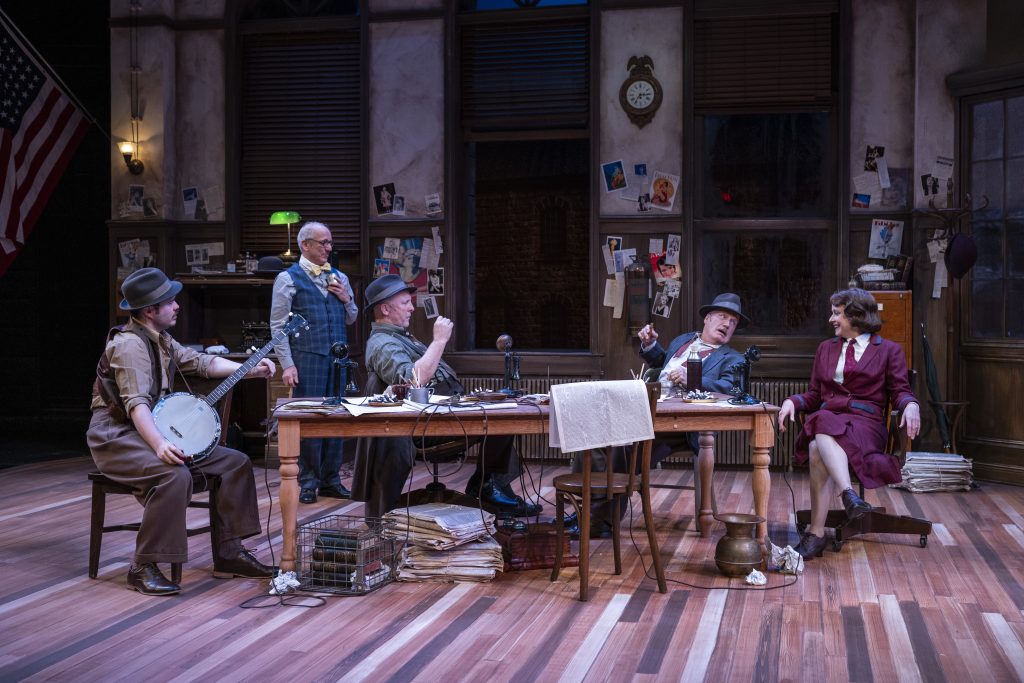
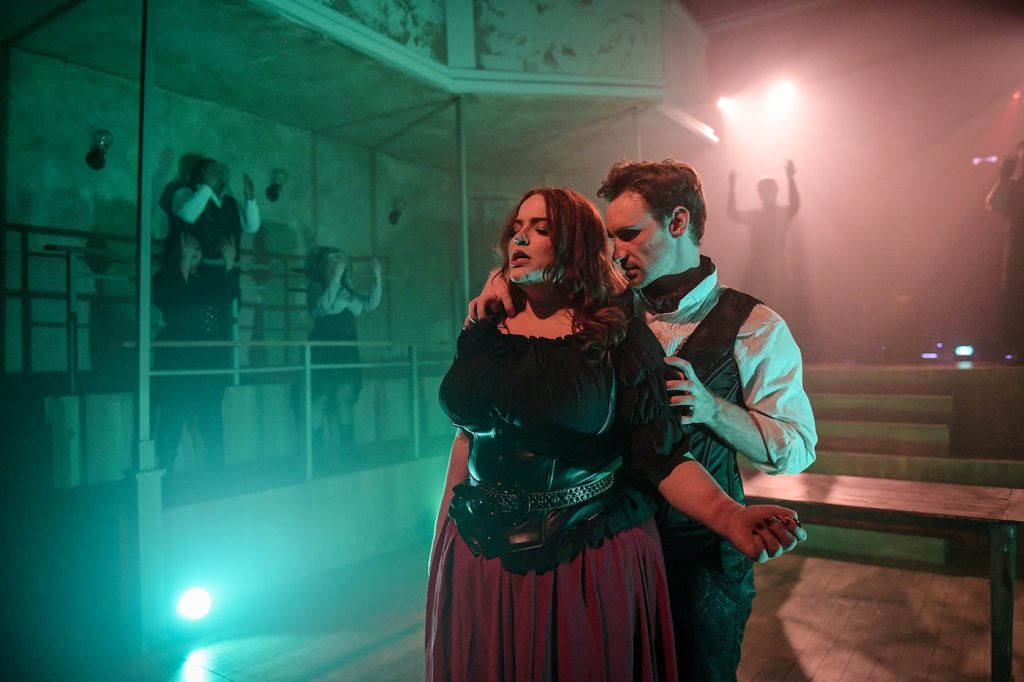
Northlight Theatre’s “Little Women,” with Tyler Meredith, Erik Hellman and cast/Photo: Liz Lauren
RECOMMENDED
“Little Women,” Louisa May Alcott’s classic Victorian novel of four sisters, has been adapted dozens of times for the stage and screen, including a 1917 silent film, a musical and an opera.
A new adaptation by Lauren Gunderson, premiering at Northlight Theatre, avoids the sentimental piety that mars some versions by using more language from Alcott’s astonishing book. It has the characters speak aloud some of the book’s non-dialogue narration, the way the narrator in Goodman Theatre’s Tom Creamer adaptation of the “Christmas Carol” uses non-dialogue bits from Charles Dickens’ novel. This way, you not only get a suitor’s proposal to Meg, but her internal reaction to it. As a result, more of the wit and complexity of Alcott’s characters come alive.
Does it succeed? Mostly, yes. Speaking as someone who has read “Little Women” multiple times, along with Alcott biographies and the lurid sensation stories she wrote before her success with the March sisters, this was one of the best versions I’ve seen, along with Greta Gerwig’s 2019 film. With wonderful performances by a tight ensemble, these are not porcelain figures with easily smoothed-over eccentricities, but real human girls who struggle and quarrel, sometimes viciously, yet have intense loyalty to each other. Under Georgette Verdin’s lively, fast-paced direction, it also shows how fun they are. One of the joys of reading the book is that you want to be part of the March family, with their homemade theatricals and newspapers. The hijinks and squabbles at the start make the sorrows at the end more poignant.

Northlight Theatre’s “Little Women,” with Yourtana Sulaiman, Tyler Meredith, Demetra Dee and Janyce Caraballo/Photo: Liz Lauren
Every “Little Women” needs a great Jo—Alcott’s semi-autobiographical stand-in as the family writer. Tyler Meredith delivers with her physicality, her witty line deliveries and her mercurial mood changes. Her “manly” Jo takes long strides and sits with legs spread apart like a guy taking up three seats on the El. Her fury when Amy destroys her book seems potentially lethal, and her grief over the illness of Beth (Demetra Dee) is heartbreaking.
Yourtana Sulaiman is an excellent Amy—bratty and selfish, but also strong and self-confident even when she’s driving Jo crazy by mispronouncing words. She is not the prissy doll of some adaptations, but an artist and a woman as willful as Jo. Janyce Caraballo’s Meg carries a touch of winsome mischief, as well as frustration over her more traditional role.
As Beth, Dee is appropriately shy and sweet, yet also playful and slyly humorous, as she is in the book. Like the other sisters, Beth has artistic talent. Hers is thwarted not by the restrictions on women at the time, but the lack of antibiotics. There’s a sweet interlude where Beth imitates a bird’s song on the piano—and teaches Jo how to do it, too. It shows Beth’s agency and maturity, which don’t usually get their due.
As Laurie, John Drea is perfect—floppy-haired, coltish, fun, egocentric and charming. He has great chemistry with Meredith’s Jo—whether they’re dancing or roughhousing or arguing. Also excellent is Lucy Carapetyan (star of Raven’s “Ironbound,” also under Verdin’s direction) in the dual role of Marmee and Aunt March. She is humorous and wise. Erik Hellman plays John, the silent Mr. March, and Jo’s professor friend, Friedrich. His sweet singing of a Goethe poem helps explain why Jo is attracted to him—not an easy task with Laurie as the more obvious male prize.

Northlight Theatre’s “Little Women,” with Tyler Meredith and John Drea/Photo: Liz Lauren
Also wonderful is the imaginative set by Sotirios Livaditis, which hangs a miniature model of the real house where the Alcotts lived in Concord, Massachusetts above the action. Raquel Adorno’s costumes are true to the time and characters—Jo wears pants-like bloomers under her plain dress, while Amy undergoes a hoop-skirted, high-fashion transformation on her trip to Europe.
My one problem with this show is its framing device, in which the real Louisa talks to her sisters about putting them into a book. “Lou” for “Louisa” will become “Jo” for “Josephine,” etc. The device is meant to convey how Alcott transforms her family into art.
This is cute and gives a reason for the non-dialogue narration. But it is also awkward, since it makes the beginning feel like the characters are putting on an amateur play. It took a little while to settle into realistic action, and later stretched out the ending. It is also not quite true. Alcott did use her sisters and mother as inspiration, but the novel was not her life. It was fiction, with extensive artistic changes.
For example, Alcott didn’t sell her hair—she caught typhus while working as a Civil War nurse and was treated with dangerous calomel pills. She likely lost her hair due to mercury poisoning, which caused health problems throughout her life. Her father, philosopher Bronson Alcott, didn’t serve in the Union Army and was so bad at making money that Louisa was the family’s main support. Rather than deal with her complicated feelings about him, Alcott mostly leaves him out of the story. (Also, “Laurie” was a Polish musician named Ladislas “Laddie” Wisniewski—my favorite bit of Alcott trivia.)
Gunderson’s play is not, of course, a biography. But the framing device gives such an overly simplistic view of the creative process that the play would have been better without it, or at least with less of it. The story of the March girls is more than enough.
“Little Women” runs through January 5, 2025, at Northlight Theatre, 9501 Skokie Boulevard, Skokie. Showtimes: Wednesdays at 1pm and 7:30pm (no performances December 25 or January 1, 2025); Thursdays at 1pm (December 26 only) and 7:30pm; Fridays at 7:30pm; Saturdays: 2:30pm and 7:30pm; Sundays at 2:30pm and 7:30pm (December 29 only). Tickets are $49-$91, available at northlight.org or by calling (847)673-6300.