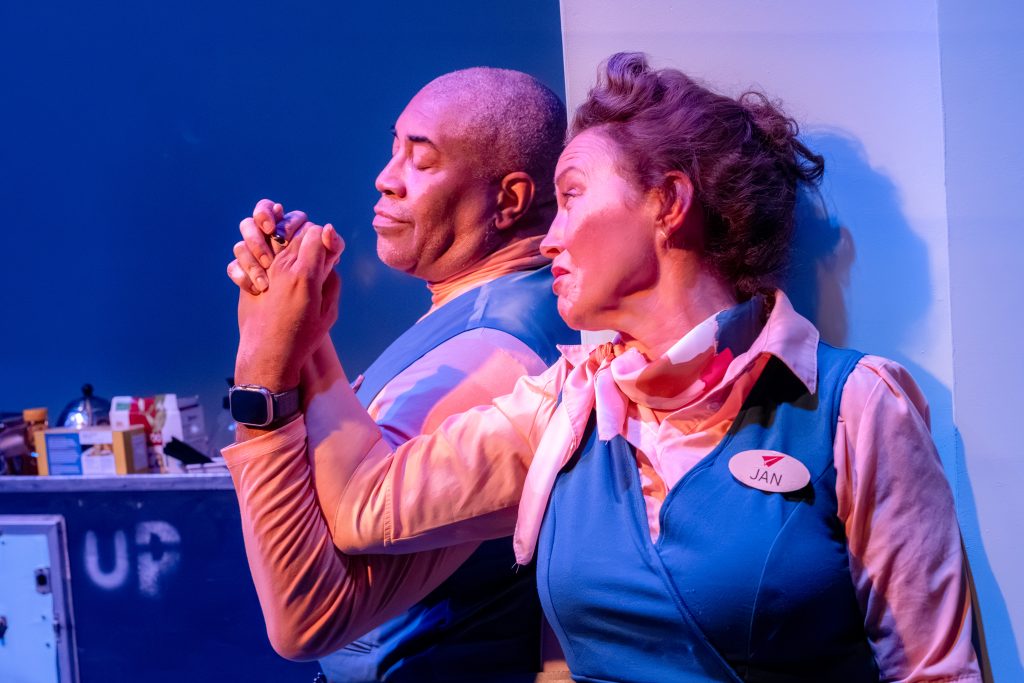
Rivendell Theatre Ensemble’s “No Such Thing,” with Matt DeCaro and Susan Gosdick/Photo: Michael Brosilow
I saw Rivendell’s world-premiere production of “No Such Thing,” written by ensemble member Lisa Dillman, not long after reviewing Goodman’s star-studded revival of Harold Pinter’s “Betrayal.” There was a certain deja vu. Both plays are about adultery among the cultured, highly educated elite; both have as background the melancholy of growing older in a youth-centric culture; both adulterous liaisons involve a dangerous juggling act with a third party; and both stories unspool partly in non-chronological order.
With all these similarities, the plays are as different as chalk and cheese. Pinter is all medium cool, creating a gap between characters and audience, which allows viewers to draw their own conclusions. By contrast, Dillman schmaltzifies her scenario, forcing us, TV-style, to sympathize with her characters and to see them as they wish to be seen, rather than as they are. To put it plainly, “Betrayal,” with its laconic open-endedness, is challenging, whereas “No Such Thing,” with its underscored emotion and contrived jokiness and melodramatics, comes off as manipulative.
The story centers on Ren (Susan Gosdick), an apparently once-successful screenwriter whose current efforts, according to her relentlessly pert agent Marilyn (Cheryl Hamada), lack “edginess.” Ren’s real problem, though, is that she is bored with her solid but unexciting husband, Ted (Matt DeCaro), and is chronically worried about her young-adult daughter, Olivia (Jessica Ervin), who is only now recovering from her nightmarish adolescent phase of drug addiction, eating disorders and amped-up teen beastliness. What’s more, age is creeping up on Ren, and with it the realization, unbearable to her, that the life she has led is the only life she will ever have, and the dreams of her youth remain just that.
Not one for philosophical acceptance of life’s inevitabilities, Ren goes the Tinder route, swiping right on a younger man, played by Josh Odor—an affair so shallow and unreal that, over the course of two years, the lovers never even learn each other’s names. The pair meet in hotel rooms for sex, of course, but also to tell each other stories using made-up identities, thus generating idealized versions of themselves divorced from the pressures and routines of daily life, which have rendered hubby so dull. The arrangement is a postmodern paradise, with existence boiled down to embroidered narratives, which can then be recycled by writer Ren into the edgy, sellable properties desired by her agent.
There’s a plot twist—an old-fashioned jaw-dropping reversal—that closes the curtain on the first act of this two-hour-twenty-minute show. Unfortunately, it’s one that alert audience members will see coming from miles away. The play’s second act retells the tale we’ve just seen, but from an earlier starting point. It ends on a note of escapism, with Ren’s steely-eyed self-absorption fully affirmed.
Director Malkia Stampley fails to extract much drama from Dillman’s stilted, self-conscious dialogue, which has too much of both sitcom cuteness and grad-school pomposity. There are histrionics aplenty but not much insight as Ren treats her standard-issue marital ennui as a crisis of asteroid-impact magnitude, and Olivia goes from needy to nasty and back again in tenths of a second, without ever settling into human.

Rivendell Theatre Ensemble’s “No Such Thing,” with Susan Gosdick and Cheryl Hamada/Photo: Michael Brosilow
Gosdick plays Ren as a split personality, never integrating the maternal and sensual sides of her characters; Ervin’s Olivia is wearing and monotonous; Odor’s younger lover seems like something out of a men’s cologne commercial; and Hamada can’t quite decide whether her mercenary agent, prone to saying things like “synergy is slobbering all over” Ren’s latest sexed-up script, is a close friend or a figure of fun. Only husband Ted, with his office job and unassuming ways, seems rooted in something resembling real life, and as a result, only DeCaro’s low-key performance comes off as containing some degree of truth and depth.
Based on comments in the program and press release, the play’s theme is the invisibility that women confront as they reach a certain age. This is indeed a problem, and not just for women: a demographically sliced-and-diced media environment has little use for older folks, whose consumer preferences have long since hardened, and hence are of little interest to most of the advertisers who dictate content. (The exception is the drug makers, who batten on the insecurities of people like Ren.) But is Ren a valid example? Eleanor Rigby, waiting at the window, is invisible; Ren, with her agent, glamorous career, and tight if bickering family, has not become one with the wallpaper.
Playgoers who appreciate ethical clarity in their theater should look elsewhere. Ren has an aversion to lying, at least when her daughter lies to her, but expresses no remorse about her sustained, carefully managed cheating. And after taking up all the space in her relationship with Ted, who as the play opens just wants a break from all the mother-daughter drama, the stronger-willed Ren then lays into him for his passivity. Lacking introspection, the play becomes a litany of self-pitying complaint.
There are some positives here. Lauren Nichols’ multi-room set nicely brings out the radically divided quality of Ren’s life, torn between home and love nest, while the use of sliding, translucent screens visually hints at the illusory nature of her talky, posing trysts, which seem more like scenes from her screenplays than “real” encounters. And the play does achieve some intensity toward the end, as the smoldering conflict between mom and daughter—conflict that at first seems to be about maternal over-concern, but by the end tilts toward actual rivalry—finally explodes.
Even so, the play doesn’t linger in one’s mind afterward, because the setup is so artificial, peopled with characters who lead bubble lives of upper-middle-class privilege. The larger world—in this case, New York City, although it could just as easily be Akron, Ohio or Perth, Australia—never intrudes, and no concern or awareness is ever expressed about anything beyond the confines of the self. At a time of genuine crisis and growing resistance, a play like this one begins to seem less about the invisibility of older women and more about the complacency of the One Percent. With its total focus on the private and the domestic, “No Such Thing” never pulls us in. Not that every play should be a ranting propaganda piece, but without some connection to the here and now, theater just feels empty.
“No Such Thing” runs through April 27 at Rivendell Theatre, 5779 North Ridge. Showtimes vary; tickets are $39, with discounts available, and are available by calling the box office at (773)334-7728 or visiting RivendellTheatre.org.