RECOMMENDED
The hallmarks of a good “whodunit” are murder, intrigue and more twists and turns than Lower Wacker Drive, all of which are adeptly presented in Drury Lane Theatre’s “Dial M for Murder,” running through October 26, a fresh take on the play by Frederick Knott that took the world by storm before becoming an iconic motion picture directed by Alfred Hitchcock. Directed by Adam Immerwahr, this new adaptation by Jeffrey Hatcher keeps the core elements of the story intact but with many changes, small and large, that produce a concentrated and fast-paced experience.
The original “Dial M” is about Tony Wendice, a retired professional tennis player who marries the beautiful Margot—not for her company but for her generational wealth. But, after discovering her past affair with professional mystery writer, Mark Halliday, Wendice plots to murder her and collect her inheritance.
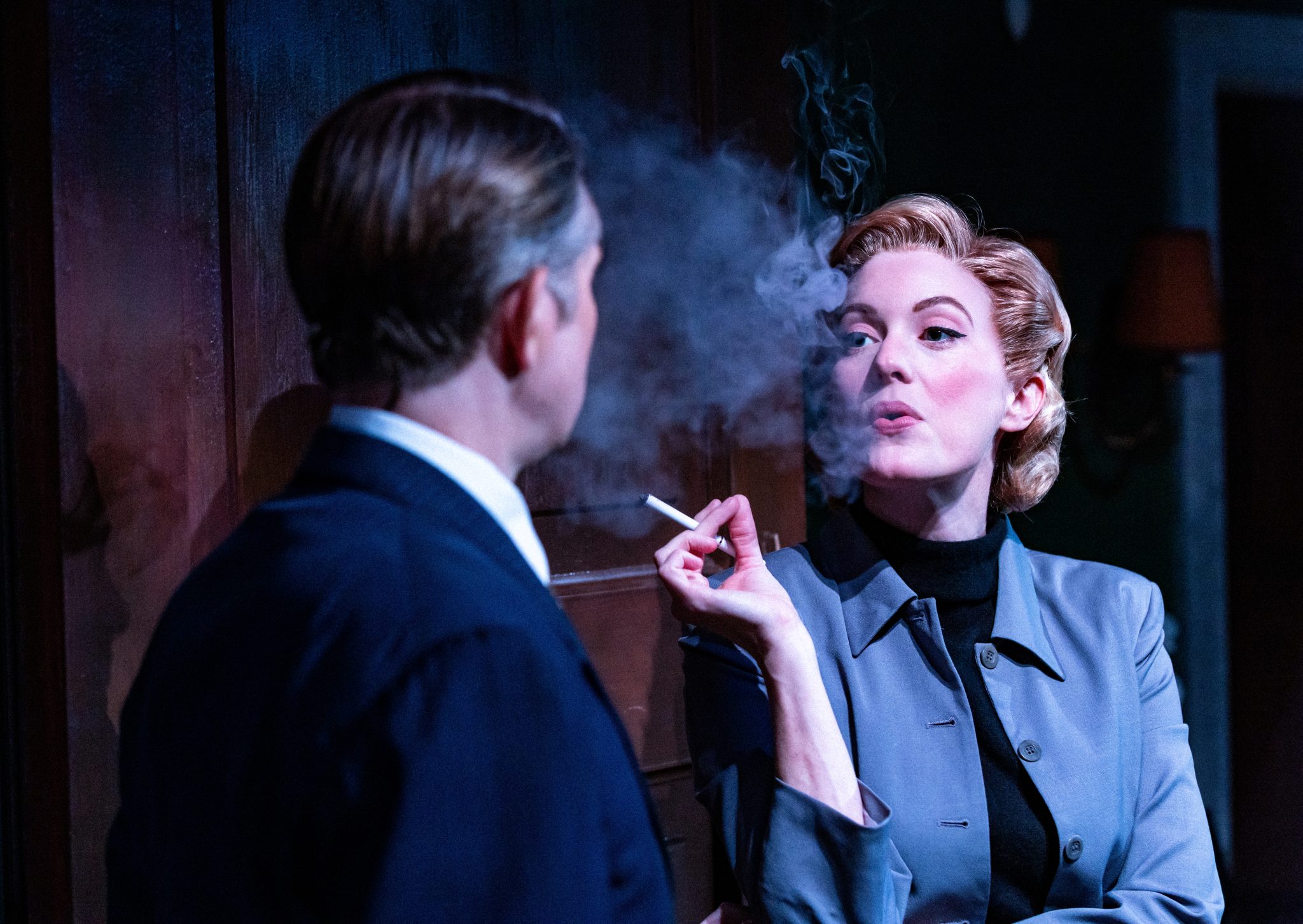
The first major difference is the gender swap of Halliday, now Maxine Hadley, played by Alexandra Silber, which gives the play a heightened sense of paranoia. The play takes place in the 1950s, when male homosexuality was illegal in England—not specifically prohibited to women, but still carrying a similar stigma—a fact that makes the cover-up of two women’s love affair even more necessary. Silber carries the role with confident aplomb, and her chemistry with Margot, played by Amanda Drinkall, radiates like the smoldering embers after a massive blaze.
The second change of note is the profession of Wendice, now a retired writer working with a publishing house to promote Hadley’s upcoming novel. Erik Hellman plays Wendice as having an artist’s sensibilities. While displaying a soft tenderness toward Margot, he draws delight from creatively plotting her murder and in the requisition of an accomplice whom he procures through an elaborate blackmail scheme. Replacing the athletic jock archetype with a more nuanced, conniving personality only elevates his role as a villain.

Other alterations to the script are small but noticeable, especially concerning the roles of Margot and the crafty Inspector Hubbard, played by Jonathan Weir. Margot’s lines have been trimmed, mostly during scenes of “female hysterics,” allowing Drinkall to deliver a performance that feels more like a real person and less like a knockoff of June Cleaver. Hubbard’s role is significantly diminished, which is a shame because Weir is a delight, like “Columbo” but with a sterner countenance. This cut gives the Inspector’s investigation greater urgency, and the audience must maintain focus as layers of new developments stack up rapidly.
No murder-thriller is complete without, well, a murder, and Ian Paul Custer as Wendice’s patsy, Captain Lesgate, during his struggle with Margot, delivers on all accounts. This Lesgate is not a cold, calculating criminal but instead comes off as a petty thief down on his luck. Almost a sympathetic character—almost. During their scuffle, Margot turns the tables and sticks it to him, literally, and Custer times the grisly denouement just right. Even though I knew it was coming, I gasped!
Hatcher’s adaptation maintains the original’s tension while quickening the pace (and shortening the runtime). Drury Lane supports the work with tremendous scenery, composing Wendice’s posh London flat with rich, vibrant colors, detailed decorations and the illusion of natural lighting, thanks to Paige Hathaway’s scenic design and Emma Deane’s lighting design. Sound design by Joshua Schmidt enhances the dialogue, with carefully placed bell tolls and whining violins that melt into key moments of revelation.
With all the fixings one would expect from a classic “whodunit” but with a refreshing update, the only mystery is why you haven’t bought tickets already.
“Dial M for Murder” runs through October 26 at Drury Lane Theatre, 100 Drury Lane, Oakbrook Terrace. Tickets are $75-$150, available at drurylanetheatre.com.