
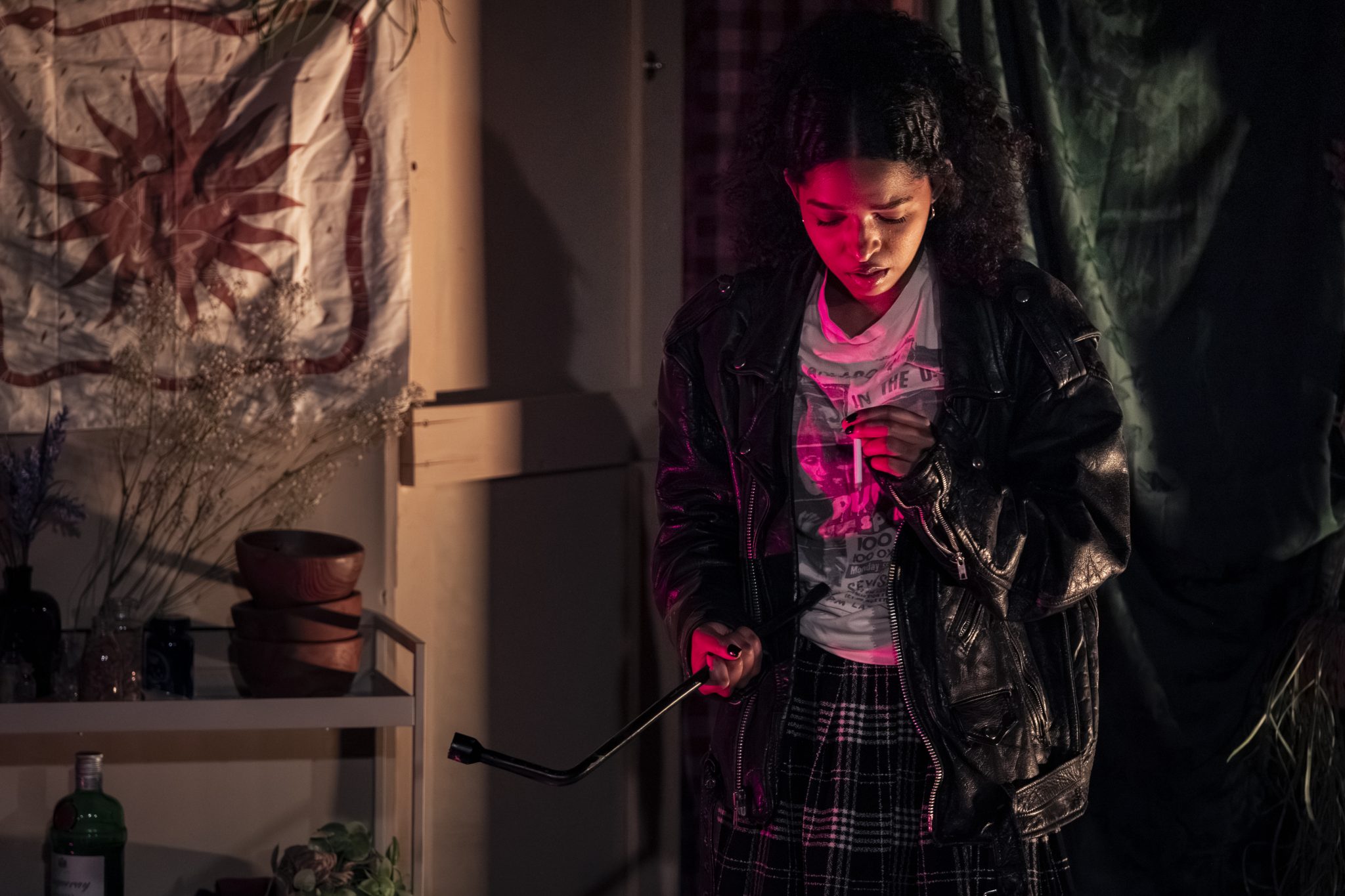
The Factory Theater’s “The Sporting Life,” with Ziare Paul-Emile/Photo: Marjorie Muller
RECOMMENDED
From William Shakespeare to Stephen King, plays and books make it clear that witches are who you go to when a plan requires help of the supernatural variety. The tradition continues in “The Sporting Life,” written by Marjorie Muller and directed by Kayla Menz, running through November 22 at The Factory Theater. The play follows a sixteen-year-old girl, Dot (Ziare Paul-Emile), who seeks a shortcut to womanhood, employing the services of a witch, Sherry (Elizabeth MacDougald). Together, they strike a Faustian bargain that sends Dot down a dark path toward murder, mutilation and maliciousness.
“The Sporting Life” combines classic horror elements with themes of misogyny and transformation. In a courtyard, Dot approaches an ominous steel door in the middle of the woods, draped on all sides by strips of gingham cloth, to beg the witch to help jumpstart her period. She is teased at school for being late to puberty by her friend, Mikayla (Tyara Whitted), the epitome of a licentious “mean girl,” whose obnoxious bullying stands in for the social pressures faced by teenage women. The witch called Sherry learned long ago that all men are scum, and she happily trades the life of a debauched male schoolteacher for Dot to have her period.
When Dot does menstruate, it’s explosive! Blood pools on the carpet. Her inept father, Joe (Bryan Breau), cowers behind a chair as Dot forcefully clears the dinner table, spilling tuna casserole on the floor. What follows is a horror show. Heads roll. Guts spill. A heart is pulled from a living chest! Dot’s descent into madness is a warning against growing up too fast and a proscription for disturbing life’s natural order.

The Factory Theater’s “The Sporting Life,” with Bill Daniel and Elizabeth MacDougald/Photo: Marjorie Muller
Personal transformation is a pervading theme in the play. Dot’s change from anxious bookworm into leather jacket-wearing homicidal maniac is obvious. More nuanced is the transformation of the witch. Sherry begins as a demonic naturopath, hair drawn back and wearing a light robe, but she transitions into a vivacious vixen when cornering her unwitting male prey. After meeting Joe, the only kind man in town, she becomes docile, domestic and only disembowels men who deserve it. The contrast between Dot’s and Sherry’s opposing paths shows that life is not only downhill—good can transform life for the better.
But about this world, I wrote “all men are scum,” and that’s true. The only characters who don’t transform in any way are the men, played by Ian Mason and Bill Daniel in multiple roles. While distinct in speech and mannerisms, they are all assholes to women—even reliable Joe harbors a hidden streak of misogyny. Not just the men—Mikayla never changes, going so far as to justify physical abuse by her boyfriend. Like Lady Macbeth, they have unsexed themselves, and the adoption of masculine traits leads to stagnation and destruction. Is masculine desire so static? As the debate over “trad wives” and female autonomy continues, the play accurately hints at the affirmative.
The set undergoes a transformation as well. The white ground and backdrop become bloodier with every scene of gruesomeness, and ends up looking like a minimalist Jackson Pollock painting—the scenery mirroring the change in the protagonist is a nice touch.
One might not expect a nuanced portrayal of the objectification of masculinity and the spiritual-sexual transformation from puberty in a play where a priest gets his whangdoodle bitten off while driving eighty miles an hour, but The Factory Theater has done it. With gore galore and in time for Halloween, “The Sporting Life” is a bloody good time.
“The Sporting life” runs through November 22 at The Factory Theater, 1623 West Howard. Tickets are $30, available at thefactorytheater.com.


