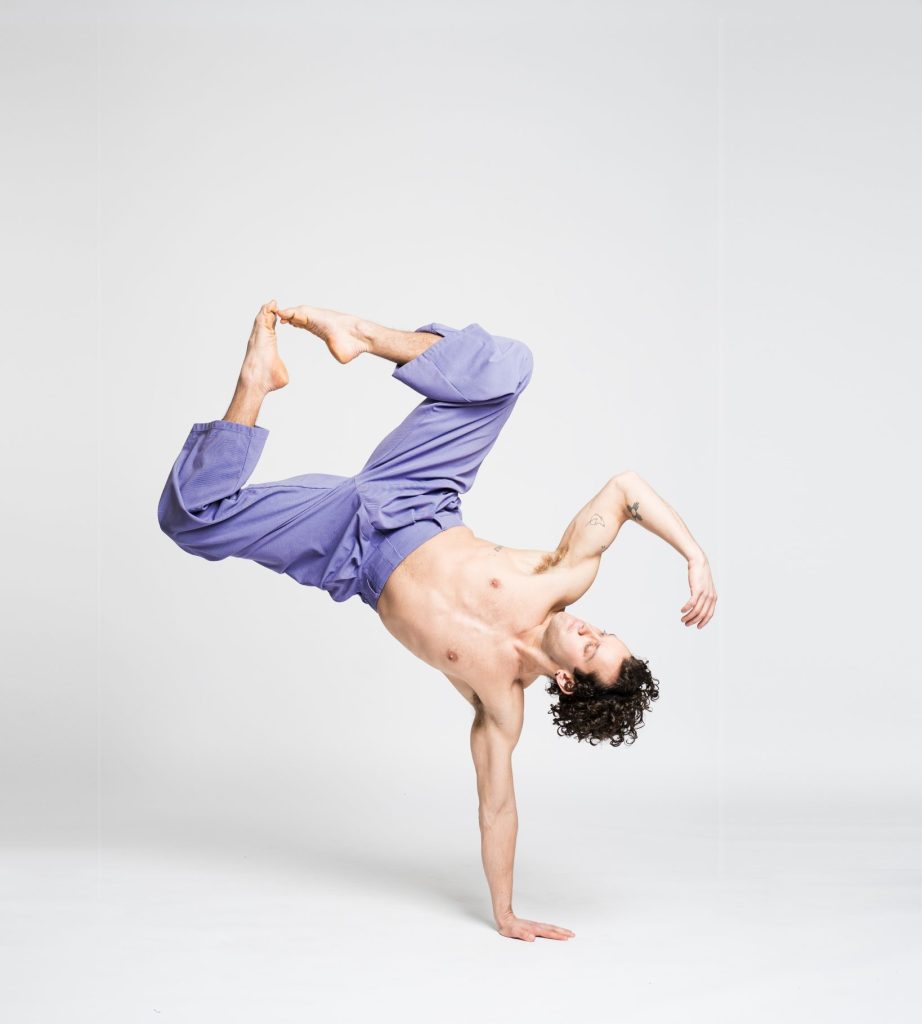
Chicago Repertory Ballet dancers Miriam-Rose LeDuc and Jackson Liee in “The Capultets”/Photo: Todd Rosenberg
Wade Schaaf, founder and artistic director of Chicago Repertory Ballet, was inspired by streaming spinoffs—specifically Netflix series like “Wednesday” and “Chilling Adventures of Sabrina” —in the creation of their new ballet, which uses “Romeo and Juliet” as a launchpad. “You’ll watch a series that builds a universe,” they tell me, “Then Netflix will take that universe and build a whole different spinoff series staying within the universe. I’ve enjoyed sinking into a different story that involves characters I already love.”
The characters in question are the Capulets, whose life outside their daughter’s ill-fated romance Schaaf has developed in an evening-length ballet. In “The Capulets,” running November 7- 16 at the Ruth Page Center for the Arts, Juliet’s parents carry on clandestine affairs of their own. Schaaf found a thread to tug in Lady Capulet’s distraught monologue—often treated as a solo in ballet adaptations of “Romeo and Juliet”—over the death of Tybalt in Act III. “It sticks out as a sore thumb as to why Shakespeare takes time out for this moment,” Schaaf tells me. “That question was a springboard for me investigating all these characters,”
In this story, Lady Capulet’s grief is romantically charged, due to an affair she’s been carrying on with Tybalt since discovering Lord Capulet in the tender embrace of Count Paris. A quick reminder if you haven’t read the play recently: in “Romeo and Juliet,” Paris proposes and ultimately is betrothed to Juliet, despite some hesitation on the part of her father. Schaaf adds subtext that Paris’ proposal is a pointed jab at Lord Capulet, and Capulet’s initial resistance to the engagement has less to do with Juliet’s tender age than his own wounded heart.
In a similar vein to Tom Stoppard’s “Rosencrantz and Guildenstern Are Dead,” “The Capulets” aligns with Shakespeare’s text in key group scenes—the opening brawl in the streets of Verona, the Capulet ball—then breaks away to follow its title characters. Schaaf says this is their first time writing a libretto, so they gave themselves plenty of lead time to develop the work. “I read and re-read ‘Romeo and Juliet’ and thought about the motivations behind what’s happening in that show,” they say. “For me, it’s imperative to think of the structure of ballet. I have a company to contend with: who’s going to be dancing? It can’t just be plot and pas de deux. We have to have various types of dance scenes, and then the flow of storyline for the audience. I found places for comedic relief, places to enjoy dance, and of course the drama which is the cornerstone of the ballet.”
As with most of their works for CRB, Schaaf blends classical, neoclassical and contemporary ballet in “The Capulets.” For this piece, Schaaf says they tended to use balletic vocabulary for group scenes and then “shed the formalism” for intimate moments, incorporating more contemporary movement. An interesting blend of both occurs in the ball scene, where stylized hand gestures transition to sweeping waltz steps, following the shifting moods of Matty Mattsson’s score. Schaaf engaged Mattsson to create music that, like the choreography, lives simultaneously within classicism, the present, and somewhere out of time. “At times it feels minimalist and other times is lush and lavish,” says Schaaf. “And it references the Prokofiev ‘Romeo and Juliet.’ There are times where I’m certain [Mattsson] has dissected and reworked the Prokofiev to create this score.”
Costumes by Nathan Rohrer—described as neo-futuristic, with both Elizabethan and contemporary lines—will add to the effect. Projections by John Pobojewski create a sense of place and advance the plot. “I’m excited to have the entire artistic team for the Scottish Play, with the addition of Matt,” Schaaf says, winkingly dodging the name “Macbeth,” in keeping with the theater superstition. Schaaf created an evening-length adaptation of the tragedy in 2019 for CRB, also performed at the Ruth Page, and made excellent use of the space for that production. Their choreography for “The Capulets” promises to do the same, incorporating an upstage platform to draw focus, establish the stature of characters, and create moments of casual intimacy.
While the tragic ending of “Romeo and Juliet” is well-known, Schaaf is keeping the final scene of “The Capulets” mum. And while it stays true to Shakespeare’s story, they say the ending is “hopeful for the people of Verona and the Capulet house.”
Chicago Repertory Ballet’s “The Capulets” at the Ruth Page Center for the Arts, 1016 North Dearborn, November 7-16. Tickets start at $39 and are available at chicagorepertoryballet.com. Limited free Ballet For All tickets available by calling (872)588-0430.