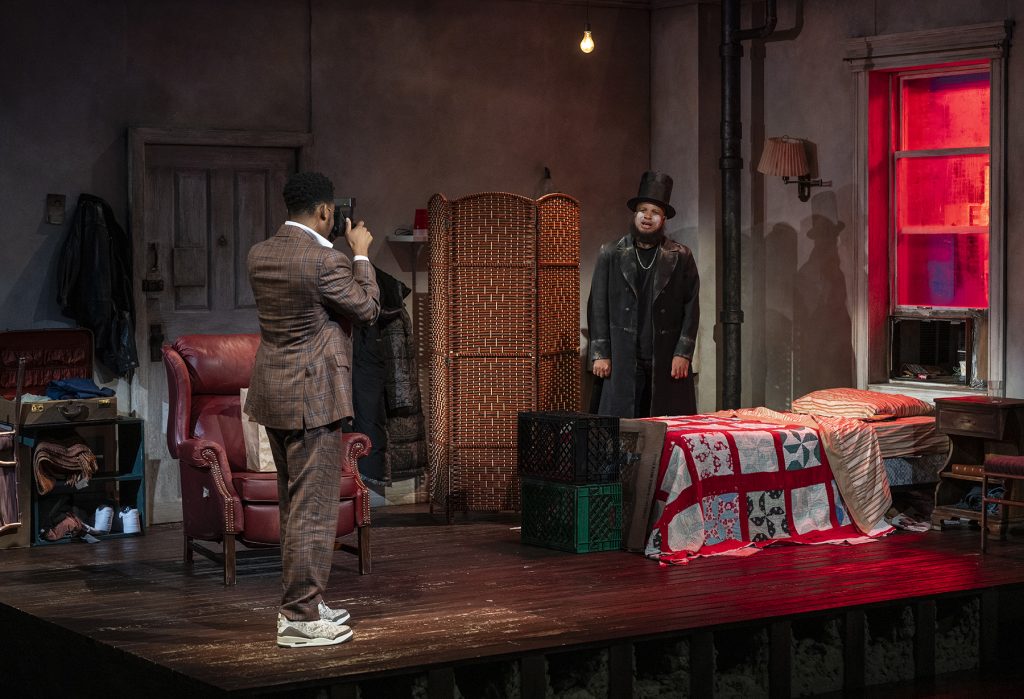
Steppenwolf’s “Amadeus,” with Ian Barford/Photo: Michael Brosilow
RECOMMENDED
When Tony Award-winning former Steppenwolf artistic director and ensemble member Anna D. Shapiro was unable to direct the company’s fiftieth-anniversary production of “Amadeus” due to health issues, another Tony Award-winning former artistic director—Robert Falls of Goodman Theatre—stepped in.
The choice was a fascinating one. If Falls had done “Amadeus” at Goodman, one can virtually imagine the epic kind of production he might have conceived, who he might have cast, how it might have looked and felt.
But Steppenwolf’s “Amadeus” was mostly cast with its own ensemble members and would be in the round in its intimate Ensemble Theater.
No matter. Falls was skillfully able to make the transposition and yet still leave his own stamp.
Falls is no stranger to the creative world of Mozart. Over a decade ago, Lyric Opera had Falls direct his own “Don Giovanni,” a Mozart opera that figures into the plot of “Amadeus.” Curiously, he had updated “Giovanni” from the eighteenth to the twentieth century.
Falls inherited the powdered wigs and such for “Amadeus,” yet it is refreshing how contemporary and understated the work feels. Salieri (Ian Barford) is not overreactive. He is always blocking Mozart professionally in a detached way while still able to appreciate—and even be moved by—Mozart’s otherworldly gifts. David Darrow’s Mozart is not a superficial goof but a coddled, lustful and coarse self-assured genius making his way through his own creative world, while trying to navigate the everyday world as well.

Steppenwolf’s “Amadeus,” with David Darrow/Photo: Michael Brosilow
Peter Shaffer’s 1979 play is, of course, far better known for its 1984 film adaptation. But kudos to the decision—made by Shapiro? Falls? Both?—to refresh the work by staging the original play as is, without later Shaffer revisions (he also wrote and made revisions for the screenplay and for a Broadway revival in 1999).
In the original play, Salieri makes his confession of the murder of Mozart to the audience from the beginning. He then proceeds to narrate the various things he did to destroy him. The climax has Salieri confessing his actions to the dying Mozart himself in a classic head-to-head confrontation that is powerful, yet here not overdone.
The reality that keeps “Amadeus” so compelling over forty-five years later is one that Falls’ staging is keenly attuned to: What makes art great and what makes art last? Any and every generation will take a stab at answering the former in its day, but no generation can know the outcome of the latter. What of itself will last and be forgotten in the long run?
Through January 25, 2026, at Steppenwolf Theatre, 1650 North Halsted. Tickets available at steppenwolf.org.