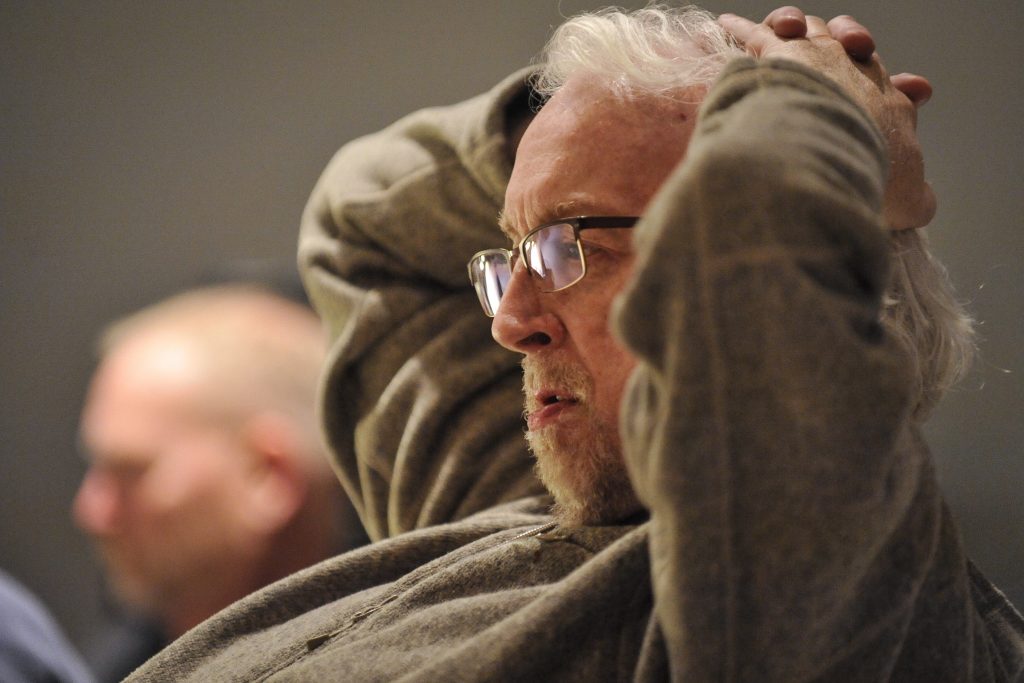
Robert Falls/Photo: Liz Lauren
Robert Falls may have stepped down as artistic director at the Goodman Theatre three years ago, but suddenly he’s everywhere on the Chicago theater scene. He directed a critically acclaimed production of “Amadeus” at the Steppenwolf Theatre that is ending a two-month run in January, and this winter is directing the late Richard Greenberg’s adaptation of Philip Barry’s 1928 comedy “Holiday” at the Goodman.
?Falls, seventy-one, says he took a break to travel and spent time with family after finishing thirty-five years at the Goodman in 2022. But he pictures retirement as playing golf or being on a fishing boat in Key West. And that’s not for him.
“I have no such hobbies, really, other than spending time in a rehearsal room with actors,” Falls says. After ending his time as artistic director, he did two more Goodman plays—“The Cherry Orchard” and “Swing State.” He also traveled in Spain, Mexico and London and taught workshops, showing fiction writers what they could learn from theater and acting, as well as working on adaptations of plays by Chekhov and Brecht. All the while, he knew he’d be back on the boards for the Goodman’s one-hundredth-anniversary season.
“Amadeus” was an unexpected gift. Steppenwolf’s former artistic director Anna D. Shapiro was supposed to direct the Peter Shaffer classic for the North Halsted Street theater’s fiftieth-anniversary season but had to bow out. Falls took over the job at the request of Steppenwolf artistic directors Glenn Davis and Audrey Francis.
“I was very moved when Audrey and Glenn, with the blessings of Anna Shapiro, called me to see if I might be interested and available,” Falls says. “I felt quite honored.” Falls notes that the Steppenwolf’s theatrical history corresponds with his own, and he has always known and admired the people at the Goodman’s crosstown rival. “It felt like a wonderful connection to the Chicago theater community,” Falls says. “I’d never worked at the Steppenwolf and the opportunity was something I cherished.” He also was excited to work for the first time on “Amadeus,” which he calls “one of the great contemporary plays of the past fifty or sixty years.”
“There’s just something incredibly juicy and fun about the play. They don’t write them like that anymore,” Falls says. “It’s both a mixture of some tremendous, entertaining comic elements as well as tragic and thoughtful and profound reflections of the nature of art.”
Falls says that the story of Wolfgang Amadeus Mozart is really the story of a freelancer, as Falls is himself. “It’s about this kid who comes into the royal court seeking a job, seeking employment and has to struggle throughout a decade for support.”
Falls says that working with a big cast of twenty in the Steppenwolf’s in-the-round Ensemble Theater presented unique challenges. “It’s not an easy space to stage a play in, particularly one as complicated as ‘Amadeus.’ It was a wonderful challenge to try to explode that room.” But he was blessed with a strong cast, headed by Steppenwolf ensemble member Ian Barford as Salieri and David Darrow as the upstart Mozart.
“It turned out to be just a lot of fun,” Falls says. The play’s tale of Salieri’s poisonous jealousy has resonance in the artistic world, he notes, as well as any competitive field where there are older professionals who see young people coming up and threatening to take their place.
The other driving element of the play is Salieri’s anger at God. Besides being envious of Mozart, Salieri’s also the only one to truly recognize his true genius and God-given gifts. “His war ultimately is less with Mozart, than wrestling with God.”

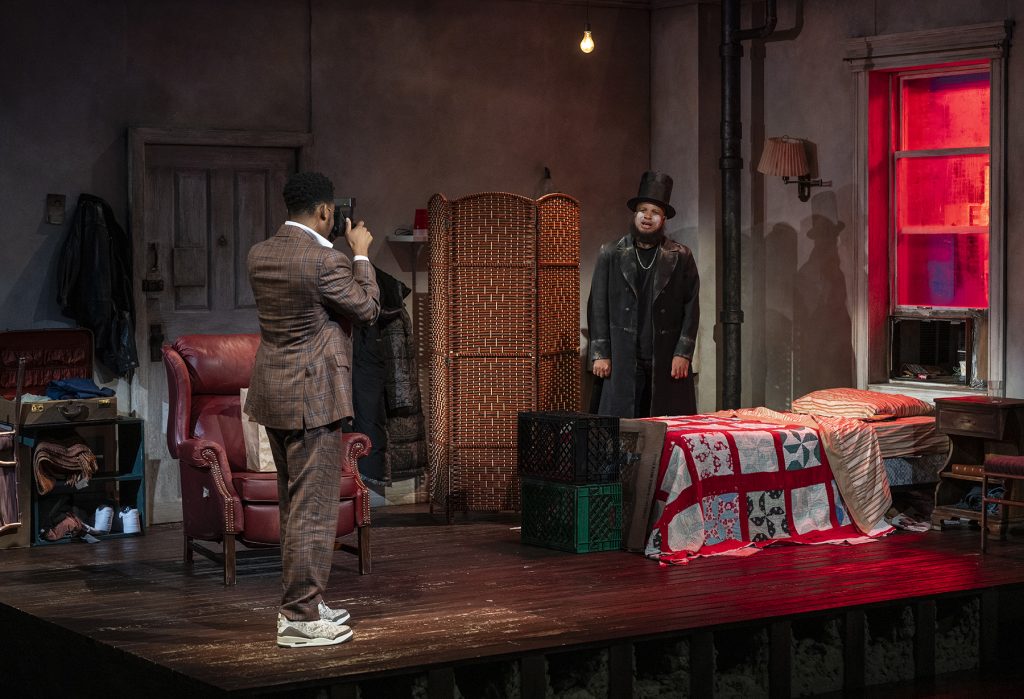
Robert Falls’ 2016 production of “2666,” based on the novel by Robert Bolaño, adapted and directed by Robert Falls and Seth Bockley. Pictured is Henry Godinez (Oscar Amalfitano) in “Part II: The Part About Amalfitano” of “2666”/Photo: Liz Lauren
Falls is now directing “Holiday”—a modern adaptation of a popular 1928 play by Philip Barry, which was made into the classic 1938 screwball comedy starring Katharine Hepburn and Cary Grant. The story is about a young man torn between his freedom-loving lifestyle and the traditions of his rich fiancée’s family.
Falls says he has been “shocked” by how many people have told him that “Holiday” is their favorite film. He says the Greenberg adaptation takes liberties with the original, but it also follows the original elements closely “in terms of the characters and their motivations.”
“He recognizes that the theme of this play was about young people, actually in their thirties, trying to look at privilege and look at money and a family that’s really been destroyed by their privilege in many ways,” says Falls. “It’s a family play, in many ways. It also has elements of a romantic comedy. There are very touching moments. There are hilarious moments. And it’s about people who are really searching: ‘What is the meaning of life, what is the meaning of work?’”
Greenberg wrote the adaptation before the pandemic, but Falls thinks it addresses how a lot of young people feel about work today. Few people have one job forever anymore, and many young adults no longer see work as the purpose of their lives. Says Falls, “I found it both wildly funny and very touching.”
Falls says that Greenberg often wrote about privilege and class, and Greenberg’s voice “melds wonderfully” with the voice of Philip Barry, whose family approved the contemporary adaptation. Falls had already started working on the play with Greenberg about two years ago, before the playwright’s untimely death in July of 2025. When artistic director Susan Booth offered the play to Falls as a chance to come back to the Goodman for the hundredth anniversary, “it was an opportunity I couldn’t resist,” Falls says. The choice was also a nod to Goodman history, since the theater had mounted four previous versions of “Holiday” since the company began in 1925. This year’s cast will include Bryce Gangel as Linda Seton, Molly Griggs as Julia Seton and Luigi Sottile as Johnny Case.
Falls says the Chicago theater scene almost six years after the pandemic is still in a state of transition, with many theaters struggling. “People are still digging themselves out of the difficulty, post-pandemic. But yet, I do think that audiences are there, audiences are hungry for work. I’ve been to the Goodmen and seen full houses. The same at Steppenwolf… That says a lot about the audience in Chicago, that’s still hungry for that experience.”
And Falls has other projects coming up later in 2026, one out of town, and one in Chicago, though for now he’s keeping them under his hat. “I’m really quite busy. It’s certainly not a retirement.”
Published in the print edition of the January 2026 issue, with the headline “The Freelancer: For Robert Falls, ‘Holiday’ Is a New Kind of Work.”