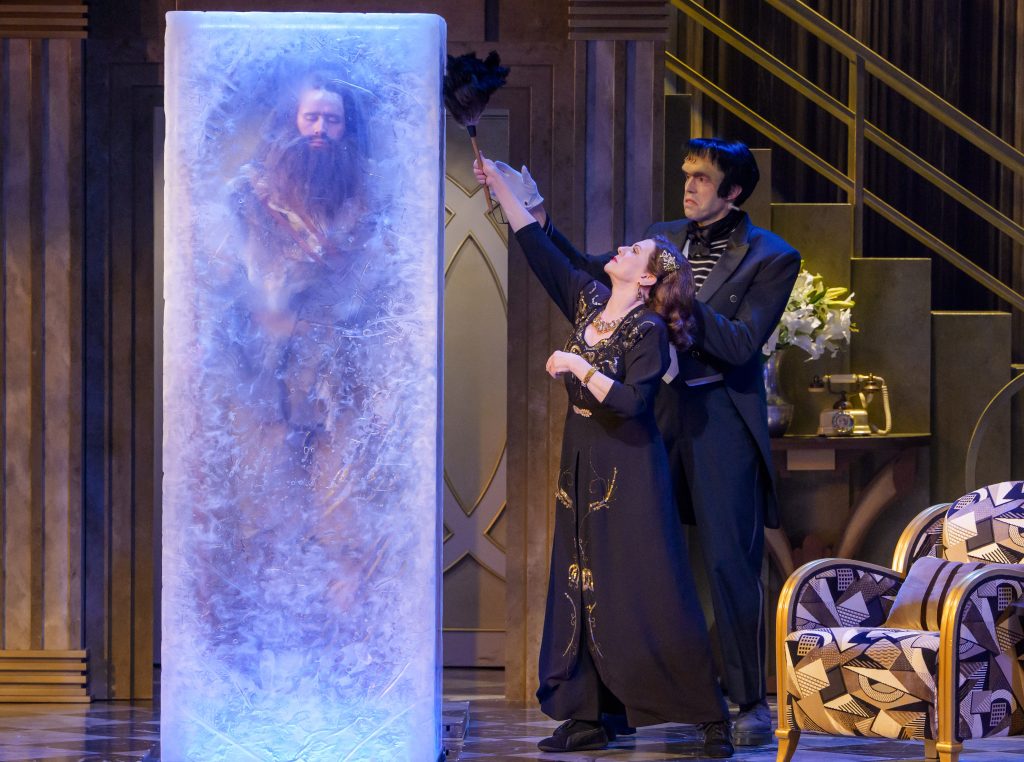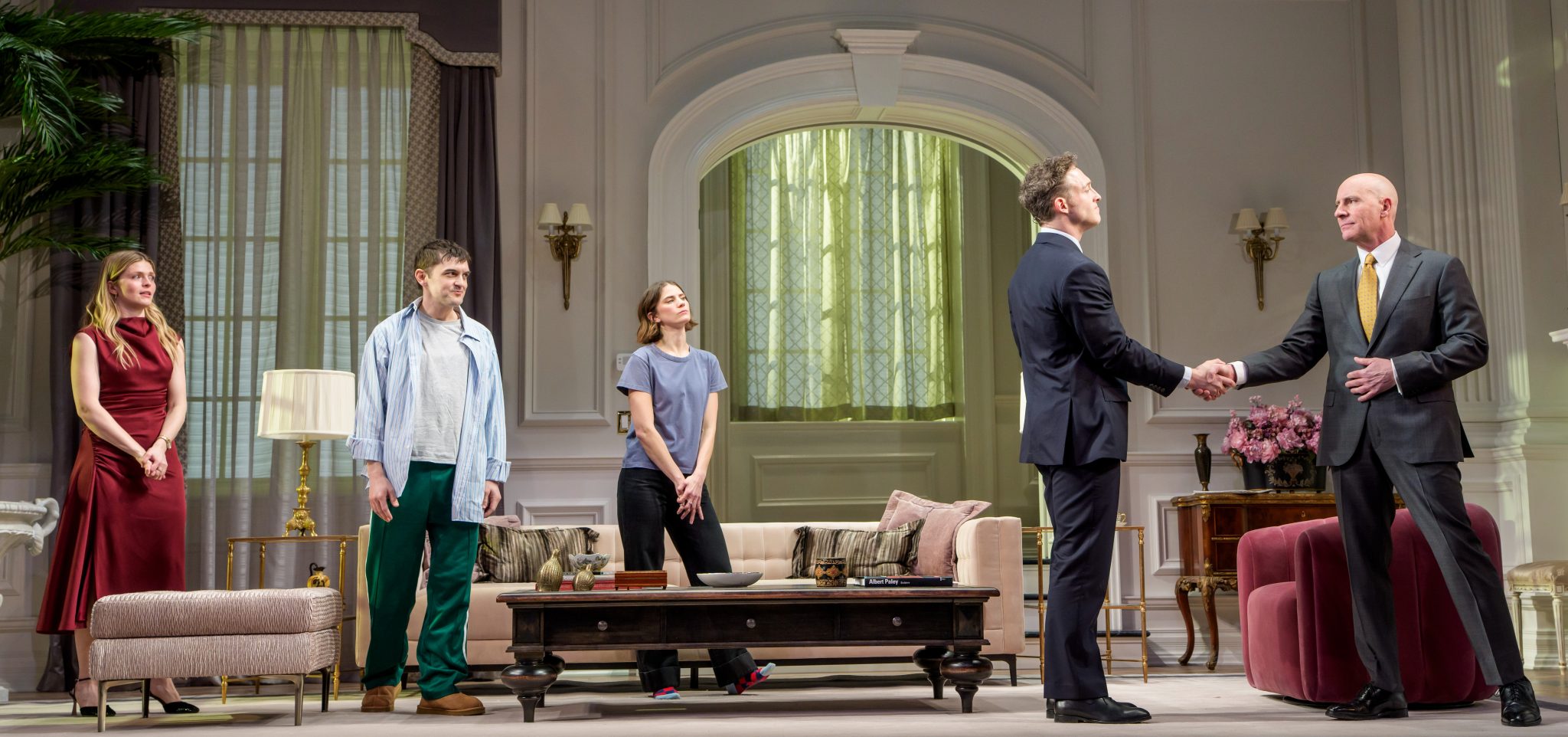
Goodman Theatre’s “Holiday,” with Molly Griggs, Wesley Taylor, Bryce Gangel, Luigi Sottile and Jordan Lage/Photo: Todd Rosenberg
RECOMMENDED
The Goodman Theatre’s staging of Richard Greenberg’s adaptation of Philip Barry‘s “Holiday” is not dissimilar in character from the theater itself.
The Goodman Theatre was founded in 1925 and, though the drama it stages today is unmistakably modern (few would show “The Brief Wondrous Life of Oscar Wao” and a production by David Byrne in a single year), there is something unmistakably centenarian about it. No matter what quantity of craft beer is sold behind its sleek lobby bar or how much the long panes of glass lining its modern building glimmer, it will never effuse the youth that comparatively newer counterparts in town like Steppenwolf Theatre and the Lookingglass Theatre Company do.
“Holiday” was first staged by Philip Barry in 1928 at the Plymouth Theatre in New York City, and though playwright Richard Greenberg has done his best to drag the play, characters and setting into the modern day, there is also something unmistakably gray-haired about it. Though its protagonists meet at an unnamed retreat in California rather than Lake Placid, and though Ubers are hailed to the artist communes of Brooklyn instead of taxis to tenements in SoHo, there is a reverence for language—an unwillingness to fully transmute the dialogue into contemporary slang from Greenberg—that lends many conversations an anachronistic patina; a stiltedness that one can neither exactly point out or ignore.
And yet, just as one enters the Goodman Theatre excited by that very marriage of youth and senility, Greenberg’s adaptation of “Holiday” works tremendously, almost outlandishly well. Well enough for a Monday evening audience to laugh nearly as much as they gasp (no matter the fact that a character compares the taste of tea to “the aftermath of battle,” or another’s politics are described as “antediluvian”). Just as often as the hundred-year-old language hauls the audience out of the time-warp Greenberg so quietly accomplishes, that same language allows moments to pulse with a depth only the lexicon of an age characterized by flappers and imminent financial collapse can provide.
“Holiday” is primarily a family drama, webbing together the relationships of the fabulously wealthy Seton family with those who pass in and out of their lives on New York City’s Upper East Side. The most natural drama in the play is borne in their relationships with one another: two daughters, Julia (Molly Griggs) and Linda (Bryce Gangel); son, Ned (Wesley Taylor); father, Edward (Jordan Lage); and deceased mother (uncast). But the play’s central intrigue—the action which propels it forward—stems from the arrival of an unrelated fifth character in their household: Johnny Case (Luigi Sottile), a lawyer from modest (if not destitute) beginnings who has fallen in love with and become engaged to younger daughter, Julia, after spending two weeks with her at a luxury, new-age rehabilitation retreat (in Santa Fe, Paso Robles, or whatever other unnamed, desert vista).

Goodman Theatre’s “Holiday,” with Alejandra Escalante and Erik Hellman/Photo: Todd Rosenberg
Following Mr. Case’s introduction, the play (and its players) revolves around a series of questions that must always arise when the moneyed fall in love with the destitute: Does he really love her? Is she acting too rashly? What does he do for work? What will so-and-so think when they hear? Though the backdrop is a twenty-first-century New York City of steel and algorithmic trading rather than brownstone and Manchurian bond trading, the push-and-pull between the head and heart translates well to the modern day. Johnny Case is reminiscent of a Fitzgeraldian figure. He has money of his own and an Ivy League degree, but one can only rise so high in that city without the proper last name. Julia’s siblings, Linda and Ned, have their opinions about Mr. Case, and gird the situation’s gravity with humor. Their father, Edward, disapproves of him at first. And their cousins are even larger caricatures of the wealthy than the family from which their wealth is borne.
What makes “Holiday”’s nearly two-hour runtime pass so quickly is not in the surprises its plot hides (one nearly knows who Mr. Case will end up with from the first scene), but in an ensemble which acts with such conviction (and modernity) that—and I mean this in the most complimentary way possible to a theater—the production often feels much more fit for television than the stage. In a recorded television show, each actor has several hundred takes to get the delivery of a line right; to sit on a couch just the way an heiress to one-billion dollars might. There are no mistakes because the mistakes are edited out. The sterling cast of “Holiday” provides a performance full of single takes so exquisite and practiced that, pieced together, give the feeling of several thousand photocopied atop one another—for how are they able to keep it up so convincingly for so long.
And, though this burden of thoroughness is carried equally throughout the cast, it is felt most distinctly when the actresses who appear on stage most often are present: Molly Griggs as Julia Seton and Bryce Gangel as her older sister Linda. Greenberg’s description of the sisters in his “Holiday” script is the most succinct way to capture their ethos. Linda is “thirty-ish, striking, smart, wistful, cutting, lovely and short-circuited.” Julia is “equally beautiful in a more commodified way, an entrepreneur.” The two represent what often seems to be the two choices for young men and women in America (for whom money is not a significant worry): Dedicate your personality to the pursuit of capital or its abolition. Molly is one of so many women with leather laptop bags running from offices in the Loop to expensive reservations in River North. Linda is the barista in Logan Square with a degree in art history and loving parents, who perhaps care too much about the quality of her coffee and too little about her hourly wage.

Goodman Theatre’s “Holiday,” with Bryce Gangel and Wesley Taylor/Photo: Todd Rosenberg
Every movement by Griggs and Gangel seems the result of months of studying these exact prototypes, of living among them. They are the very age they depict. The dress is familiar; perhaps worn in the audience, if it were younger. The way each throws open curtains, walks across the stage, and sits upon prop furniture—it is their performances that make the script, despite its anachronistic moments, unmistakably contemporary.
The remainder of the cast is equally wonderful, but more often serves as foils for Gangel and Griggs’ characters to play off of. It is a play of sisters as much as it is of romance. Ned Seton provides frequent comic relief from the show’s drearier episodes. His father, Edward, provides an equal amount of sobriety when the mood turns the other way. Johnny Case’s flippancy and seeming irresistibility drive the plot toward its conclusion. And the cast of more minor, non-familial members allows each Seton sister and brother to act as they would if the others weren’t around, giving their characters a necessary second dimension.
If there is a third character who significantly contributes to the play’s realism, it is an ensemble of many who perform backstage. Richard Woodbury (sound designer), Amith Chandrashaker (lighting designer) and Walt Spangler (set designer), among others, provide a world for the Seton Family to inhabit. Acting can only do so much to compel a theatergoer to forget, if only for a moment, that the room they are viewing on stage is not a room at all. Light must pour through a window the way it only does in the morning, and laughter must sound different when coming from downstairs. And the living rooms of billionaires must look and feel like those they must live in—that delicate, somehow maddening balance between cleanliness and sanitation; a couch that must be expensive but not made for comfort.
“Holiday” runs at Goodman Theatre, 170 North Dearborn, through March 1. Tickets are $34-$104, available at goodmantheatre.org or by calling (312)443-3800.