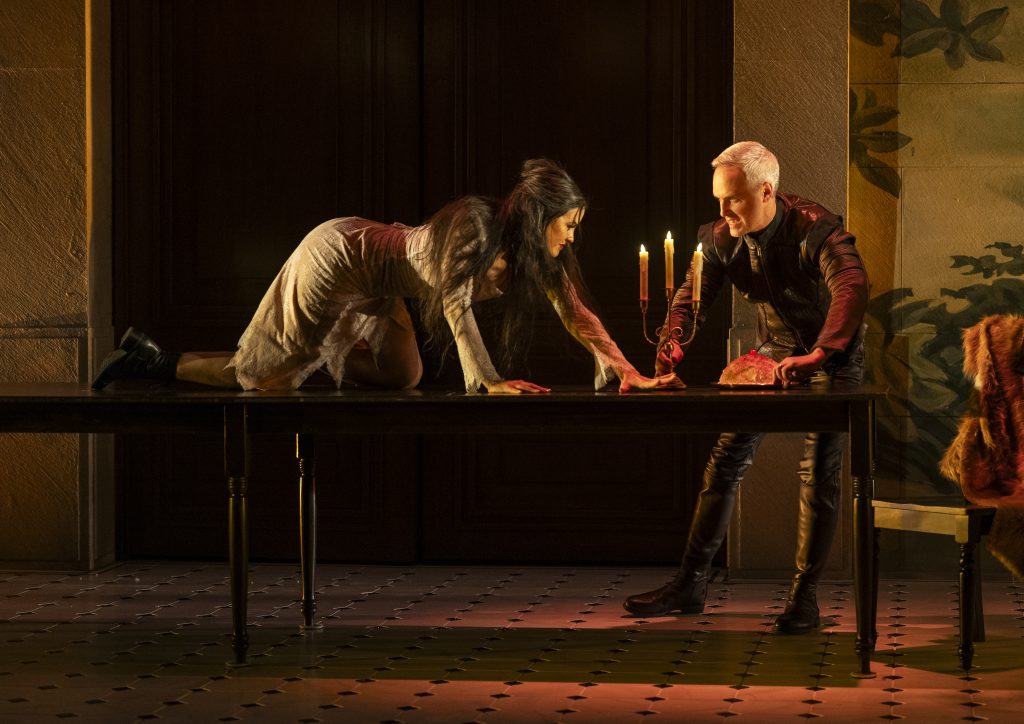
Lookingglass’ “White Rooster,” with Sunnie Eraso/Photo: Justin Barbin
“The Spectacle has, indeed, an emotional attraction of its own, but, of all the parts [of a tragedy], it is the least artistic… the production of spectacular effects depends more on the art of the stage machinist than on that of the poet.”—Aristotle, “The Poetics”
Perhaps the second scariest phrase in the language (after “some assembly required”) is “written and directed by…” The reduction of two pairs of eyes to one, and the removal of the creative tension between playwright and director, is a license for self-indulgence.
And self-indulgence is what we get, in spades, in Lookingglass Theatre’s “White Rooster,” written and, yes, directed by Matthew Yee. It’s packed to bursting with eye- and ear-catching visual and musical effects, staged with the imagination and high production values Lookingglass has long been known for. But the cleverness of the spectacle cannot hide the absence of a cohesive storyline, compelling characters and underlying purpose. The play made me think of those pretty jellyfish you see at the aquarium, rippling with luminous, hypnotically gorgeous colors, but without any brain to speak of.
Written as a series of short, loosely connected shaggy-dog stories that together constitute a long shaggy-dog story, “White Rooster” drags painfully, despite all the hoopla on Natsu Onoda Power’s compact, deliberately ramshackle set, illuminated by Hannah Wien’s lurid lighting. The problem isn’t the lack of narrative incident. It’s that the plot rambles and staggers, never achieving any propulsive energy, and the nested tales of which it’s made fail to converge. The monotony is due at least partly to the director’s unwillingness to sharpen or focus the disjointed script of a playwright who happens to be himself.
“White Rooster” weds fantastical Chinese folktale motifs to a laconic, vaguely Sam Shepard-like Old West sensibility, tied together with a minor-key rock ‘n’ roll score. None of these elements is treated with particular sharpness or care. The result is an Osterizer brand of postmodernism, blending the disparate ingredients into a frothy mix that goes down like a Disney animated feature slated for global distribution.

Lookingglass’ “White Rooster,” with Karen Aldridge, Mark Montgomery, Reilly Oh, Noelle Oh, Louise Lamson, Elliot Esquivel/Photo: Justin Barbin
The story is one of death and decay, a theme not unsuited to the present moment. However, whatever power the play might generate is hamstrung by its cool, dispassionate take on life and death in a universe where the line between living beings and ghosts has worn thin. In a village built upon bad karma, undead ancestors, climate disaster and murderous greed—as well as an inexplicable unwillingness on the part of the residents to leave the stricken place—lives a girl named Min, who is sweet, loving, innocent and a little thin in the personality department. The play recounts her relationship with her crazy-doomed parents, crazy-doomed boyfriend Pong and eventually her crazy-doomed rooster husband (yes, that’s what I said), who—spoiler alert!—ends up as chicken soup in what might be the play’s sole sensible moment. Other than the nice but passive Min, every character presents as either simple, mad or—in the case of June, the not-so-friendly ghost who lives in Min’s attic—evil.
The show has a distinct Young Adult flavor, with simplified language that makes every utterance feel like a laugh line, a limited emotional palette and ceaseless stage business, a concession to short attention spans. The play has no shortage of darkness, with its endless, repetitive accounts of haunting and possession. But the horror is of the spooky campfire tale variety, and it doesn’t resonate. What would seem to be this death-obsessed play’s big question—is the world we live in redeemable or even survivable—isn’t directly or usefully addressed.
On the plus side, Caitlin McLeod’s puppets are cute and expressive, and they’re well-operated by the cast—especially the white rooster groom, a handsome fowl who, when brandished by Min, seems vibrantly and mischievously alive. The shadow puppet sequences also work beautifully, giving a nice low-tech touch that’s refreshing in a CGI world. The seasoned cast knows how to sculpt a role out of movement and gesture; it’s not their fault that the play’s characters lack dimension. Sunnie Eraso is a winsome, sympathetic Min; Daniel Lee Smith and Louise Lamson as an elderly couple are well-paired, revealing more complex marital dynamics than one initially expects; and Elliot Esquivel steals the stage as a loping, loose-limbed, seed-spitting cowboy-shaman. (Esquivel plays the part through April 5, then hands it off to Nik Kmiecik). The cast also includes Karen Aldridge and Mark Montgomery as Min’s parents, Reilly Oh as Pong and Noelle Oh as the striking but not quite terrifying June. And the electric-guitar-led musical interludes (co-composed by the playwright and sound designer Justin Cavazos) convey mood and feeling, although the songs themselves—like much else in “White Rooster”—quickly begin to seem much of a sameness.

Lookingglass’ “White Rooster,” with Noelle Oh, Reilly Oh, Sunnie Eraso/Photo: Justin Barbin
Many viewers will respond to this play’s razzle-dazzle, its ability to wrest droll and sometimes magical effects out of simple means. Puppets appeal to everybody’s inner child, and there’s a mannered, puppet-like quality to much of the acting here. It’s enhanced by Mara Blumenfeld’s patchy, textured costumes, especially those worn by the demonic June and by Min’s monstrous hybrid husband—half human, half poultry—in the second act.
The problem, at least for this critic, is that despite the emphasis on spectacle, the show isn’t so much playful as morbidly silly, like a Halloween prank that just won’t end. Every time the pacing flags, the play tosses in a plot wrinkle—infanticide, family annihilation, extreme child abuse—that’s horrific but handled in a jokey manner, blunting its edge.
There’s a lot of energy and a lot of technique on display in “White Rooster,” a production that will appeal to those playgoers primarily attuned to effect, or what Aristotle in “The Poetics” called the “art of the stage machinist.” Alas, this play about insatiably hungry ghosts roaming a sterile landscape is unlikely to satisfy those viewers seeking something deeper and more personal.
Lookingglass Theatre’s “White Rooster” runs through April 26 at Water Tower Water Works, 821 North Michigan. Tickets begin at $40 and can be obtained by telephone at (312)337-0665 or online at lookingglasstheatre.org.