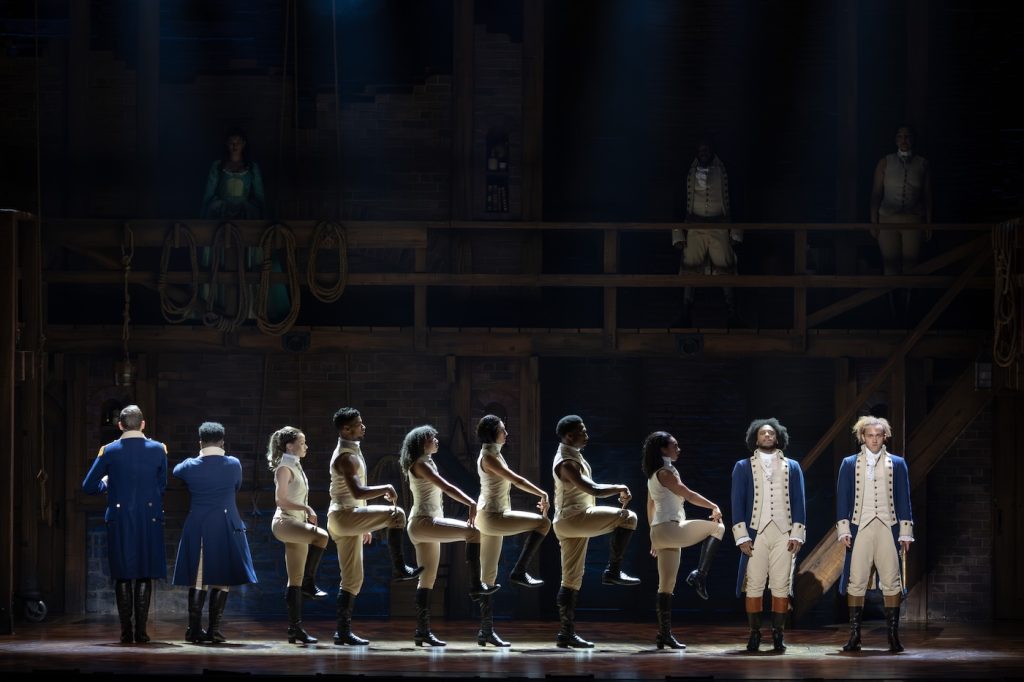
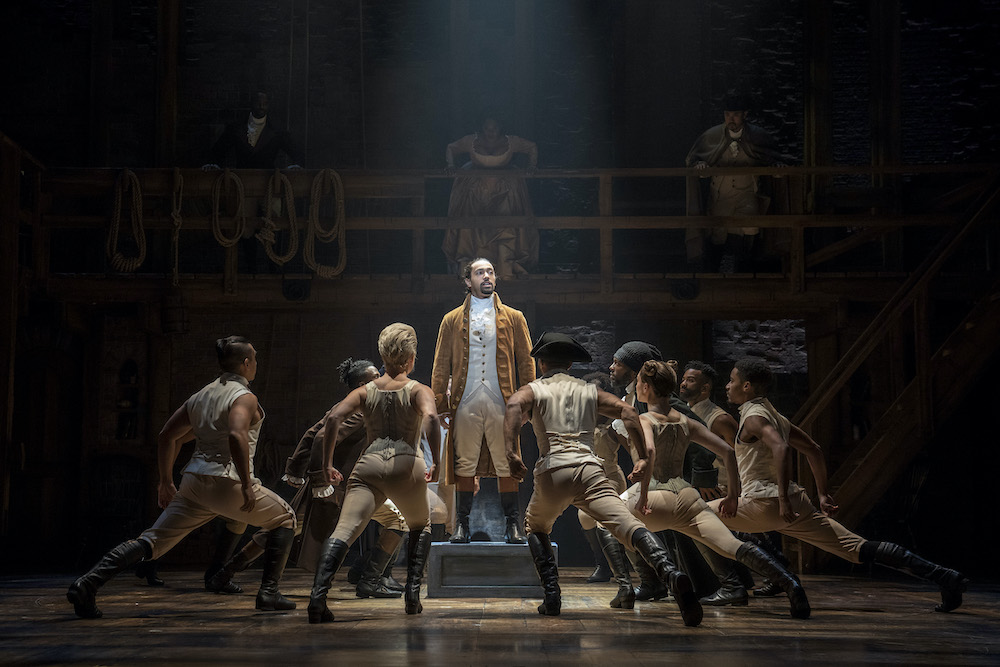
Tyler Fauntleroy and company in “Hamilton” National Tour/Photo: Joan Marcus 2024
When I first met producer Jeffrey Seller in October 1997, he was promoting the first Chicago production of “Rent.” His self-introduction was memorable.
With carefree curly light-brown hair and intense blue eyes that focused in, Seller surrounded my hand gently with both of his and said somberly, “I’m sorry you have to talk to me. You really should be talking to Jonathan, but you can’t for obvious reasons. This is something I really need to do for him.”
“Jonathan,” of course, was “Rent” composer, lyricist and book writer Jonathan Larson, who had died of an aortic aneurysm just ten days shy of his thirty-sixth birthday, mere hours after the final dress rehearsal of “Rent” in January 1996.
“He wasn’t feeling well,” Seller recalled. “He had the flu and was worn down from a lot of last-minute changes to the show. But no one could have possibly expected that he would pass away just as his lifelong dream was about to be fulfilled.”
Seller was one of a handful of people who knew of Larson’s talent long before the rest of the world learned about it posthumously.
“I met him in 1990,” Seller says, “just after he had mounted a vaudeville-like show that I thought had some terrific music in it. I was just starting out, too, so I made a point of introducing myself and letting him know that I thought he was a really gifted composer with a good theatrical sense.”
Shortly after that initial meeting, Larson contacted Seller with a novel idea.
“He said, ‘I’m working on a musical theater adaptation of “La bohème” where the artists all live in a flat on the west end of New York today, instead of in nineteenth-century Paris. Instead of tuberculosis, the heroine will have AIDS.’ I told him flat away that I thought it was a magnificent idea, and he went to work on it.”
A workshop production of “Rent” was presented in 1993, which Seller describes as having a lot of great music, but little character development.
“It was about sixty-percent the same music as now,” Seller says. “Especially the opening ‘Rent’ number, which knocked my socks off. (It still does, in fact, every time.) But you didn’t get to know or care about the characters, so that had to be adjusted.”
Larson went to work again, and more and more changes were made, right up through that final dress rehearsal on that fateful January day.
“By the time of that rehearsal,” says Seller, “it was pretty much there. Of course, we all knew it would need the normal adjustment process that a show goes through when it is being previewed. But unfortunately, Jonathan never got to do that.”
Seller says that as in the show, Larson was living in a flat with other artists right through to his death.
“It was so horribly run down that the set designer for ‘Rent’ made sure that it didn’t look too much like home to him. The set was actually better.
“The main difference about Jonathan not being here is that he ended up dying still living the lifestyle portrayed in the work, which is eerie.
“I can assure you that if he were here, he would be talking to you right now about happily making the transition to wealthy composer and playwright. This was, after all, only his first major work, so he’d already been planning out what his next show would be.”
“That is the saddest thing of all to me,” Seller says with a sigh. “Apart from the loss of a dear friend, if ‘Rent’ was the start of such a successful career, imagine what the finish would have been.”

Jeffrey Seller/Photo: Emil Cohen
Fast-forward almost twenty years later to October 2016—the opening night of the first Chicago run of “Hamilton.”
Seller had produced other shows that had come through Chicago in the intervening years—some had even originated here—but “Hamilton,” like “Rent,” was a cultural phenomenon. I hadn’t given much thought to the fact that the same producer was behind both such milestone works until seeing Seller again that night.
“That opening-night moment when the producer of a little show called ‘Hamilton’ remembers you interviewed him circa twenty years ago (when he was producing another little show called ‘Rent’) and introduces you to the show’s composer/lyricist/book writer and you spend the intermission discussing how the little show he wrought is changing the template of musical theater. Rahm Emanuel joins in as well,” I posted that night. “Glad I didn’t follow my original plan of heading to the restroom!”
Nearly another decade has passed and “Hamilton” is returning to Chicago for a third staging, through April 26—a bit prematurely, and for an unprecedented reason. Of course, I wanted to hear the details from Seller himself.
“After an amazing three-year and three-month run in Chicago,” says Seller, “we closed [the original run of] ‘Hamilton’ as planned in January of 2020. And then we came back, I think, two years ago.” September through December 2023.
“There you go.”
Less than two months into Donald Trump’s second term as president—“Hamilton” made headlines by pulling out of its planned 2026 run at the Kennedy Center, setting in motion an ongoing exodus of productions and personnel.
“If I were going to write another chapter of my book, ‘Theater Kid,’ I certainly would write about that.”
What did happen with the Kennedy Center, as Seller experienced it?
“So, Donald Trump fired the chairman of the board David Rubenstein, fired the president and CEO Deborah Rutter [who previously led the Chicago Symphony], fired every single member of the board who was a Democrat or was aligned in any way with Democratic administrations prior to his and named himself the chairman of the board.

The Company in “Hamilton” National Tour/Photo: Joan Marcus 2024
“I called Lin [-Manuel Miranda, composer, lyricist and book writer of ‘Hamilton’] and said, ‘Lin, we have to pull out. They have politicized the Kennedy Center. They have made it a political arm of the Trump administration and the Trump agenda.’ He completely agreed. And then we had to get our ducks in a row.
“In the days thereafter, we made our announcement that though we had announced ‘Hamilton’ as coming to the Kennedy Center as part of the 250th anniversary of the country, we did not have a signed contract. We would therefore take our hold off and we would not come.
“We did it because we would not allow them to use ‘Hamilton’ to make profits or to be in any way associated with their political agenda. That was our primary reason. We did it because it was the right thing to do. It represented our values and our ethics.
“But secondly, we did it because we knew that the moment [Trump] took over, you could never rely on their word and you could never rely on their signed contracts.
“What if we had said, ‘Okay, we’ll stay.’ And then we did something two months out that he didn’t like and he said, ‘Cancel “Hamilton.”’ We would have had nowhere to go.
“And guess what happened? There were some shows that were supposed to play there this July, August, September, October, and they had signed contracts and they just found out they have nowhere to go.
“And you know what I say? Shame on them for not pulling out earlier. They were hoisted by their own petard. They chose to stay. They signed a contract and they will no longer be playing there because of Trump. He backed out on his word and tore up the contracts. Let me know how the suit works out when they sue him for the guarantee and for when they get paid.”
There is anger apparent but also a discernible sadness evident in Seller’s telling of the saga.
“Well, you could certainly draw a line and a correlation between ‘Hamilton’ pulling out of the Kennedy Center and the announced closure of the Kennedy Center this summer. It may have consequences that we did not foresee that may be very negative, because he may just tear the whole thing down. God knows what he’s going to do.
“The Kennedy Center is in no need of a two-year renovation that would close it down, that’s for sure. It had a big renovation and extension added in 2019.”

Justin Matthew Sargent in “Hamilton” National Tour/Photo: Joan Marcus 2024
“But here’s the thing. Our good friends in Chicago were available. Our good friends in Chicago stood up. My thought right away was you do what’s right, you cancel. No way. Then you solve the problem. The thing you do to solve the problem is you call Chicago.”
How did that come about?
“I was like, ‘Shit, I’m pulling out of the Kennedy Center.’ So first I called our New York friends Jimmy Nederlander and Nick [Scandalios, both of the Nederlander Organization] and said, ‘Hey, I need to come to Chicago.’ And they said, ‘Yeah, you can come to Chicago.’ Remember, we work very closely with Nederlander. They’re actually in our same office building.”
Broadway in Chicago wasn’t initially involved?
“We deal with Broadway in Chicago on the execution of shows, but we deal with Nederlander for the bookings of shows. The booking of the Chicago theaters is run out of New York.
“The concern with ‘Hamilton’ coming back to Chicago after only two years is that we all said, ‘You know, we’re used to coming back on a schedule that would give it a little bit more space.’ And we wondered whether or not we would be able to sell out. The good news is, we’re almost sold out now, so it’s going to be a fantastic return.”
Will it be the same cast that we saw in 2023? “You know what? Every principal is always on a one-year contract. So there certainly may have been people who were there two years ago who will be there now.”

It’s curious that Seller’s 2025 book “Theater Kid: A Broadway Memoir” doesn’t have much to say about “Hamilton.” That may be because of a 2016 coffee-table book about the show, “Hamilton: The Revolution” that Seller was involved with.
“Theater Kid” largely leads up to “Rent” with an enormous amount of specific detail about Seller growing up near Detroit, finding his own love of musical theater in attending, performing in and producing shows in synagogues, summer camps and in high school and college before heading to New York to work for an agency that booked national tours of musicals.
There, Seller discovered Jonathan Larson as a solo performer writing and performing shows and the two collaborated on “Rent.”
By contrast, Seller’s subsequent decades of success are dealt with in “Theater Kid” as if they were an afterthought, including “Hamilton.” Perhaps that is because Seller convincingly made the case for how much “Hamilton” owes to “Rent?”
“You’re very perceptive,” says Seller followed by a long pause.
“The original draft of the book actually ended with ‘Rent,’ because it’s a coming-of-age story of a show called ‘Rent’ and of a producer named Jeffrey Seller. So they both arrive, right? ‘Rent’ arrives and I arrive and that story is done. And obviously the beauty and uniqueness of my career is that I got to go on and produce ‘Hamilton.’
“So when Simon & Schuster bought the book, they said, ‘But you’ve got to write about ‘Hamilton.’ I thought, ‘What can I write that will be illuminating, that will add to what we’ve already written?’ We had already—I mean, I had commandeered the ‘Hamilton’ book. I worked on every page of that book. And that was a great book.
“Then I thought, ‘Well, what I can do is tell one great story about each of these later shows.’ That is what led me to say, ‘I don’t need to talk extensively about the making of “Hamilton.”’ In its own funny way, it’s actually a less dramatic story. There’s less conflict. It’s less dramatic.
“‘Hamilton’ was almost a divinely inspired work. And the creation of ‘Hamilton’ was a joyous, ebullient and completely functional experience which, as you know, doesn’t make for big drama.

(l-r) Lauren Mariasoosay, Marja Harmon, Lily Soto in “Hamilton” National Tour/Photo: Joan Marcus 2024
“But what I thought would be interesting to address was, What was the effect of the election of 2016 on ‘Hamilton?’ And that was the story I chose to tell in the book, because I could tell another story in which I was at the center of the story, and it was both consequential and dramatic.”
Those of us who create at any level are not always the best judge of what we create. But Seller seemed to be a very good judge of the significance of “Rent” in “Theater Kid.” Maybe the vantage point of thirty years helps, but Seller is eloquent about the way that show changed everything.
“You’re bringing up a very curious line of inquiry, which is how do we, as both—whether we are artists or we are producers—judge our own work in the present, in real time, as we’re making it?
“How can I, as a producer, judge the work in a way that enables me to offer the authors suggestions, criticism that will be valuable in improving the work? Am I right? Am I wrong? And then how can I judge it longitudinally?
“I do believe that the benefit of thirty years gave me a perspective of how ‘Rent’ changed the world, which was not exactly what we thought when it opened.
“I remember saying at the time that if this show runs as long as ‘Tommy’ ran, and that show ran two years, I would say, ‘Dayenu.’ I don’t know if you’re Jewish, but that would have been ‘sufficient.’ That would have been worth it. Bringing ‘Rent’ to Broadway felt like it was important to do, and if it only ran two years, that would have been okay.”
“Rent” ran on Broadway for twelve years.
“Others began to posit [at the time], ‘Does this mean this is the new era of rock musicals?’ And of course, no, that is not what happened.
“But what did happen as a result of ‘Rent’ was an era of taking bigger risks, of doing shows we didn’t expect to see on Broadway, and of doing contemporary musicals about real people with real problems who live in the present.

“Avenue Q” at the Mercury Theater Chicago 2018
“As I have said, there’s no ‘Next to Normal.’ All the shows that came and did so well after ‘Rent’ from ‘Next to Normal’ and ‘Dear Evan Hansen’ to ‘Spring Awakening’ and ‘Hamilton’ would not be there. They all were on the shoulders of what Jonathan [Larson] did. But so was ‘Avenue Q.’ And certainly so was ‘In the Heights.’” (Sellers was a producer on “Avenue Q” and “In the Heights.”)
As an aside, I mention that I never got “Avenue Q.” Maybe it’s a puppet thing.
“Well, I’m going to tell you, that’s your flaw because ‘Avenue Q’ is a perfect musical. But you know what? I shouldn’t have said ‘flaw.’ It’s just your taste. That show, up until ‘Hamilton,’ I used to say, was my perfect musical. The book, music, and lyrics work one-hundred percent of the time. It’s a very unique and wonderful show.”
One common characterization of “Rent” when it opened thirty years ago was that it was another “Hair.” I recall interviewing the original producer of “Hair,” Chicagoan Michael Butler [who passed in 2022] as he was opening a Chicago revival of “Hair” in time for the Democratic National Convention that same year. He seemed skeptical, though he hadn’t seen “Rent” yet at the time.
“Michael was the impresario who made a critical decision about ‘Hair,’ which was to fire Gerry Freedman as the director and hire Tom O’Horgan when they brought it to Broadway [in 1968]. That was radical. I don’t know that many people who saw it at the Public [Theater], but people said it was great at the Public.
“‘Hair’ is an incomprehensible musical, to be honest. The book absolutely makes no sense whatsoever. But the score of ‘Hair’ did one-hundred percent and absolutely did go wider than even the score of ‘Rent.’ I mean, ‘Aquarius’ became the song of an era. Michael Butler put the companies of ‘Hair’ in so many places and as you know, did very well with it.”
Chicago figures predominantly in Seller’s aspirations and career. He coveted going to Northwestern University, for instance.
“You know what? Sadly, I actually had written a chapter about my summer in which I was a student at the Northwestern National High School Institute theater program, but it had to be cut from the book. They are affectionately and colloquially called the Cherubs. I was a Cherub at Northwestern.
“It’s an intensive five-week high-school theater training program that Northwestern does for rising high-school seniors. They’ve been doing it for I don’t know how many years.” Since 1931, so ninety-five years. Nearly a century.
“There are many people in the theater world that will tell you they did it as well. I did it when I was sixteen. I was there in the summer of 1981 going to see ‘Evita’ at the Shubert Theatre and going to see the very first production of ‘Balm in Gilead’ at Steppenwolf as well.”
Sixteen years later in 1997, Seller found himself back at the Shubert Theatre [now the CIBC Theatre] with the first Chicago production of “Rent,” where we first met.
“My professional association in Chicago starts there and then it continues through every single one of my shows. But most importantly, ‘Rent’ and ‘Hamilton,’ followed by pre-Broadway engagements of ‘The Last Ship’ and ‘The Cher Show.’
I recall enjoying Sting’s “The Last Ship” at its pre-Broadway Chicago premiere, and was puzzled why it never fully caught on. It was fascinating to hear Seller’s explanation in interviews of why audiences ultimately didn’t accept it.
“At the end of the day, people didn’t like ‘The Last Ship.’ That’s why it didn’t succeed. That’s what we as producers have to confront, right? There’s no bullshit. There’s no excuses. They either liked it, or they didn’t. If they do, they love it. They keep buying tickets. If they don’t, they don’t. And that’s why it failed. The rest is still hindsight.
“This is where you ask as you brought up earlier, ‘How do we judge our own work?’ In the end, it’s very hard to both be in the middle of the work and then step outside it and judge it at the same time.
“I certainly came to a post-show opinion that the show’s underlying message was about loss in every way. Loss of community, loss of family, loss of relationship, loss of love, loss of job, loss of industry. On that level, I think we were very successful.
“But we were supposed to do a show about redemption. The redemption of work, work as a redeemer. And I think we missed that focus. I think our focus wound up on a different thing. And I think that’s why the show failed. That’s just an hypothesis.
“You know what the good news is? Sting is out doing ‘The Last Ship’ in Europe right now, and I hear he’s selling out opera houses. God bless him. I love him. So he has his redemption. Sting’s redemption is he’s doing the show, he’s in the show, and they’re selling out. That’s called redemption.”
And “Hamilton” coming to Chicago when the Kennedy Center was no longer an option to present it seems its own redemption.
“You know what? That’s the happiest part of the story for me. When Washington failed us, we knew we had a home in Chicago. And isn’t that the best thing of all?”
“Hamilton” runs March 4-April 26 at the CIBC Theatre, 18 West Monroe, broadwayinchicago.com
Published in the print edition of the April 2026 issue, with the headline “A Hamilton Redemption: After Kennedy Center Withdrawal, Producer Jeffrey Seller Turns to Chicago.”