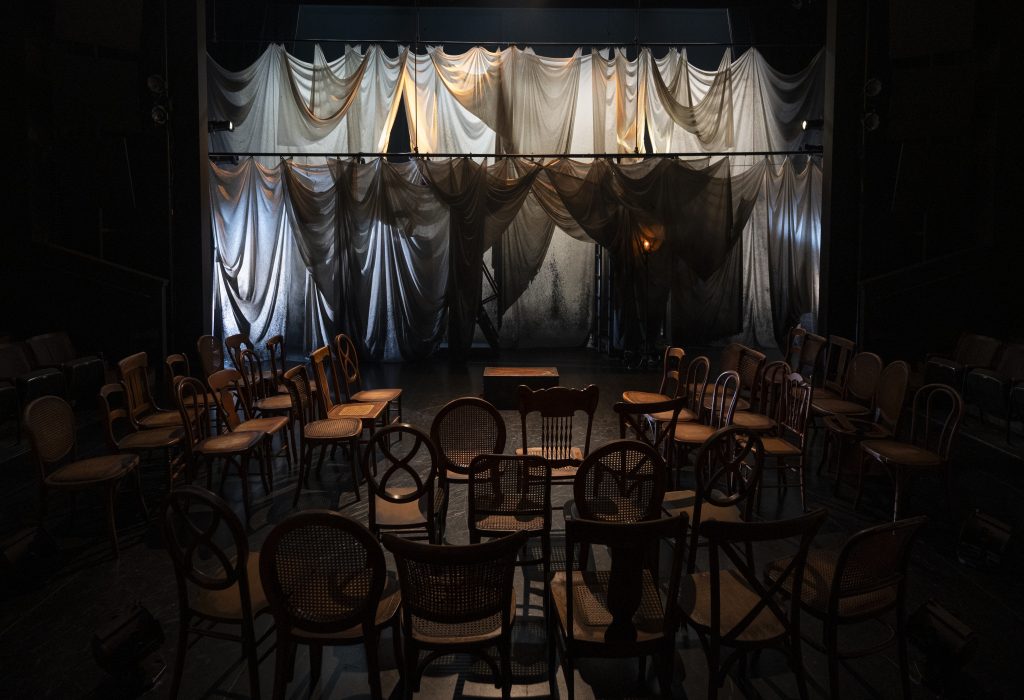
Chicago Shakespeare Theater’s “The Merry Wives of Windsor,” with Ora Jones, Jason Simon, Rohan Ryhs Degala and Issy van Randwyck/Photo: Kyle Flubacker
RECOMMENDED
The online program for Chicago Shakespeare Theater’s production of “The Merry Wives of Windsor” begins with a puzzling, and arguably dead-wrong note from director Phillip Breen. It reads “There are no jokes in ‘Merry Wives,’ only situation and character; bacchanalian laughter and chaos…” Breen has done himself a disservice because there are jokes galore in the play and his production and cast nail them. Or at least they nailed the ones I caught. The puns and wordplay, some groaners and many magical, come so fast and furiously that I stayed up late into the night following the show’s opening to read the Folger’s annotated edition of the play, to find wordplay I missed and keep the delight going.
“Merry Wives of Windsor” is largely a sex farce. The original production, which may have premiered before Queen Elizabeth I, likely ratcheted up the naughty verbal wizardry about, for example, erections, horns, bucks and butts, with a liberal dose of lewd gesture. Breen’s note tells, a bit haughtily, how he saved the play by rejecting generations of edited texts and timeworn fixes, digging into the Folio to retrieve the soul of the original. Part of that soul is found in the places where lurid puns can be, and are, punctuated by public waggings of private parts. Of course, in Shakespeare, the salacious is often sagacious. Anyone who has muddled through Latin 101 will be amply rewarded with the grammar lesson delivered by Nick Sandys, who, as Welshman Sir Hugh Evans, commences a parade of malapropisms that lead to the gutter. For something less highfalutin, wait for the gag with the brassiere and the melons (or are they gourds?).
One enduring question of this play is who is it mostly about? At the center of the action is the big and bigger-than-life rogue Sir John Falstaff, played with requisite girthy gusto by Jason Simon. Shakespeare penned this play after his two histories in which the character, a Danish knight and pal of Prince Hal, previously appeared. The Falstaff of “Merry Wives” is a less poignant character and less witty character than he was in “Henry IV,” Parts One and Two. He is, however, the object around which all of the play’s humor depends. What Shakespeare denies him verbally here, he makes up for in pratfalls. Simon is one of those rare big actors, like Jackie Gleason or Oliver Hardy, who can combine arrogance with haplessness, and who usually ends up getting kicked for laughs. Perhaps Breen could have found ways to pull out a deeper humanity from this ultimately sad character, but then Falstaff might lose his utility as prop around which the farce revolves.

Chicago Shakespeare Theater’s “The Merry Wives of Windsor,” with Issy van Randwyck/Photo: Kyle Flubacker
There are three main threads in the plot, each running its own deceit. There’s Sir John Falstaff’s plan to fill his empty purse by seducing two wealthy wives in Windsor. There’s the wives’, Mistress Page and Alice Ford, attempt to fool Sir John by leading him on and tormenting him. The remarkably versatile Chicago-stage regular Ora Jones and lithe, impish Issy Van Randwyck, a baroness with a long and celebrated resume in British theater and comedy, animate the production and squeeze meaning and comedy out of all their lines, making even obscure and marginally comprehensible dialogue clear. (Thank you!)
There is also the plan of one jealous, beleaguered husband, Master Ford, played believably and gracefully by Timothy Edward Kane, to catch his wife in flagrante with Falstaff. There’s another minor subplot about who will marry Page’s daughter Anne. That subplot makes room for three of Anne’s suitors. The comic standout is the arrogant Frenchman Dr. Caius, played by Nate Burger, who delivers one of the show’s funniest performances and its most ridiculous accent.
“The Merry Wives of Windsor” is not one of Shakespeare’s more perfectly crafted plays. Its beginning and its end drag a bit, and the main characters are not as multidimensional as one might expect. There are some plot turns that are difficult to follow. Yet the show has rewards aplenty, many of them rooted in Shakespeare’s Witzelsucht (clinically compulsive punning). As a piece of history that reflects its time, it’s fascinating too. Despite all the fluff, Shakespeare works in deep moral and religious themes he returned to often.
One more note on Breen’s conception of the show. Despite his commitment to restore the virtues of the original work, he inserts some anachronisms—including characters disguised as well-known modern, branded comic superheroes—that break the show’s own reality. These take one as far from the Folio as Superman is from Krypton. (Yikes! I’ve fallen into the same trap!) It’s a small quibble over an excellent production. “The Merry Wives of Windsor” is produced less often than other plays in the heart of the Shakespeare canon. It is worth catching.
“The Merry Wives of Windsor” is on stage at Chicago Shakespeare Theater through May 3. Tickets available here.