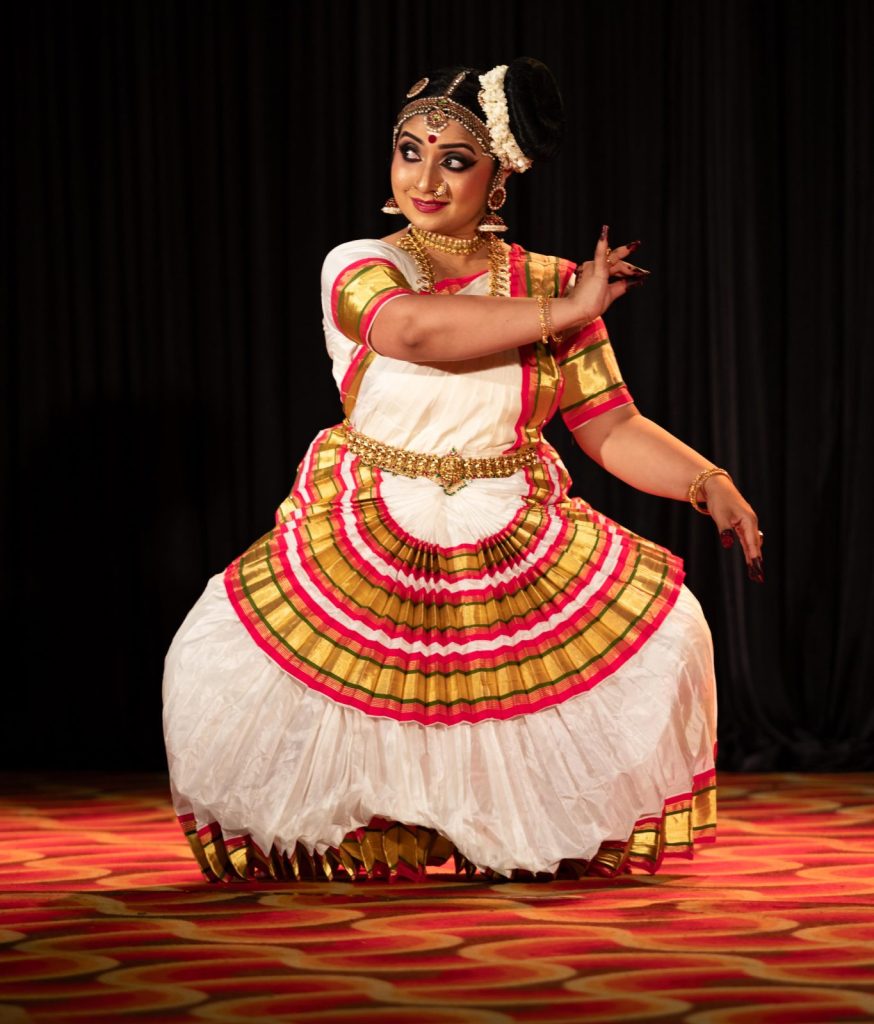
Chicago Danztheatre’s “Architecture of Memory.” Photo: Zakari Kaletka.
At the start of my interview, Ellyzabeth Adler, the founder of Chicago Danztheatre Ensemble, says she was recently paid a compliment by a colleague on a panel reviewing grant applications. The reviewer said nearly every application she read included work that was developed at Chicago Danztheatre’s space in Ebenezer Lutheran Church in Andersonville.
The Ensemble’s path from small, independent company to multidisciplinary arts incubator is a lesson in the power of perseverance. Adler, whose company is named after the German Expressionist Tanztheater tradition, marries media in her productions and has, across more than twenty years, built relationships with visual artists, playwrights, actors, dancemakers, musicians, video artists and educators. Under her guidance, the auditorium and surrounding rooms in Ebenezer Lutheran have been transformed into a fully equipped theater and studios, transforming into a home to artists in need of increasingly scarce affordable creative space. The Ensemble recently received several grants to fund programming, rehearsal space and subsidized performances in their flourishing home.
Adler says shepherding Chicago Danztheatre Ensemble through the pandemic and then building it into a resource for Chicago’s creative community took the front seat for several years. With that momentum, Adler will premiere an evening-length work, “The Architecture of Memory,” which runs May 8-23. I spoke with Adler about the piece, its lengthy percolation, and the power of community to provide hope in hard times.
It has been almost ten years since you’ve created an evening-length piece.
The last one was in 2018. Then I got pregnant and the pandemic happened. When we came back after two-and-a-half years, it was a retrospective of twenty years of my work. Creating something brand new takes two years.

Chicago Danztheatre’s “Architecture of Memory.” Photo: Zakari Kaletka.
“Architecture of Memory” has been two years in the making, then?
It started when we did “Art. Heals” [a festival of thirty artists in 2022] and started playing around with video projection and other ways to tell stories. But really it started over ten years ago, when a friend gave me a book of essays and short stories about getting lost and finding oneself. That concept was so beautiful to me because of my own life journey and people I know. I asked my friend, director Steven Fedoruk, “How did you know you were different from your family, and you would be a director?” He said as a boy, he would look at the front door of his house, and he knew one day he would open it up and start running. He met and worked with [actor and director] Frank Farrell, who was a big influence. I love that story because we meet people who change the trajectory of our lives.
“Architecture of Memory” includes the Red String Theory, a Chinese proverb that says there are people we are destined to meet over the course of our lives who will change us. That’s so much what this story is about, creating a chosen family, surrounding yourself with people who love you for whoever you might be.
The other thing that’s happening with me and so many friends is we’re cleaning out loved ones’ houses. They’ve moved on to dementia care or passed away. One friend told me a story that he was able to clean out a lot of his mother’s things, but he hasn’t been able to give away her Sunday best dresses. He said he felt if he gave them away, she’s permanently gone.
The concept of “The Architecture of Memory” is that when you walk by a building, you remember meeting someone there, or having your first kiss there, or it’s your mother’s Sunday best dresses. All these things help us reflect and make us the people we are today and the people we want to be.
Tell me about the collaboration with Hart Ginsberg.
I met him when I first started thinking about this show during “Art. Heals.” I worked with Wannapa P-Eubanks, and Hart created the video that went with that piece. I started following Hart’s work more. I asked if he wanted to collaborate on this project. We both were talking about the concept of memory. Going back to the Red String Theory, you meet people who might be on the same wavelength, and then the collaboration happens.
How does video factor into this piece?
It’s a twofold question: I’ve always done video of some sort, that’s always been projected straight to the back wall. For this piece, I’m integrating it more. We have a peach-colored Marley floor, so we’ll be projecting on the ground. Different performers will be flying kites and being in the clouds. That’s pushing me artistically to ask how I can have the film be more than just display and seamlessly interweave it on stage.
The other concept is that these are dance-heavy films, where the dance in the film parallels what’s happening on stage. It’s a challenge to sync it up. I recently came across a functional Victrola and the owner let me use it in one of the films. It’s a beautiful image—an old thing we don’t use any more. It’s not a record, but a cylinder you have to wind. Here’s an artifact of how people were first able to listen to recorded music. The films can stand on their own, so now it’s figuring out how to integrate them in the performance.
Is there anything else you’d like to mention?
About four years ago, I was walking by a floral shop near my house and saw a mannequin dressed up with fabric and flowers. I took a picture, thinking “someday this will spark something.” It goes to show how long the trajectory of something goes to be creative. We’re using three mannequins. One of them looks like the picture I took four years ago.
I feel like this show has been a long time coming. It is inspirations from my journeys and my path. I feel in the times we’re in right now, we’re needing hope and perseverance. I think that’s the big thesis of this piece—hope and finding community. COVID disbanded our communities, but new communities have cropped up. That’s where the perseverance and hope lies.
Chicago Danztheatre Ensemble’s “Architecture of Memory” at Chicago Danztheatre, 1650 West Foster. May 8-23, Fridays and Saturdays at 8pm. $10-$25. Tickets and info at danztheatre.org.
Published in the print edition of the May 2026 issue, with the headline “Where Hope Lies: The Evolution of Chicago Danztheatre’s ‘Architecture of Memory.’”