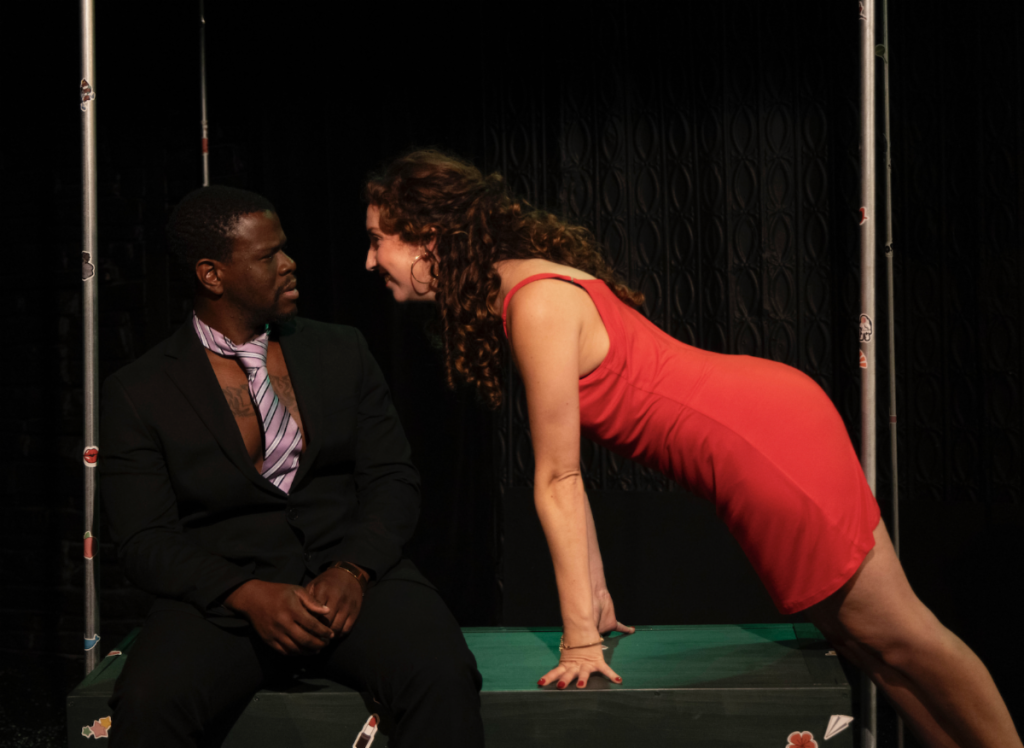
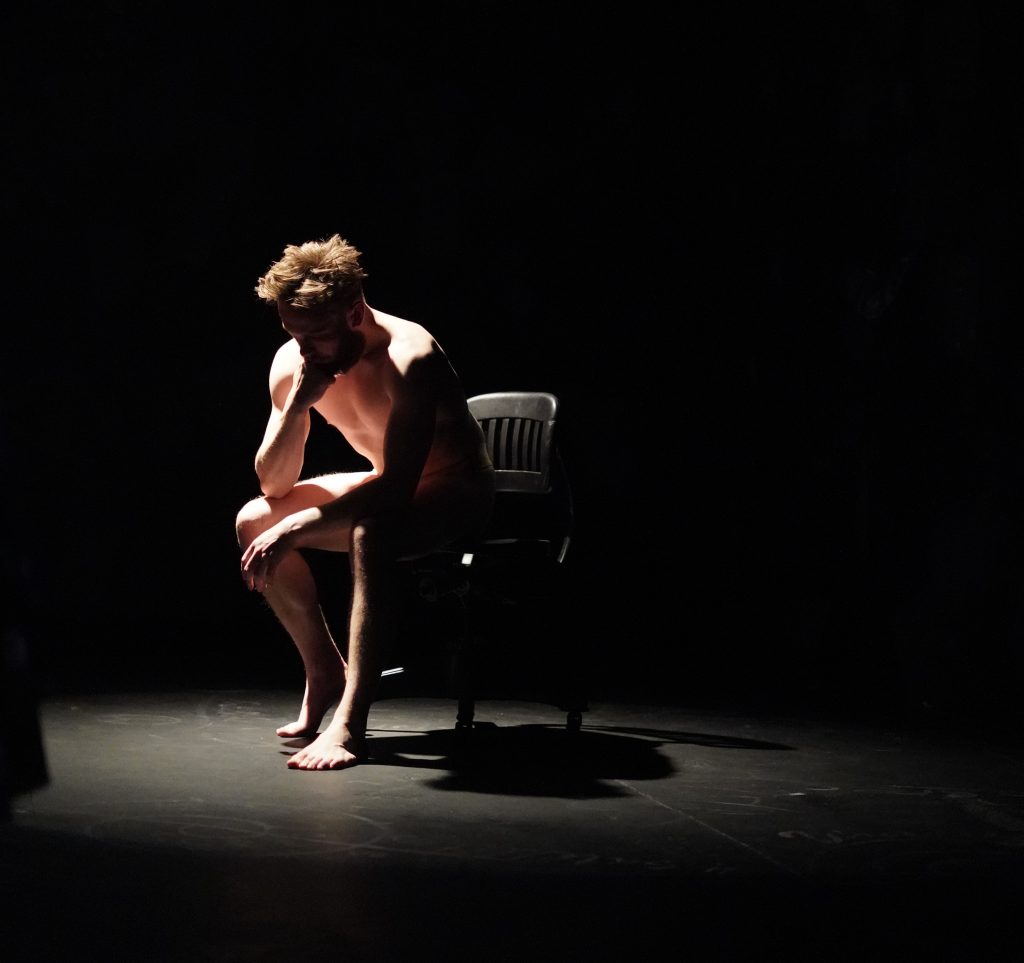
No Dogs in the Kitchen’s “The Importance of Being Earnest”/Photo: Alex Albrecht
I’ve seen two productions of “The Importance of Being Earnest” over the last two months: in May, a “film noir-style” staging in May courtesy of Modern Archaic Theatre, and now No Dogs in the Kitchen Theatre Company’s ultra-farcical take on Oscar Wilde’s 1895 comedy. Interestingly, both versions omitted my single favorite line. Speaking of a protagonist’s wealthy benefactor, the funny-scary Lady Bracknell asks, “Was he born to what the Radical papers call the purple of commerce, or did he rise through the ranks of the aristocracy?” (At least I think the line was cut from the two shows, but it’s possible that I missed it amid the barrage of bon mots that constitutes Wilde’s epigrammatic script.)
If that line—a wickedly apt encapsulation of Gilded Age, robber-baron capitalism—was indeed omitted, the question arises, why? Impossible to say with certainty, but one could guess that neither director thought the audience would get it. The failure to trust either viewers or play mars the No Dogs in the Kitchen production, as director Genevieve Corkery labors so hard over the show’s sight gags and humorous effects (many of which, in fairness, are nicely done, as when Lady Bracknell measures her prospective son-in-law’s cranium with calipers) that the slapstick silliness ends up overshadowing the show’s raison d’etre—its keen verbal wit—which is more than just an amusing send-up of Victorian melodrama. Wilde’s glittering ironies and paradoxes are also a critique of the era’s ham-handed moralism, which at the human level tended to produce more posturing and hypocrisy than actual uplift.

No Dogs in the Kitchen’s “The Importance of Being Earnest”/Photo: Alex Albrecht
There’s a reason Wilde subtitled his masterpiece “A Trivial Comedy for Serious People.” As with all classic satire, the play’s humor conceals—dare I say it—an earnest attack on bourgeois verities, ranging from class distinction to moral rigidity to the cult of true womanhood. But one wouldn’t necessarily know it from No Dogs in the Kitchen’s production, which is so relentlessly paced and busily staged that the script’s zingers don’t land the way they should.
We never really get to explore the plot’s driving metaphor of “Bunburying”—i.e., the way male protagonists Jack and Algernon escape the boredom of upper-crust respectability by creating chronically needy or morally suspect alter egos. Nor do we fully relish the symmetry of the two female leading roles, Cecily and Gwendolen—both of whom are romantically aroused by the name “Ernest,” which is to say “earnest,” a word with heroic cultural associations. Yet the two have no use for simple sincerity, dealing with the limits of their circumscribed, chaperoned lives by turning every interaction into a scripted scene, performed for private amusement or public attention. As the elaborately goofy plot about secret identities, hidden pasts and thwarted romances unspools, the action dissolves into absurd posing and role-playing, and Victorian high seriousness dies of acute laughter.
“Earnest” is a fun play, but here the fun is taken too far, turning a comedy of manners into a live-action Punch and Judy show. Some of the actors—notably Garrett Wiegel’s Jack and Jasmine Luethy’s Cecily—display poise and restraint, but David Lovejoy’s bearded, deep-voiced Lady Bracknell is way over the top, while Mitch Karmis is trying too hard in the admittedly unrewarding roles of Lane and Merriman, the play’s two servants. The rest of the eight-person cast would benefit from dialing it back a bit, although Gus Thomas does manage just the right expression—somewhere between a sour sneer and a childish pout—for the decadent, self-indulgent Algernon.

No Dogs in the Kitchen’s “The Importance of Being Earnest” with Garrett Wiegel and Gus Thomas/Photo: Alex Albrecht
Technically, this is one clever, good-looking production, with a fine job done by costumer Emma Millisor as well as by lighting and sound designers Eli Green and Grace Patterson, collaborating to create numerous freeze-frame monologues where characters declaim directly to the audience their tragicomic woes. Most deserving of kudos is Tom Fitzmaurice’s intentionally artificial, “tennis anyone”-style set, which at one point magically flips from outdoors-looking-in to indoors-looking-out.
At times, the production has a stylized silent-movie feel, while other moments bring to mind the comic riffing and giggly nostalgia of Mel Brooks’ “Young Frankenstein.” But the chief artistic inspiration seems to be the movie spoofs that ran on the old “Carol Burnett Show,” featuring emotionalized close-ups and hyperbolic line readings. Burnett’s TV satires worked wonderfully, but they were only ten or so minutes long. Staged over two hours, with no intermission, this show’s comedic excess begins to grate.
Well-designed, punctuated with crisply timed stage bits, this “Earnest” is nevertheless something of a disappointment, especially in light of the outstanding job No Dogs in the Kitchen did last year on another biting satire, Richard Dresser’s “Below the Belt.” By slighting Wilde’s social insights and always going for the obvious laugh, the production doesn’t so much update the play as it does subvert its still potent subversiveness.
“The Importance of Being Earnest” is onstage at the Facility Theater, 1138 North California. Tickets are $35 for adults, $25 for students/seniors and are available here.