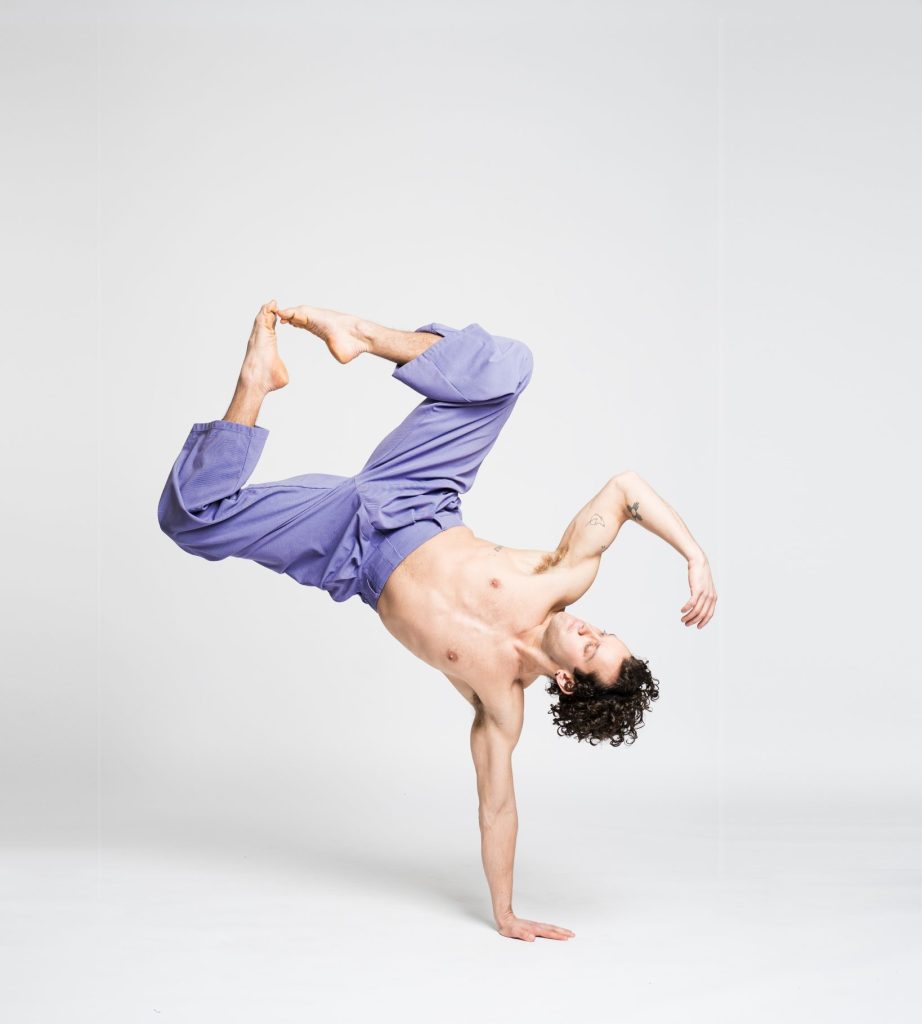
Chicago Dance Crash/Photo: A. Deran Photography
On a lovely evening in June, about twenty dancers, most clothed in something baggy and black, are at work in the studio of the Chicago Cultural Center, pairing off in conversations without words. They make contact with their heads, their torsos, their feet. That last intertwining would normally require caution, but here, the possibility—in fact, the beauty—of falling is a point of interest. And it’s an unusual one for these dancers trained mainly in hip-hop and other street styles—dancers who would more often employ a dive to the floor as a deliberate thrill for their audience.
Today, however, they’re participating in an open workshop led by choreographer Annie Franklin, part of a residency with Chicago Dance Crash that will culminate in the company’s debut of Franklin’s new work, “Six Ways to Fall,” along with two others. Franklin, who blends many styles and influences, is a natural match for this company that fuses street dance and concert dance. The dancers here are up for the challenges she poses—even though those are based on the postmodern dance practice of contact improvisation, which might sound foreign if Franklin had described it in its original terms. Instead, she makes it feel natural.
“I definitely take from different practices and traditions,” she says. “Contact improv can be such a universal language. To bring that concept to street dancers, I kind of adapt how I’m speaking about it with them. To me, contact improv is just connecting to someone physically and finding some sort of relationship within that.”
Franklin is configuring “Six Ways” in little chapters that explore various ways people experience vulnerability: related to physical, emotional, social, relational and existential challenges, and to identity. During an in-progress showing of the new work, ensemble members plunge; they shelter each other; they pulse. Sometimes they jerk; tics and quirks are part of the vocabulary here, Franklin says. And they introduce a motif: a hand in front of the face sometimes masks its expression. At other times, held at a distance, the hand serves as a mirror. In one of several duets, KC Bevis, also Dance Crash’s artistic director, insists on showing a reticent Logan Howell his reflection. A freestyle section addresses vulnerability of a different kind. At this showing, a quartet challenges a fifth dancer, the lanky yet surprisingly strong Ethan Stamps, to create on the spot moves on a horizontal, his whole body parallel to the floor.
The sequences read as logical—in the language of dance, they are complete sentences—but it took years for Franklin to create this particular lingo. She began serious dance training at age ten, with Hip Hop ConnXion in Chicago’s northwest suburbs. Over many years, she progressed through ConnXion’s levels and eventually directed a branch of the company at Western Michigan University, where she studied as an undergrad. Suavé, ConnXion’s founder and director, “is like a father to me,” she says, and for many years, she adds, her work reflected ConnXion’s hard hitting style.
“It wasn’t until I went to college that I started training in more Eurocentric forms like ballet, modern and postmodern, and learning the culture and history of those forms,” she explains. That training allowed her to “find breath within” her movement—to add leg extensions, create body “line” and consciously form body shapes. For a while, her movement became very soft and gentle. Since then, she says, the soft and the hard have been “weaving in and out. I’ve been trying to find a balance: hold on to that attack that I still feel and love, and also have a sense of fluidity throughout my body.”
“Six Ways to Fall” is her third work with Crash, and her biggest. For one thing, she is working with the composer e j e c t (also known as Jordan Dismuke), to create an original score. She feels the current group of Crash dancers is heavier on street dance, in common with her early training. “This work holds the most intention—and took the most effort,” she says.
Chicago Dance Crash presents “expo/sd” at Ruth Page Center for the Arts, 1016 North Dearborn, Friday, July 24 and Saturday, July 25 at 7pm. Tickets on Eventbrite.