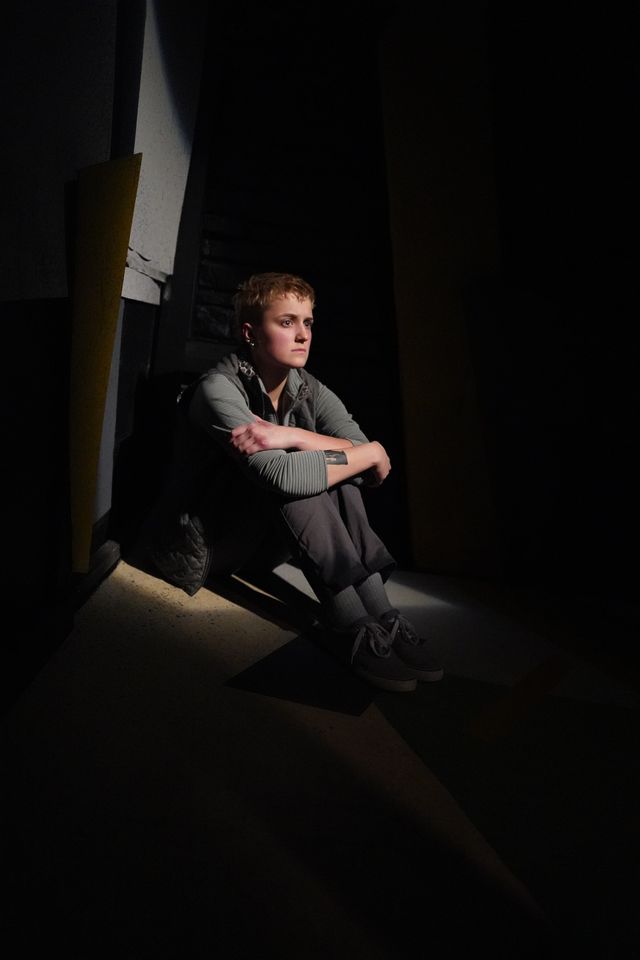
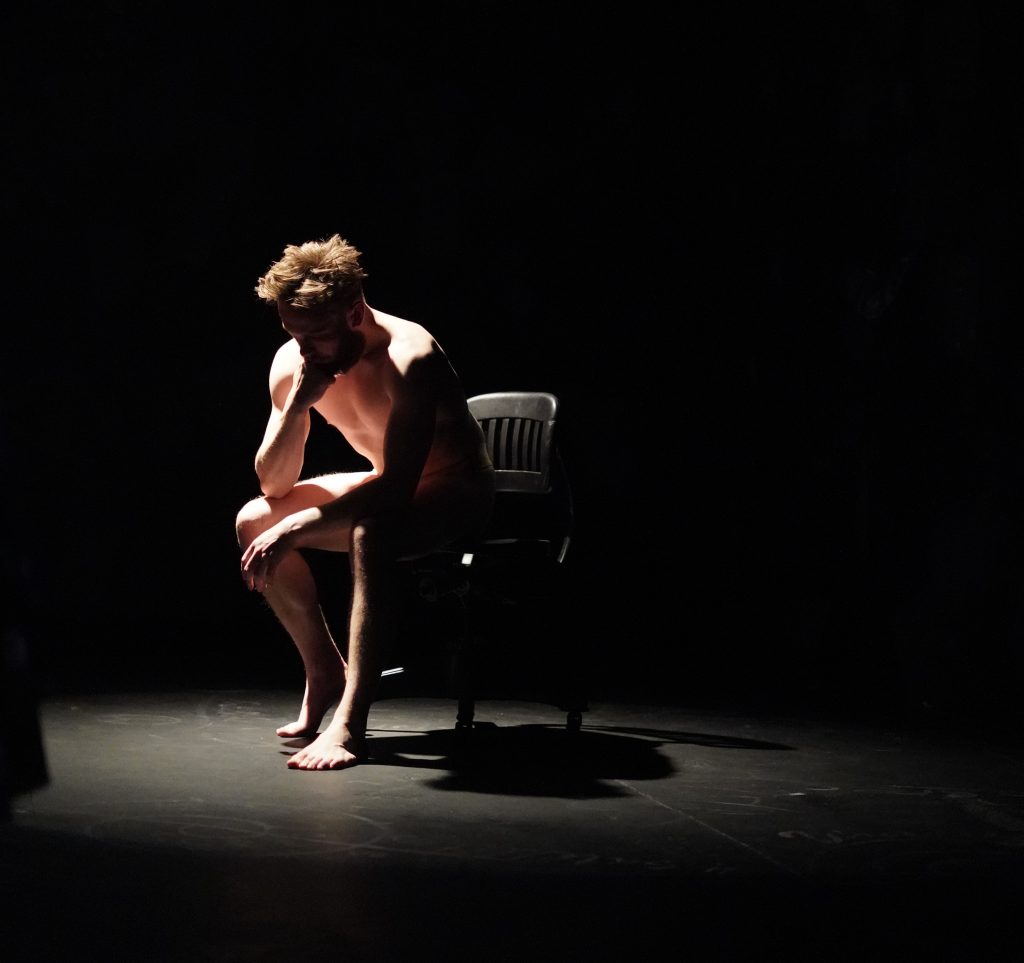
Brittany Burch, Paul D’Addario, John Gawlik/Photo: Joe Mazza
Irish playwright Marina Carr’s 2009 work, “Marble,” is really two plays separated by an intermission, the first very promising, the second disappointing. The first act of this domestic dramedy, handsomely mounted by the Gift Theatre, accents the humor and whimsy of its slightly fantastical plotline, in which two married couples become enmeshed through the amorous dreams that one of the husbands has about his best friend’s wife, a dream simultaneously and precisely experienced by that woman about the other man. The second act—and this is a problem in the writing, not the production—shifts from charm toward hysteria, turning what had been an engaging and witty tale into a less-than-intelligible tantrum that lacks satisfying closure. Director Kay Martinovich, who specializes in Irish drama, extracts what meaning she can from this overheated, underdeveloped play, but in the end it’s like trying to squeeze blood from, well, marble.
The play’s arc as a whole is from a grounded sanity toward something else, which the playwright seems to suggest is authenticity and true individuality. From a less romantic point of view, however, it seems considerably more sinister and destructive.
The story’s driving force is Catherine, wife of Dublin attorney Ben and mother of two never-seen children. Bored with her marriage to her dependable, if placid and sometimes boorish, spouse (who at one point tells Catherine, who is touchy on the issue of aging, that “old women interfere with my sense of self”), and sensing her options narrowing within her gilded-cage lifestyle, Catherine feels her own sense of self collapsing.
And that’s when the dreams begin about making passionate love to her husband’s fellow lawyer and drinking buddy Art, a married man she hardly knows, in a spectacularly luxurious hideaway bedecked with silk sheets, fancy draperies and white marble—hence the play’s title. Art, meanwhile, confesses to Ben that he’s had an identical dream involving Catherine, a disclosure that naturally upsets his friend and begins to shake him out of his complacency. Ben realizes that his marriage to Catherine, whose eye color he has trouble remembering, is not all it could be. And as for Art’s view of his marriage to his depressed, embittered, quasi-alcoholic wife Anne: “We’re happy, no more miserable than anyone else.” It could be the motto not just for both couples, but for the universe of this play.
In the first act, the mystically symmetrical dreams are treated by Art as an interesting coincidence, by Catherine as the first interesting thing that’s happened to her in ages and by Ben as a sign of trouble ahead. But the action remains within the context of existing relationships and shared reality. At a certain point, though, the increasingly dream-intoxicated Catherine decides that “being awake is no longer important” and that “night is where it all happens.” Soon after, she dyes her glossy black hair blonde, in order to become the sexy creature latent within her dream life.

John Gawlik, Brittany Burch, Paul D’Addario, Cyd Blakewell (rear)/Photo: Joe Mazza
It’s here where the play cleaves in two, losing its toehold in reality and appearing to embrace, what appears to this critic, as a literally mad version of life as pure wish fulfillment, detached from any ethical or rational consideration. The play seems to accept this message in which art and imagination don’t so much reinvigorate life as obliterate and replace it. “I think our dream is about dying,” says Catherine at one point. The play itself ends on something of a morbid note, more redolent of cold marble than of warm flesh.
While the script may lack balance, the performances, under Martinovich’s full-throttle direction, are uniformly strong. Brittany Burch gives a manic intensity to her depiction of the laser-focused Catherine, while John Gawlik’s Ben is a moving portrayal of wounded incomprehension. Paul D’Addario nicely captures his character’s hail-fellow-well-met exterior, which covers inner confusion and uncertainty, while Cyd Blakewell is convincing as the defeated, fearful Anne, whose extreme aversion to change and growth undermine her own situation.
With its rhythmic, propulsive, richly expressive dialogue, “Marble” is clearly an actor’s play, and the cast members sink their teeth into the script’s moments of heightened eloquence and fierce verbal sparring. All members of the Gift Theatre’s ensemble, they play off each other with a relaxed assurance that’s a pleasure to behold. If there’s one quibble, it’s that the Irish accents tend to drop away as the emotional temperature rises.
The show’s compressed, in-the-round space on the third floor of the vast Copernicus Center in Jefferson Park is less than ideal in terms of sight lines and acoustics, but Martinovich’s uncluttered blocking on Merje Veski’s simple set and the performers’ clear, unmiked delivery make for a viewer-friendly experience. Stephanie Cluggish’s costumes are straightforward and unobtrusive, with well-chosen footwear—the lawyers’ polished brogues, Catherine’s more daring suede boots—used to convey status and self-image.
But all the acting, directing and design skill in the world can’t save a play that starts strong and then goes off the rails, never managing to balance out its characters conflicting world views or find a closing cadence.
Marina Carr’s vision of the modern, high-tech world—a place that substitutes endless busyness and distraction for purposeful existence, only to insist we smile through the creeping sense that life is passing us by—is not easily dismissed, and in fact seems more compelling now than when this play opened seventeen years ago. But whatever the answer is for this malaise, I doubt it involves turning against our nearest and dearest, who after all are not our enemies, but rather fellow victims of an atomized, dehumanizing social order. Catherine’s response to her crisis is to sunder her connection to the real world of other people and escape to the misty, solitary ecstasy of her dreams. The irony here—and it’s not one that that play itself seems to pick up on—is that Catherine’s misery and alienation are ultimately rooted in the sterile, life-denying isolation that she craves.
The Gift Theatre’s “Marble” is on stage at the Copernicus Center, 5216 West Lawrence, through August 30. Tickets and more here.