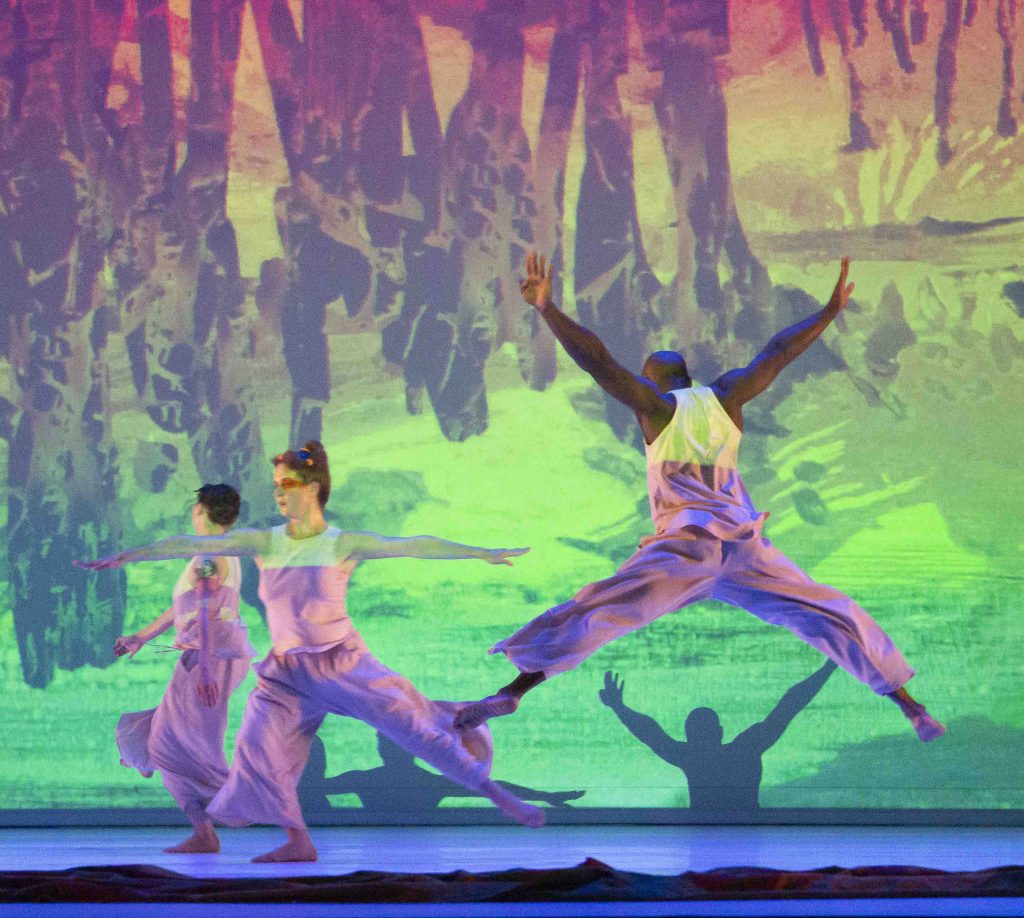
“Inventory of Lost Books”/Photo: Chuck Kramer
“Welcome to the Midwest’s book-processing center.” Every book you can imagine from “The Color Purple” to “The Beginnings of Western Science” makes its way here to be sorted and censored according to federal dictates ruling from an unassuming tome. Amid a soundscape of atmospheric recordings and intense practical thumping and stamping, a censor drone leafs through book after book demanded from the piles surrounding them and pulls random pages out after briefly skimming for suspect terms. This begins Non:op’s Chicago run of “Inventory of Lost Books,” an atmospheric installation that illustrates book bans and the censorship of literature and ideas through the lens of visual art.
The censor damns books with an echo of the random application of what are decidedly, hatefully calculated statutes from today’s federal fascists. “I’m just doing my job,” they say. They turn to your tour group and ask for a book from the pile. “Should we burn it?” they inquire. “They always do this,” moans your tour guide. “SHOULD WE BURN IT?” demands the censor, brandishing “The Things They Carried.” If you yell, “no!” they censor it anyway. If you say nothing, they censor it anyway. Who knows what they’d do with an affirmative.
Random acts of violence in this first room give way to a soupy sea of language as you walk into the second, where whirls of ocean are projected on the walls and waves of pages coat the sea floor where you walk. Delicate mottled butterflies of paper pinned to the walls with words studding them like a monarch’s patterned cells flap in the light breeze. Unhinged but pleasant vocables from bodiless voices float around; their visual counterparts float across the walls, projected syllables that never quite gel into sense. These word parts drift calmly as water gradually overtakes the projections. You peruse the leftover literature snowed on the floor. Seemingly random beats rattle the floor from beneath, stuttering your steps.
The temperature rises as new flames lick the walls. The freezer becomes a furnace. Cyclonic wheels of fire whip up around the central column, voices balloon and the words on the walls begin to burst and flicker, frenzied. Ghosts of machines crank and grind over the words, chalky shades interrupting the best-laid plans of language. When the dust settles after the fire and ash drift in the air, your group is abruptly ejected from the tour, and you shuffle back into the harsh light of the street in front of Theatre Y’s converted church space.
“Inventory of Lost Books” successfully takes over its two rooms in such a way that especially the second room, titled “Circulation,” feels made for the installation. Scenic and installation design collaboratively conceived by Amanda Love and Christophe Preissing are immersive and powerful. As a member of the facility tour, guided by actor Kyle Gregory Price, the experience of walking into that second room—white, cold, like a snowed-in walk-in freezer—provokes the out-of-body feeling one dreams of with installations, but rarely gets. Even the column in the center of the room is integrated successfully.
This is in no small part due to Liviu Pasare’s video design, which is as good as it gets for a storefront gallery show. There’s never a dull moment on the walls, never too much sameness, and with every flicker of light the material pinned to the walls gathers a new texture: first seashells, then snow angels, then hot coals.
The first room, “Withdrawn,” is also successful at integrating a slightly devilish warehouse feel with its space. The sounds, both of recited lines from condemned books and mechanical clanks and bangs, grow increasingly feverish, creating a tense atmosphere. The room’s books, pulleys and basket conveyances for redacted pages contrast heavily with the ethereal pinned butterflies of “Circulation.”
If the somatic transition into the second space was everything I wanted, that room’s harsh conceptual juxtaposition with room one left me wanting. I feel that this pair of rooms miss their opening and closing counterparts in “Inventory of Lost Books,” which is designed as a four-part installation series. We’re missing the full scope when we’re given only parts two and three back-to-back. It would be easy to wave this off if not for the rooms’ clear difference in narrative and character. Separately, they each have their own sense. Together, I looked for a clear story from the second room and, after the show, I reached for abstraction from the first. Simple scenic relationships, such as the windows from room two into room one, could be leveraged to build such relationships, but are only visually apparent with no clear point of view.
We are missing, also, an intent or motivation for the viewer. Who are we in this rope-and-pulley book-banning contraption? When discomfort arises in room one as the censor, played by E’Mon Lauren, requests book after book, there is no sense of narrative stake should we say yes or no. Are we complicit? Are we mere witnesses to mutilation? In room two, my interpretation is the sense that we are books, words or ideas burned in the destruction of culture, but when the censor enters the room and begins fidgeting with a paper shredder, I lose what sort of space, narrative or not, we occupy. Other people quit moving around, and instead watch the walls looking unsure of what to do. Where “Withdrawn” has clear forward momentum, “Circulation” stalls in terms of how we understand our relationship to the installation’s movement.
When the performance ends and we are quickly ushered out of the space, it feels like a missed opportunity to say something about book banning today. Yes, it is clearly bad, but how is it specifically bad? What’s our role? The central question on the installation’s marketing flyer, “what is lost when books are silenced?” is for me open without evolution after viewing the piece. Even brief signs would tell us how to walk away and perhaps explore what happens if we choose not to ban the book that the censor waves in our faces. Or, rather than leave us in a sympathetic but inactive sorrow for our state, show us a book we might, in our darkest moments, wish was banned. Similar narrative complications would elevate this aesthetically impactful installation.
“Inventory of Lost Books” at Theatre Y, West Cermak, through August 23. Tickets here.