“Liliom,” Courtesy of Czech National Ballet/Photo: Sergei Gherciu
The Joffrey Ballet is no stranger to the work of John Neumeier. The Milwaukee-born choreographer and longtime director of the Hamburg Ballet makes stunningly designed story ballets with ample idiosyncratic flourishes embedded in challenging technique. In 2015, the Joffrey presented the U.S. premiere of Neumeier’s “Sylvia,” his chromatic, sleekly minimal adaptation of the nineteenth-century tale of the Greek archer torn between fierce sisterhood and romance. Two years later, Neumeier came to Chicago to collaborate with Joffrey and the Lyric Opera on a new production of Christoph Gluck’s “Orphée et Euridice.” And in 2023, the Joffrey made a splash with Neumeier’s haunting adaptation of “The Little Mermaid” (based on the tragic Hans Christian Anderson story, not the Disneyfied take).
This fall, the Joffrey again brings a dark tale envisioned by Neumeier to these shores. “Liliom,” a play by Hungarian playwright Ferenc Molnár and the source material for the musical “Carousel,” runs September 17-27 at the Lyric Opera House. Adam Blyde, the Joffrey’s longstanding rehearsal director and newly appointed associate artistic director, spoke with Newcity about the ballet and the company’s experience as a North American home for many of Neumeier’s works.
John will be here for the first week of the process with his team of stagers. As they’re working with the characters, they’ll spend a lot of time talking about what it is you should be feeling and connecting that to the movement, so it doesn’t become abstract movement—which is easy to do. Knowing the intention behind a movement transforms the meaning of it. It manifests itself; if you’re really thinking about something as you move, it’s embodied in that movement.
These dancers are so accomplished; you can ask them to do anything, and they can just do it. So that will be something that will be instilled from the beginning, and we’ll talk through that through the whole process. Especially as the dancing gets more familiar in the body, you can kind of streamline things and they move faster, but then you almost have to take a step back and ask, what was the intention of this? What are we trying to say? Rather than just that the dancing is beautiful.

“Liliom,” Courtesy of Czech National Ballet/Photo: Sergei Gherciu
The subject of the play is quite dark. How does the mood of the material influence the rehearsal process?
When it is a slightly heavier story sometimes rehearsals can get challenging. When you’re in a dark place throughout your day it can be hard to separate from that, but we try to have a good and positive and open environment in the studio. I think it’s also part of being an artist, and what you want to be doing is investing in these characters. It’s Depression-era America; there wasn’t a lot of hope, and there is that weight for the whole group. But we’re good at how we communicate with each other and helping dancers get out of their heads. Living in it does feed the artistic output. The more you can embody that, it can be heavy on you, but produces a more authentic performance. And there are light moments in it as well.
Why do you think John Neumeier trusts the Joffrey Ballet with his works?
This is the U.S. premiere, and “Liliom” has only recently been performed anywhere outside the Hamburg Ballet at the Czech National Ballet. It’s really an honor that the first time this will be seen in America is at the Joffrey. A lot of it is a testament to John’s relationship with [Joffrey artistic director] Ashley Wheater. John has known Ashley for a long time and Ashley is a huge fan of his work. It was always part of [Wheater’s] plan when he first came to the Joffrey that, as he builds the company, they will be ready for John’s work. Starting with “Sylvia,” it set the tone, and once you have that first experience as a choreographer, you get a sense if this is a place your work can live. I think we provide incredible dancers and great actors here. I’d like to think it’s been a smooth journey.
Also, I think John’s first role as a young dancer was on the Lyric stage, so he has a strong connection to Chicago. We want to be the company that’s good at everything—we want to be as broad in our scope as possible.

“Liliom,” Courtesy of Czech National Ballet/Photo: Sergei Gherciu
Tell me a little about the score and presentation of the music by Michel Legrand.
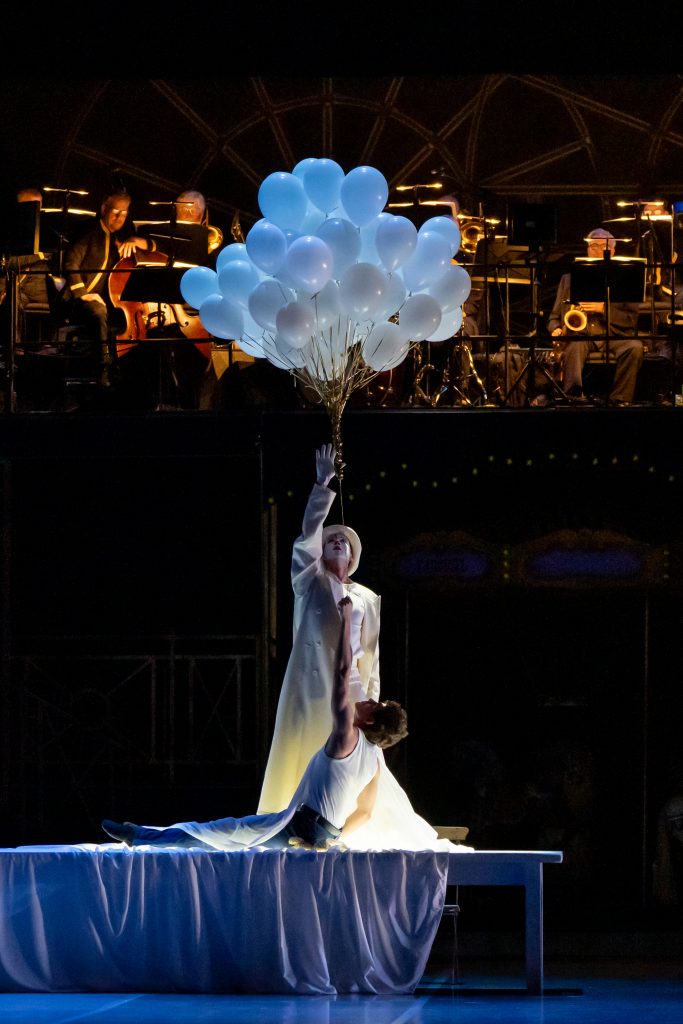
There will be the full orchestra in the pit, and there’s a grandstand construction at the back of the stage that’s part of the scenery with a jazz band playing. It’s a very layered, complicated score. This is a fairly new thing for us. We’ve had bands on stage, but this is on a much larger scale. There’s something beautiful about the duality of the lush orchestra score with this brassy band sound that evokes the era. It’s well used to delineate some of the characters and their motifs. It’s a beautiful score but also effective narratively.
Is there anything else you’d like to mention?
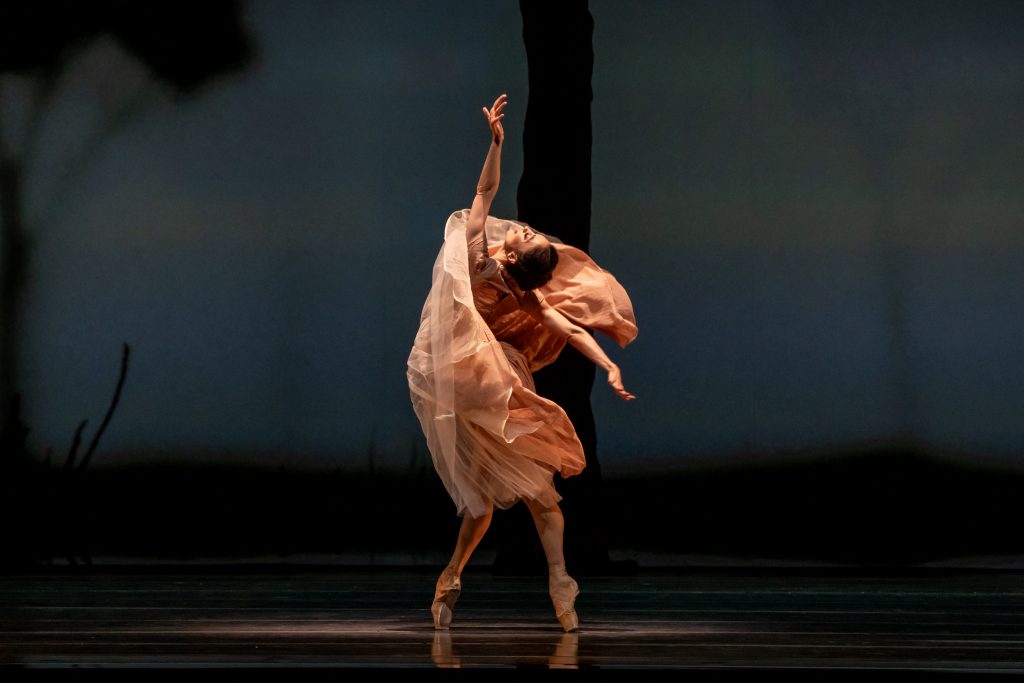
It’s going to be a really wonderful theatrical experience of not just pure dance but seeing their humanity with this beautiful set and costumes. The clown figures suggest symbolic images. And with the layered score and lighting to show the present time and purgatory, I think it’s a wonderful dance theater performance.
The Joffrey Ballet’s “Liliom” at the Lyric Opera House, 20 North Upper Wacker. September 17-27. Tickets start at $47. Tickets and info here.
Published in the print edition of the September 2026 issue, with the headline “The Meaning of the Movement: Into the Dark World of John Neumeier’s ‘Liliom’ with the Joffrey Ballet.”