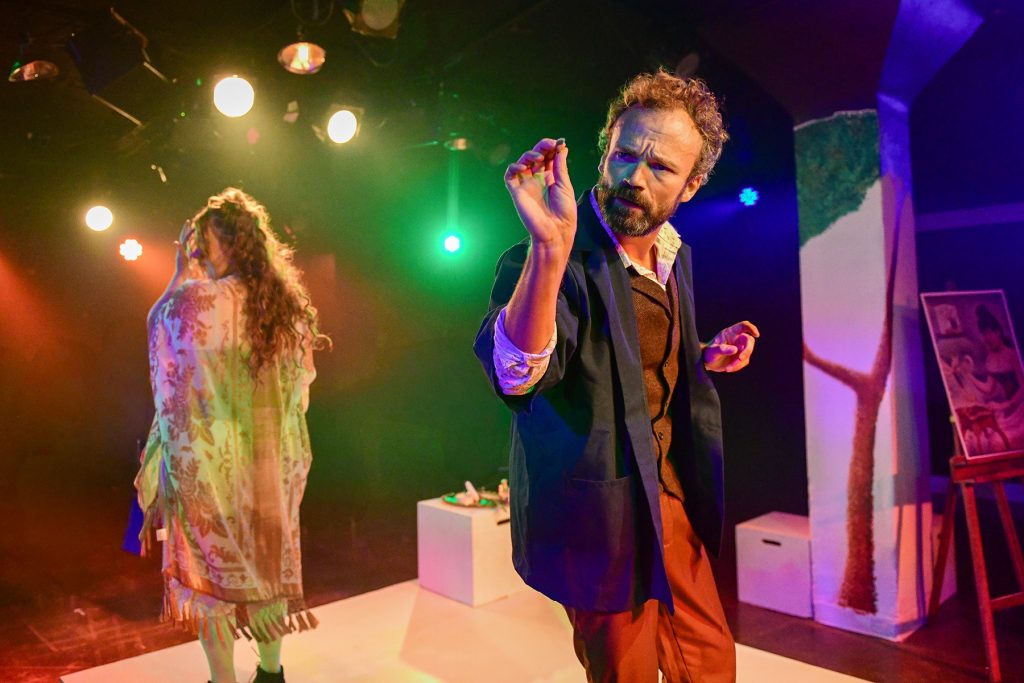
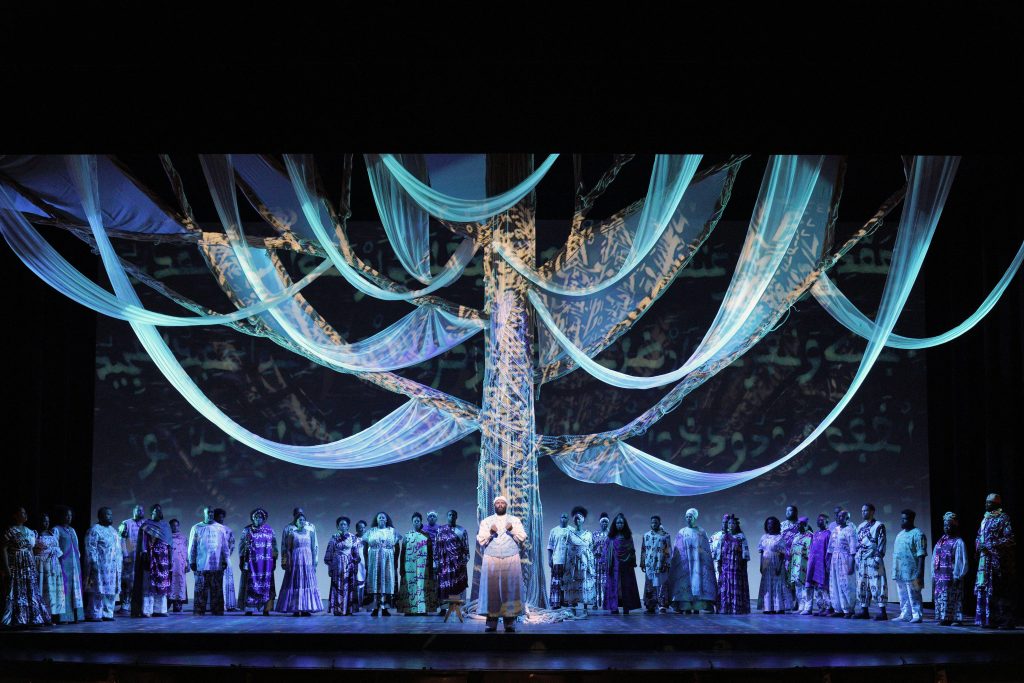
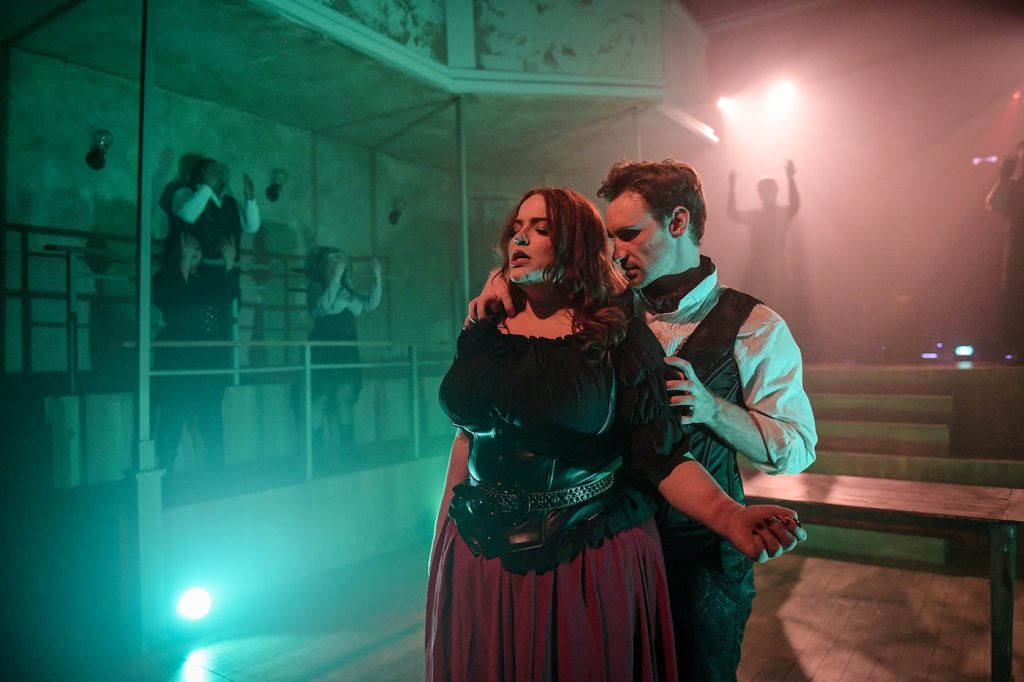
Kokandy Productions’ “Jekyll & Hyde,” with Kevin Webb, Ismael Garcia, Quinn Simmons, Maiko Terazawa, Emily McCormick, Ava Lane Stovall, Gabby Sauceda-Koziol and David Moreland/Photo: Evan Hanover
This story appears in our 2026 Fall Arts preview, featured in our September issue.
Kokandy Productions is experiencing a rise-to-superstar moment. In recent years they’ve consistently produced well-received shows and audience hits. This fall, their 2025 production of “Jekyll & Hyde” will move to Broadway in Chicago, while highly anticipated new productions like “Sunday in the Park with George” will take the stage as well. There’s some special ingredient in Kokandy’s recipe—can we sample it and discover the secrets of a successful Chicago storefront company?
Kokandy’s first musical production, “The Great American Trailer Park Musical,” was staged in 2012 at Theater Wit. Since then, they’ve produced fan favorites and award-winners alike, including 2022’s “Sweeney Todd” and last year’s “Amélie.” They’ve historically picked shows that do well in confined spaces, from the heartwrenching intimacy of “The Last Five Years” (2013) to the bloodbaths of “Sweeney” staged right in your face.
Kokandy became a “basement company” when they moved into Wicker Park’s Chopin Theatre from Theater Wit. Chicago storefront (or basement) theater, by its nature, is often produced in small and unconventional spaces, and equally often, the constraints of the space make the show what it is. The flexibility of the basement space is a major strength of Kokandy’s compact staging, an approach that’s made each show more inventive than the last.
“Control what you can control has always been my motto,” Scot Kokandy says. A production created within the limits of its circumstances becomes uniquely adapted from its source material. This is how Chicago gets its distinct productions: you have to work with the columns in the middle of your stage, so you integrate them into your show.
Company leaders Scot Kokandy and Derek Van Barham speak of audience entry points as a vital concern for selecting a season. “‘Musical’ is just such a buzzword for some people,” artistic director Van Barham explains, “and so there’s always going to be that audience.” This is especially true of shows that aren’t produced often, like “Jekyll,” and shows Kokandy approaches in a fresh or edgy way, like “Sweeney Todd.”
For non-aficionados, Kokandy looks for entry points to convert audiences to musicals, even when patrons don’t think the genre is for them. Executive producer Scot Kokandy is convinced everyone loves musicals—they just don’t know it yet. Some shows are admittedly easier to make converts with: “I love that we were able to get so many people into the theater for the first time for a show like ‘American Psycho’ and then get them to come back the next season for ‘Into the Woods,’” Van Barham says. “That tickles me.”
When asked how he got invested in Kokandy, Van Barham mentions their productions of “Heathers,” a Chicago premiere and milestone for the company, and “The Last Five Years,” which was staged at Theater Wit as a “dueling pianos” production. The two main characters “basically underscored each other through the whole show,” Van Barham says. “They were like full-on Billy Joel, Elton John-style playing at the same time.” The production was one of those inventive takes on a familiar show. “Heathers” was an on-brand Kokandy production to Van Barham, too: a bit dark, a bit weird and all enticing.

Ava Lane Stovall, Ismael Garcia and Quinn Simmons (front, top to bottom) with the cast of Kokandy Productions’ production of “Jekyll & Hyde”/Photo: Evan Hanover
“Jekyll & Hyde” is similar. Robert Louis Stevenson’s drippy Gothic novel of good and evil serves as the backbone for Frank Wildhorn’s legendary and over-the-top score. Actor Ava Stovall, who plays Lucy, calls it an “earth-shattering sound output with diverse vocal textures: an operatic quartet, a soft nineties love song, an orchestral rock fusion with full-ensemble harmonies and a face-melting power ballad all in one night.”
“Jekyll & Hyde” has long held cult status despite going largely unproduced for years. For Scot Kokandy, it is a bucket-list show. “It was the first show I saw on Broadway on my first trip to New York when I was eighteen,” he says. “I still have the ticket. I saw it on July 24, 1998, almost twenty-eight years to the date.
“In 1999, composer Frank Wildhorn made history by becoming the first American composer in twenty-two years to have three shows running simultaneously on Broadway,” Kokandy says. “I have loved the music ever since. It would be a soundtrack I would listen to often for years after seeing the show.”
“Jekyll & Hyde” also has die-hard fans in Kokandy’s audience. “Watching people get to experience it live, I think, is akin to seeing people get to see their favorite band in town for the first time in ten years,” Van Barham says with a smile. “For so many people, that show has existed as a cast recording for twenty years with no chance to really experience it live and in person. I would sit on those side steps next to the audience bank at least once a week and just watch people sing along, fully crying, standing ovations mid-show for some of those big bouncy numbers. It was like being at a rock concert.”
Performing as Lucy was a dream for Ava Stovall, too. “I found a great deal of commonality between her and myself when I first watched the show at a young age,” she says. “And she quickly became the role I most wanted to play.”
“Lucy is one of those roles that lets you do a little bit of everything,” Stovall continues. “The material is incredibly challenging for multiple reasons, and as an actor, that’s always fulfilling. She’s a difficult track. The score is a beast—the emotional burden can take you out if you’re not careful, and the physical demands are greater than one might expect. She was an incredible teacher.”

David Moreland and the cast of Kokandy Productions’ production of “Jekyll & Hyde”/Photo: Evan Hanover
Because of the challenging score and the devoted audience of “Jekyll & Hyde,” the Kokandy team decided their production couldn’t be stripped down, as many storefronts might do for budgetary and space reasons. It instead needed a full orchestra, a feat attempted even by fewer and fewer traveling Broadway shows. And, they said, why not go bigger— “Jekyll” would be a good opportunity to try something in Chopin’s upstairs theater, which has thirty more seats than Kokandy is used to filling. It was a gamble. As Kokandy says of the decision, he “hoped it worked, or at a minimum didn’t kill us.”
“We weren’t walking into this production hoping for commercial success,” says Stovall. “We walked in with a tangible hunger to create something horrifying and exciting and heartbreaking and sexy and fun. So maybe that was it: a willingness to go there. If you’re going to do ‘Jekyll & Hyde,’ you have to go there.”
The risks paid off. “The audience reaction after the show was as if they just got off a roller-coaster and wanted to get in line and go again,” Kokandy says. Some of those audience members were Broadway in Chicago staff who were cheering on their friends in the production. After an enthusiastic meeting, “Jekyll” was given a second life in this fall’s Broadway in Chicago subscription series. The commercial producer has some history of working with other Chicago storefronts, including Porchlight and Timeline, showing the interconnected nature of Chicago’s theater scene even at different budgetary levels. Everyone’s seeing everyone’s work at some time or another, and this leads, naturally, to collaborations—even at the scale of the resurrected “Jekyll.”
From the outside, it looks like Kokandy’s spreading out, but Scot Kokandy doesn’t feel “Jekyll”’s extended life changes the company in any fundamental way. It’s just another run of a great show. “Jekyll” did elevate their ambition for scale, however, and two of this year’s productions—”Hair” and “A Clockwork Orange”—will run upstairs at the Chopin. At one point, Kokandy Productions will have three shows running simultaneously, just like Frank Wildhorn. “That is wild to me,” Kokandy says gleefully. “Scary and fun and just wild!”
Since expectation and production-scaling happens show-by-show, for Derek Van Barham it isn’t so much a “what’s next” for Kokandy but a “what’s now?” “In this moment where it feels like we could be growing in certain ways, we’re just looking at each production as how it might challenge us,” he says. “When a show is successful, there’s the question of what is growth going to look like? And I feel like there is constantly an ask of, how does a storefront get bigger? Do we want to jump to Equity? Do we want to move into a bigger space?”

David Moreland and Kevin Webb with (back, l to r) Quinn Simmons and Ismael Garcia in Kokandy Productions’ production of “Jekyll & Hyde”/Photo: Evan Hanover
“The scale we’re usually doing it at, ‘Jekyll’ aside, I think is such an important part of the Chicago landscape for musicals, for plays, for dance,” says Van Barham. “I love this corner of the community.” “Jekyll”’s run at Broadway in Chicago is a huge opportunity to turn audiences from the big stage toward smaller ones, and onto a different scale and community of artists, by interesting them in work they don’t otherwise see: work specific to Chicago’s ecosystem. For Ava Stovall, the opportunity of breaking into that audience with the Broadway in Chicago run is “completely and utterly surreal…I don’t have the vocabulary to adequately convey how special it is.”
For Kokandy’s staff, internal success is all about transparency, communication and remembering what makes their company unique. “We work hard while being sure to enjoy the ride,” Scot Kokandy says. “I think especially post-pandemic, all of us were having our internal ‘Do I want to go back to the grind of having a full-time job and then rehearsing nights and weekends?’” Van Barham says. “A different value has been placed on our energy and time. In storefront [theater], nobody’s making enough money. Obviously we’re all here because we really want to be here. So let’s make the hours that we’re spending together fun. If the thought of going to rehearsal is making people miserable, then I’ve messed up in some way.”
This approach works both onstage and off: “the cast grew incredibly close, [and] so many of my favorite moments happened backstage with my friends,” Stovall confirms. “Kokandy’s greatest strength—namely, the people who helm it—is the equal importance they place on both the art form itself and the well-being and joy of the artists creating it. To work at Kokandy is to collaborate. To create. To play. It makes you feel like a kid again, standing in your imagination’s playground alongside a room full of people who are just as excited to play as you are.”
Van Barham’s explanation for audiences returning to theaters after a time of social isolation is similar. “I was struck by sporting events and concerts and dance, you know, people were going out. It was just not going out to sit and watch something happen at them.” Instead, companies like Kokandy have needed to create immersive, unforgettable experiences by maintaining the close proximity of artist and audience. For Kokandy, this was always a priority, and it gave them a leg up.
“Art must be accessible,” Stovall says. “A production’s budget will never define its potential for success or its capacity to make an impact. I’m confident that any theater has the potential to create the kind of work Kokandy does. It begins with an audience member seeking passion and not budget.”
“It feels so special to what happens in Chicago, what happens at the storefront level, where shows aren’t happening at you. They’re happening with you,” says Van Barham. “You know, we’re in real time and space. We are in the basement of the Chopin, and this really fucking cool thing is happening because you’re in the room here for it.”
“Otherwise, why are people getting off their couch?”
Published in the print edition of Newcity’s September 2026 issue.