
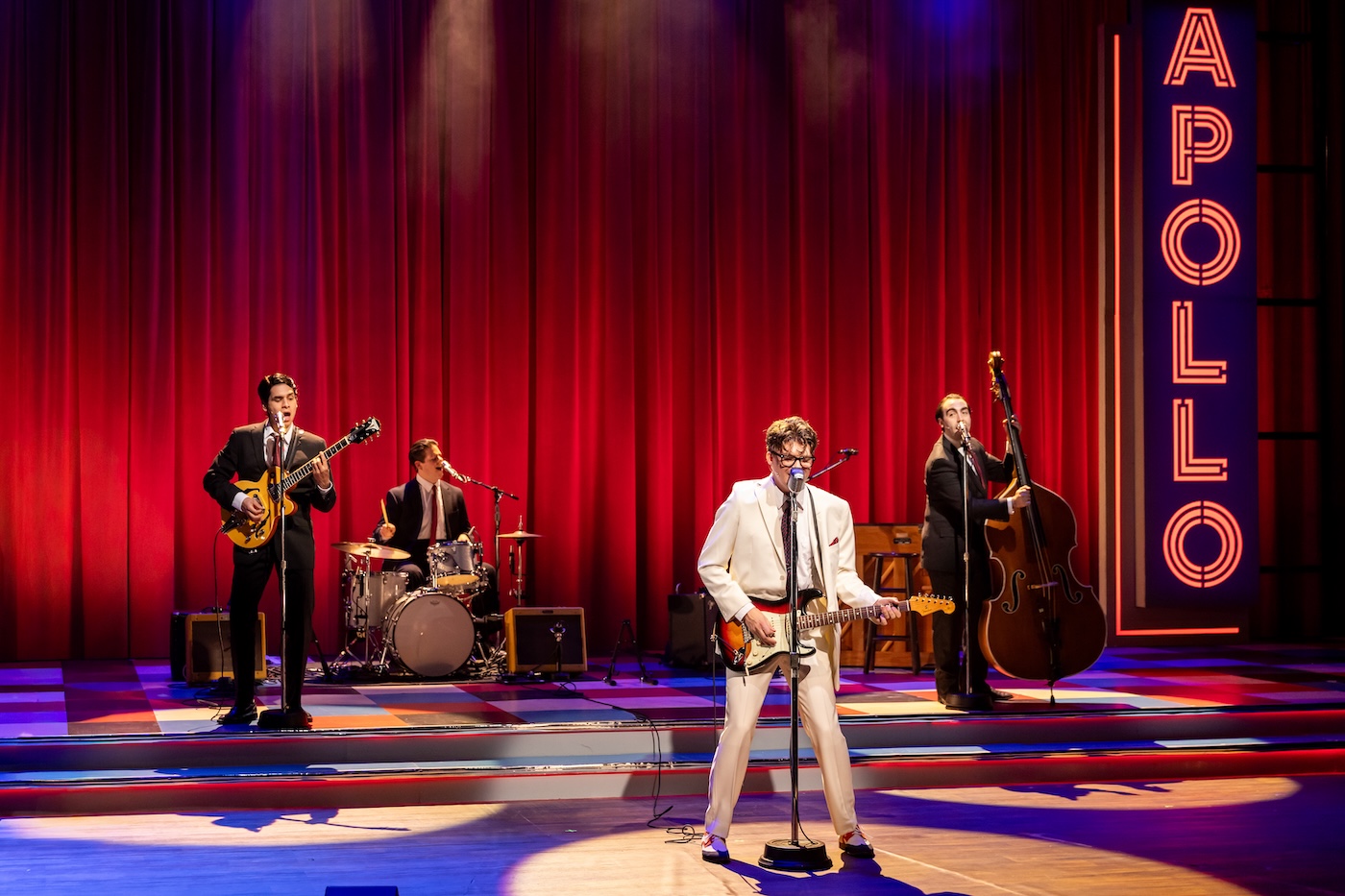
Drury Lane Theatre presents “Buddy — The Buddy Holly Story,” with Elliot Coe Esquivel, Alek Boggio, Joey Chelius, Grant Alexander Brown/Photo: Kyle Flubacker
RECOMMENDED
If one did not get the chance to see Buddy Holly perform before his unfortunate death at the age of twenty-two, now’s the chance. “Buddy—The Buddy Holly Story,” running through October 18 at Drury Lane Theatre, is as much a concert as it is the biographical telling of the rock ‘n’ roll icon’s short but prolific music career.
“Buddy” is a two-act musical written by Alan James which first premiered in 1989. This “Buddy,” directed by Drury Lane’s Artistic Director Matthew D. Carney, retains the property’s electric energy. Joey Chelius plays the titular role with verve and pizzazz, resembling the more rollicking Buddy Holly seen in rare footage of live concerts than the more reserved impression made on Ed Sullivan.
Over the course of more than twenty tunes—including the hits “Peggy Sue,” “Oh Boy,” “That’ll Be The Day,” “Not Fade Away” and “Maybe Baby”—Chelius nails Holly’s vocal prosody, slurring, squeaking and hiccuping while simultaneously shredding the strings of his crystalline-sounding Stratocaster. Backed up by his band, “The Crickets”—played by Alek Boggio (drums), Grant Alexander Brown (upright/electric bass) and Elliot Coe Esquivel (rhythm guitar)—it feels natural to get on one’s feet during a post-story encore.

Drury Lane Theatre presents “Buddy—The Buddy Holly Story,” with Joey Chelius and Samantha Sayah /Photo: Kyle Flubacker
The narrative moves briskly, singling out key moments in Holly’s artistic evolution. Buddy is led through his journey by an assortment of twentieth-century male archetypes. “Hipockets Duncan,” a well-meaning disc jockey; “Norman Petty,” an open-minded record producer; and a spunky journalist—all played by Russell Mernagh—are set up as foils against Holly’s unique, bombastic nature. One sees Holly transition from gritty rock ’n’ roller to a cleaner pop sound, symbolized in the decision to include the memorable chime-toned celesta while recording the song “Everyday.”
Holly’s universal appeal is reflected during a potentially ill-fated booking at the Apollo Theatre in Harlem—before Holly can win over the discerning audience, the theater’s hosts, played by Marta Bady and Eric Andrew Lewis, treat the congregation to a foot-stomping rendition of the Isley Brothers’ “Shout” that threatens to rock the large red neon “Apollo” logo sign right off its hinges.
Touching are the scenes with Holly’s wife, Maria Elena Santiago Holly, a woman of Puerto Rican descent, played by Samantha Sayah. The backlash that Holly received for not marrying a white woman is alluded to briefly, but the focus is on her as a muse for Holly. Holly stays up all night to compose the song “True Love Ways” for her, perhaps his most tender lyric and melody.
“Buddy—The Buddy Holly Story” captures the lightning-in-a-bottle intensity of one of America’s greatest pop-music legends. The story of a young underdog who balks against conformity is nothing new but is nevertheless inspiring. Like Holly himself, the focus of the production is on the music, and the backstory one receives greatly enhances and refreshes these already well-beloved songs.
“Buddy—The Buddy Holly Story” is on stage at Drury Lane Theatre, 100 Drury Lane, Oakbrook Terrace, through October 18.


