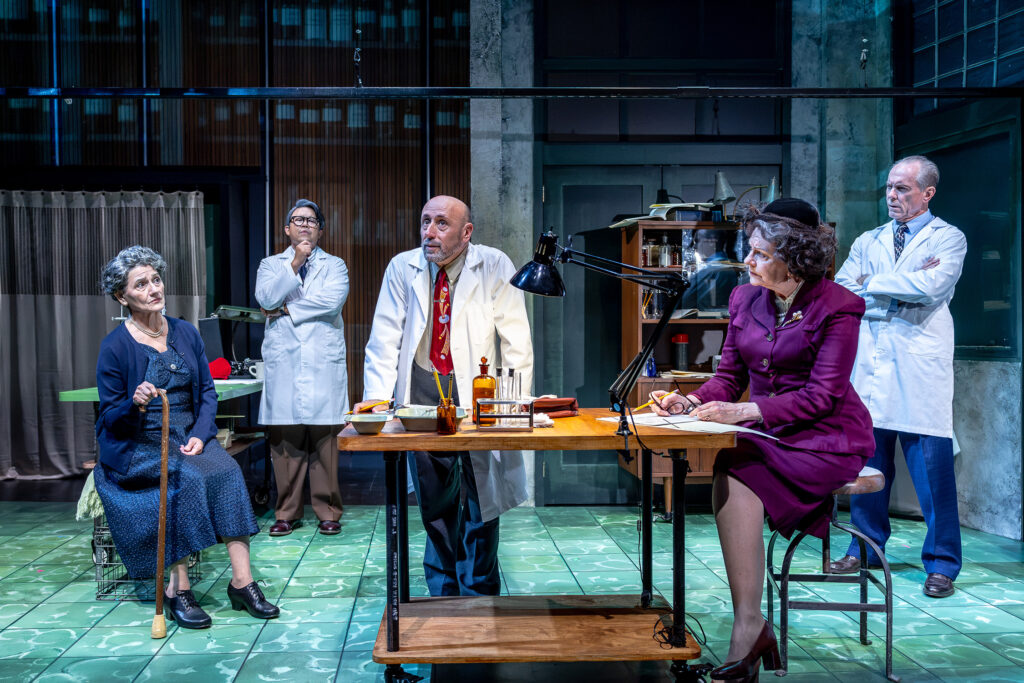
Cast of “The Birth of the Pill”/Photo: Brett Beiner
“Revolutions come into the world like bastard children—half improvised and half compromised,” quips Benjamin Franklin in the musical “1776.”
He was talking about the American Revolution, but the line also could apply to one of the most important inventions of the twentieth century—the birth control pill. Being able to prevent pregnancy helped women to pursue education and careers, and to enjoy sex without worrying about the risk of an unplanned child.
Contraception before the 1960s was illegal, so developing the pill took courage and ingenuity. And the invention came with a shadow side—early versions were tested on women in Puerto Rico who weren’t informed of serious side effects. And Margaret Sanger, one of the pill’s champions, had unsavory ties with the eugenics movement.
Chicago author Jonathan Eig’s 2014 book about this fascinating history, “The Birth of the Pill,” is now a play getting its premiere at the history-focused TimeLine Theatre. Written by Jessica Huang and directed by Sandra Marquez, the play grapples with both sides of the pill’s story—the ingenuity of its inventors and the suffering of the women who took the trial dosages, which were up to one hundred times stronger than modern pills.
The play is informative and often funny, with a strong cast that includes Chicago theater stalwarts Janet Ulrich Brooks as Sanger, Mary Beth Fisher as Katharine McCormick, the feminist millionaire who funded the research, and Mitchell J. Fain as Goody Pincus, the controversial doctor chiefly responsible for the pill’s invention.
However, the script sometimes felt less like a theatrical story than an entertaining lecture, and its tone is uneven. The material feels better suited for a documentary film than a play.
“The Birth of the Pill” starts with a fictional character, Ramona Delgado, a Puerto Rican woman who was part of the pill trials, played by the highly charismatic María Victoria Martínez. As Delgado, Martínez acts as the show’s Mistress of Ceremonies, while also playing other characters—a maid, a lab assistant and TV interviewer Mike Wallace.

“The Birth of the Pill,” (left to right) Mitchell J. Fain and Janet Ulrich Brooks/Photo: Brett Beiner
Delgado narrates the action; she can snap her fingers and freeze a scene to explain it. These snaps, which came with a sound effect like the magical blink in “I Dream of Jeannie,” were cute at first, and then got annoying.
The play includes some excellent material—especially the scenes between Sanger and McCormick, who became friends during the suffrage movement. McCormick decides to use the money she inherited from her wealthy and schizophrenic husband (heir to the International Harvester fortune) to fund the pill. Both Fisher and Brooks are brilliant as these quirky, complex women, who are beyond caring what society thinks of them. It would be fun to see a play just about their relationship.
Also terrific are the scenes between Pincus and John Rock (played by TimeLine company member David Parkes). Rock is a Catholic doctor who had been treating women with fertility problems and decided to participate in the pill research. We first meet Rock in a locker room, unabashedly naked. This is a man who rejoices in nature and is the most cheerful warrior on the pill team.
Less successful are the scenes with researcher Min Chueh Chang (Rammel Chan) in the lab, testing progesterone on rabbits and rats. Chan is sympathetic and convincing, but it’s hard to make repetitive lab tests look exciting, and this sequence goes on too long. The best part was learning that a bunch of rabbits is called a “fluffle.”

“The Birth of the Pill,” (left to right) Janet Ulrich Brooks and María Victoria Martínez/Photo: Brett Beiner
The play starts with wacky comedy and ends with a serious conversation. In the final scene, Delgado confronts Eig (Fain) about his telling of the pill’s story, and how he didn’t give enough space to the suffering of the Puerto Rican women. It is earnest but fits awkwardly with the rest of the play. This may be because we really don’t know Delgado as an individual, despite Martínez’s energetic performance.
The show tries to do too much in ninety minutes. It talks about serious science and politics, while also being wacky, while also debating the way history is told, while also exploring a sad story about eugenics and exploitation.
It’s important to bring attention to the fight for women’s freedom to choose their biological destiny, especially now that women’s rights are increasingly being denied in the United States. But despite its good intentions, “The Birth of the Pill” doesn’t quite work as theater.
“The Birth of the Pill” at TimeLine Theatre, 5035 North Broadway, through October 4.