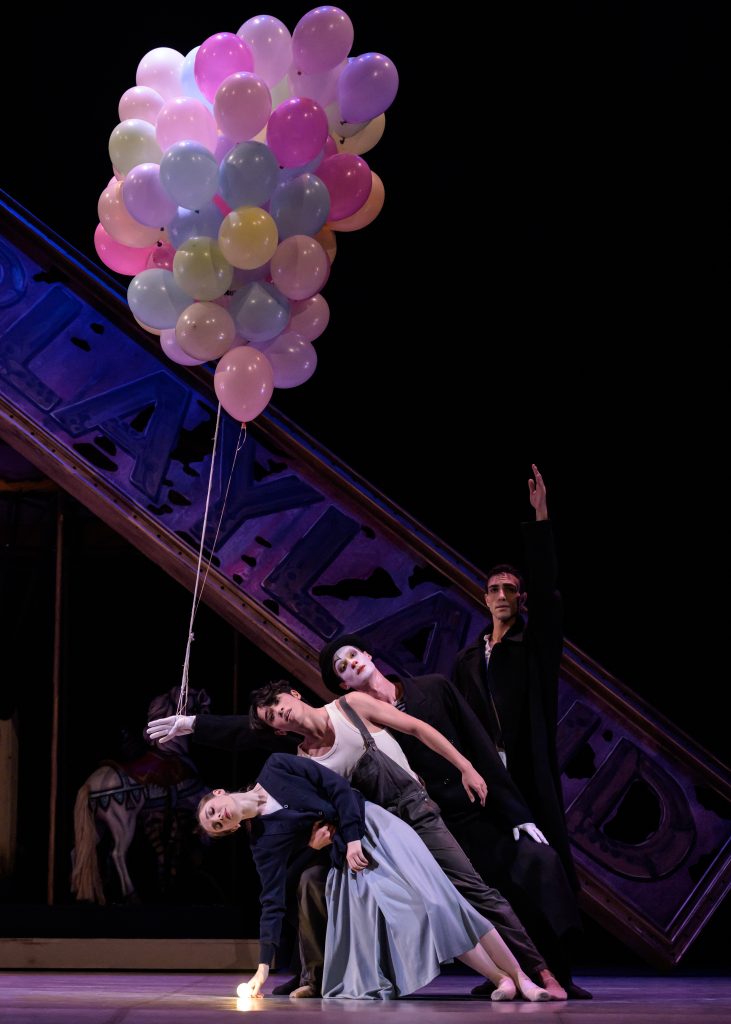
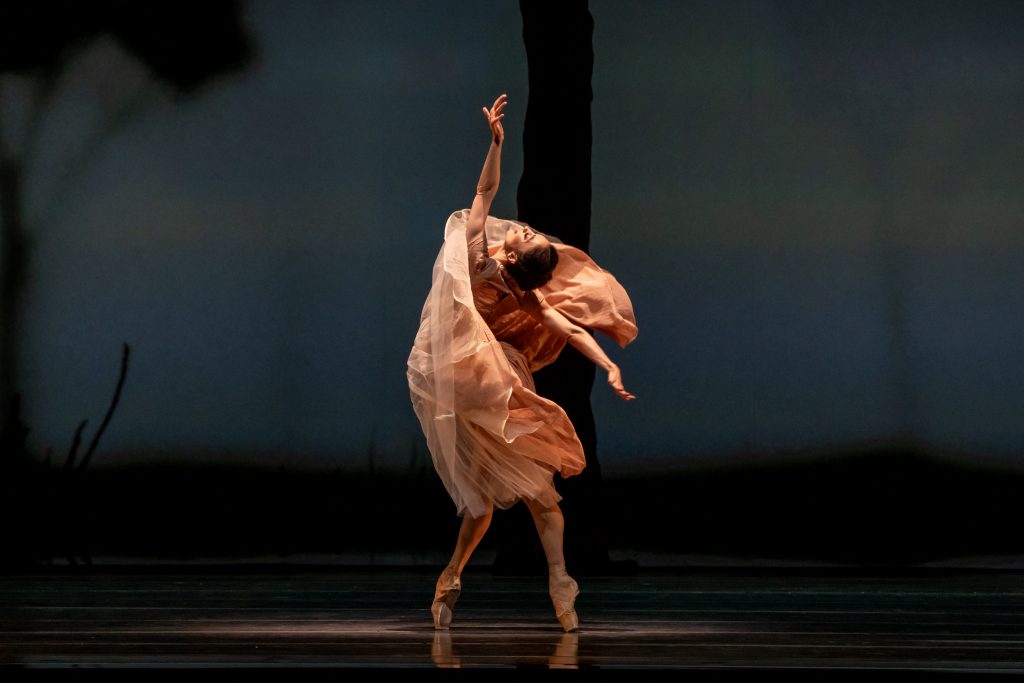
Gayeon Jung in the Joffrey Ballet’s “Liliom”/Photo: Cheryl Mann
RECOMMENDED
Dance is the most direct form of artistic communication from human to human, “because we [the choreographer and the audience] use the same instrument,” remarks choreographer John Neumeier in a recent documentary. That view of the medium is key to his masterwork “Liliom.” The ballet, which the Joffrey Ballet is performing at the Lyric Opera House, through September 27, quickly unfolds into big and busy scenes, achieving a cinematic scope amplified by the Lyric Opera Orchestra in the pit—conducted that evening by Nicholas Koo—and, suspended above the action, the sixteen-piece Rob Parton Big Band, both performing Michel Legrand’s score.
The Joffrey, whose repertory includes several Neumeier ballets, is the first U.S .company to stage “Liliom,” which is based on Ferenc Molnár’s 1909 play that inspired the musical “Carousel.” This stunning visual production, with sets by Ferdinand Wogerbauer, quickly pulls us into the colorful yet tawdry landscape of a Depression-era carnival, as the action unfolds in this dark tale. And, as expected at this company, we consistently see top-notch dance technique—not least in a scene shortly before intermission, where a huge male ensemble dances in powerful unison to protest their joblessness.
But it’s the ballet’s very first moments—when Evan Boersma, cast throughout the run as the death figure Balloon Man, transforms a ballet-trained body into something other worldly—that should set our expectations. In the universe Neumeier creates, every movement, whether it’s a gestural hand striking or a fabulous arabesque extending, springs from the same place: creative expression. And it’s the dancers who access that unified source that capture our attention.
At the September 18 performance, the cast (there are three total) is led by Valentino Moneglia Zamora as the bad boy carnival barker Liliom, and Gayeon Jung as his innocent love interest Julie. Each of these beautiful dancers breaks through to the essence of their character at times. Zamora is showy yet shallow; toward the end of the ballet, Jung’s mournful solo that follows her lover’s suicide culminates in seemingly endless cambrés derrieres, compelling backbends that threaten to break her. But through most of the ballet, their duets lack the chemistry that is evident in the dancing of a happier couple, Lauren Quinn as Julie’s friend Marie and Xavier Núñez as her fiancé, then husband, Wolf. Maybe that problem is baked in: It’s only after Liliom’s death that he and Julie are truly able to connect. Yet in this cast it’s Hyuma Kiyosawa, as Julie and Liliom’s son, Louis, whose characterization most ably and consistently embodies the dark drama at the center of the story. His every move, whether he is smacking the air in frustration or leaping through it with boyish enthusiasm, emanates from a single, heartfelt identity.
The story spools in a loop: in the prologue, Liliom briefly returns from purgatory and tries to gift a shining star to his disillusioned son, who rejects it. In the end, the scene recurs and Julie retrieves the star. As the curtain descends and our imaginations slowly return to the realistic, contemporary world, she is still sitting alone with her memories. Many plot twists occur in between, and audiences can benefit from the program’s scene-by-scene synopsis as they navigate Neumeier’s fascinating world.
The Joffrey Ballet’s “Liliom” at the Lyric Opera House, 20 North Upper Wacker, through September 27. Tickets start at $47. Tickets and more at joffrey.org.