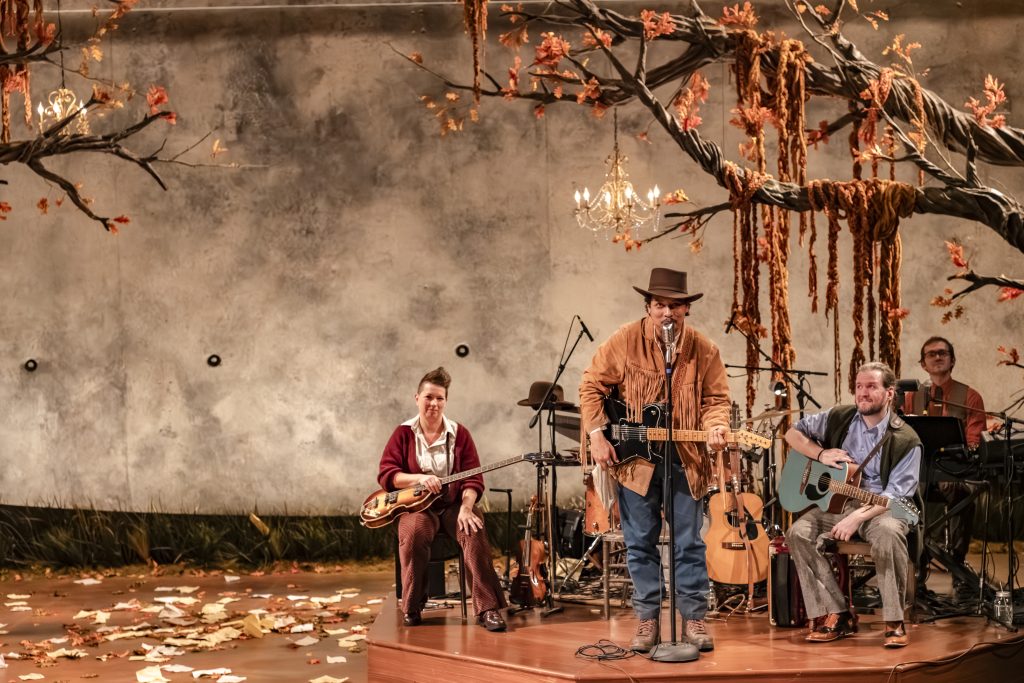
Writers Theatre presents “Two Sisters and a Piano,” with Neysha Mendoza Castro, Andrea San Miguel and Adam Poss/Photo: Michael Brosilow
RECOMMENDED
In 1991, the collapse of the Soviet Union plunged the nation of Cuba into a massive economic depression. Cut off from their benefactors, Cuba descended further into a military state, where the strict rationing of food was compounded by a distrust between government and citizens. It is within this atmosphere of desperation and paranoia that the play “Two Sisters and a Piano” is set, running through March 29 at Writers Theatre.
The play is historical fiction about a writer and revolutionary, Maria Celia (Andrea San Miguel), serving house arrest with her musically inclined sister, Sofia (Neysha Mendoza Castro), and both under constant surveillance by the state. Directed by Lisa Portes and written by Pulitzer Prize-winner Nilo Cruz (“Anna in the Tropics”), the story explores themes of disparate power dynamics between men and women, the individual and the state and the struggle between heart and mind to accept love from one’s enemy.
The location and setting is not at once apparent, and it takes a bit of time before the flesh of the play is exposed. The play begins in media res, with soldiers ransacking a house and terrorizing the two women, and from there the audience is left to piece together why persons with Spanish accents are speaking about Mikhail Gorbachev—it is recommended that one reviews the history presentation on the television screen in the lobby before the performance.
What is apparent from the beginning is a pervading dichotomy of beauty and decay. The setting is magnificent, taking place in the spacious salon of a large, colonial-style mansion with a high balcony overlooking the ocean accessible via a spiraling iron staircase. But everything is in decay. The sisters’ radio has gone kaput. The family piano is out of tune and rotting. The sisters themselves are diminished, isolated from society after serving a prison sentence for Maria Celia’s revolutionary writing. The younger Sofia is burning herself up with desire to meet men, go outside, be anywhere but here, while Maria Celia pines for her estranged husband, a revolutionary who managed to escape and whose letters to her have been seized by the state. What were once lives of wealth and opulence now dwell inside a wretched reminder of the past, a reflection of the degradation in their own souls.

Writers Theatre presents “Two Sisters and a Piano,” with Arash Fakhrabadi/Photo: Michael Brosilow
Despite the slow-burning beginning, things heat up in the second act, which dives into the struggle between hierarchies of power. Maria Celia is tortured by the lack of communication with her husband, a fact taken advantage of by the roguish and handsome Lieutenant Portuondo (Adam Poss), who, in a deliciously wicked ruse, seduces her by reciting erotic poetry from her husband’s letters, meting them out one at a time like a palliative morphine drip. He is both man and the state, and she in her melancholy and status as woman is nigh but powerless against his advances.
Sofia does meet a man—a plucky piano tuner named Victor Manuel (Arash Fakhrabadi). Their hormones align, but in a short soliloquy Victor admits that he is too scared of state surveillance to return, instead riding his bicycle past her house in hopes that she might chance to glance out of the window. He is a man, and free, but is subordinate to the state, adding another layer to the disparate power dynamics of post-Soviet Cuba.
Once the ball gets rolling, “Two Sisters and a Piano” is an irresistible force. The play does what historical fiction does best: it informs one about an important era in history from the perspective of the people who lived it. A high-stakes political thriller laden with romantic suspense, “Two Sisters and a Piano” hits the right notes.
“Two Sisters and a Piano” runs through March 29 at Writers Theatre, 325 Tudor Court, Glencoe. Tickets are $35-$95, available at writerstheatre.org.