
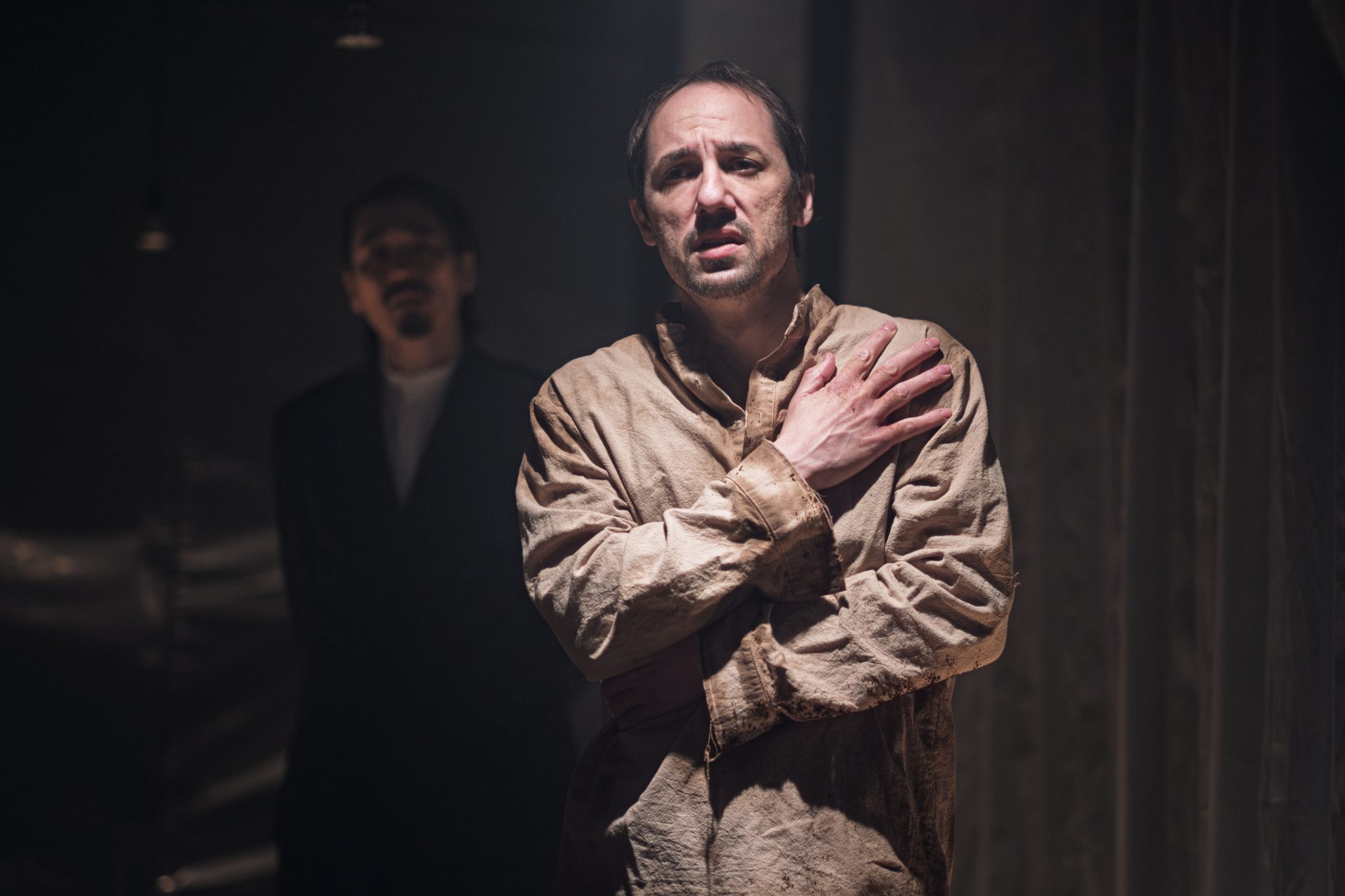
TUTA Theatre’s “Crime and Punishment,” with Huy Nguyen and Clifton Frei/Photo: Logan and Candice Conner, Oomphotography
RECOMMENDED
Russian novelist Fyodor Dostoevsky (1821-1881) has been called a superb master of plot structure and merciless dissector of the psychology of evil. A twenty-first-century adaptation of Dostoevsky’s “Crime and Punishment,” on stage at TUTA Theatre through June 28, gives audiences an opportunity to meet one of the most famous murderers of late modern literature. Directed by Jacqueline Stone, this adaptation by Marilyn Campbell and Curt Columbus is a ninety-minute stripped-down version, requiring one to pay close attention to the intricate system of philosophy that drives the plot.
“Stripped down” might be an understatement. In the novel, the protagonist Raskolnikov lives in a dirty, rundown apartment, and wears clothes that attempt to be fashionable but are old and decrepit. In the play, his condition is even more abominable. Clifton Frei plays Raskolnikov as steadily grim and tapers the swings of mood exhibited by his literary counterpart—although there are some “swings” of a knife. He is dressed not in dilapidated formal wear but in peasant clothes. His apartment is a twisting corridor with nothing but brown, fragrant dirt as his furniture, and long “staircases” are suspended above his head to imply the sense of vertigo that he occasionally gets while mounting the steep, winding flight of steps of his Saint Petersburg tenement. Set design by Tatiana Kahvegian and Keith Parham cast Raskolnikov as an animate corpse residing in a fresh grave, one of the most pathetic characters of literature made even more wretched.

TUTA Theatre’s “Crime and Punishment,” with Felix/Photo: Logan and Candice Conner, Oomphotography
The abbreviated story cuts two ways. Only the scenes that directly inform Raskolnikov’s philosophy—akin to Nietzsche’s theory of the will to power—are included. Huy Nguyen plays detective Porfiry, who either feigns interest in Raskolnikov’s “Napoleon complex” or is genuinely curious. Regardless, Nguyen’s warm smile and flashing eyes make one forget that he is actively pursuing Raskolnikov for the murder of an elderly pawnbroker and her younger sister. Nguyen embodies the soul of Porfiry and pulls double duty as the affable drunk Marmeladov, one of the few secondary characters to make an appearance.
TUTA associate company member Felix plays Raskolnikov’s love interest, Sonia, an archetype for the prostitute with a heart of gold. Daughter of the drunkard Marmeladov, she is forced to sell her body to support her family yet remains devoutly Christian. Felix is striking in the role, the dim overhead lights making their deep-set eyes resemble the black, empty sockets of a skull. Their costume, a long, white, ironically virginal gown and a cross hung around their neck, stand in sharp contrast to the hellish, graveyard-like setting. Fortunately, two major scenes between Sonia and Raskolnikov are left more-or-less intact, essential for understanding the former’s turn to salvation in the story’s denouement.

TUTA Theatre’s “Crime and Punishment,” with Huy Nguyen and Clifton Frei/Photo: Logan and Candice Conner, Oomphotography
A fan of the novel may struggle with the omissions, with characters like the lovable Razumikhin, the “Übermensch” Svidrigailov and Marmeladov’s consumptive wife, Katerina, left on the cutting-room floor—these characters elicit impressions of deep pathos, philosophical insight and raucous comedy, and the play feels claustrophobic and cloying with their absence. Those unfamiliar with the story will need their wits about them to decipher Raskolnikov’s complex philosophy of how great men may ignore social and legal constraints to achieve their goals. But the adaptation is adeptly written, and diligent newcomers may experience a reverse reaction to fans of the original work—that this synopsis lays the foundation for one to dive into the novel with abandon, the finer theoretical points already internalized.
TUTA’s “Crime and Punishment” succeeds in presenting a version told through the protagonist’s eyes, not Dostoevsky’s. Raskolnikov is a notoriously unreliable narrator, but Frei’s portrayal is less deceptive, his face giving away the emotions that are hidden on the page. Here lies a more honest Raskolnikov. It might be a crime not to check out this nimble adaptation of the literary classic.
“Crime and Punishment” is on stage at TUTA Theatre, 4670 North Manor, extended through August23. Tickets are available at tutatheatre.org.


