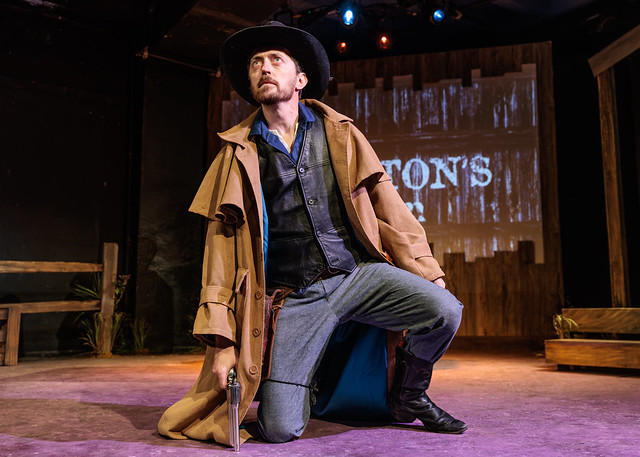
Michael B. Woods (Shane)/Photo: Steven Townshend
RECOMMENDED
To do “Shane” on stage, you won’t be able to have real horses or wide Western vistas. But you do need a great Shane, and City Lit Theater scored big with Michael B. Woods. A past Jeff award winner, Woods looks and acts so much like the lonesome mystery man of the classic Western that he could be a tintype in a Ken Burns documentary. He’s slim and tall with an intense, blue-eyed stare and a slow, deliberate way of speaking—the way he drawls out the word “millinery” is one of the show’s many wonders.
Dressed in a broad-brimmed black hat, Woods conveys the gunfighter’s vast interior pain under his reserve. This may be sacrilege, but I think Woods makes a better Shane than Alan Ladd did in the 1953 movie—Woods’ performance is grittier, more a piece of the mythic past.
Director Mark Pracht adapted this “Shane” not from the movie but from the original 1949 novel by Jack Schaefer. In program notes, Pracht says he started working on an adaptation about twenty years ago but put it in a drawer and didn’t revisit it until last year. Pracht says that the concept of manhood has now been weaponized, with the “manosphere” making masculinity into a reason for cruelty and domination. In “Shane,” Pracht instead presents his heroes as hard-working men who respect others, while knowing that there is a time when you can’t back down.
“Shane” is about how a stranger with a past that clearly involved violence comes to stay with a homesteading family and helps defend them against a rancher who wants to take their farm.

Ross Childs (Curly), Jay Donley (Wilson), Michael B. Woods (Shane)/Photo: Steven Townshend
As in the novel, the story is told by Bob Starrett, the young son of Joe, who’s the leader of the local homesteaders. The adult Bob tells the story, and both the adult and the child Bob are played by Bruce Holtman. He’s a good choice, as he has the soft features of an overgrown boy and moves like one, with his sudden quick dashes around the barnyard. His portrayal is both humorous and tender. My one quibble is that he went through some of the narration segments too fast and words got lost. He doesn’t have to be as deliberate as Shane, but we do need to understand him.
Since this is a small theater with a small budget, Jeremiah Barr’s set must lean hard on the audience’s imagination, and it’s effective. There are just a few pieces of rough furniture—a table and chairs, a front porch, fence posts and farm tools. The “saloon” is a bar just big enough for two men to lean on. Projections on the back wall by G. “Max” Maxin IV provide a sense of space, showing sunsets and shadowy silhouettes representing action in the distance. Some of the projections seemed hokey at first. But they gain in power as you become familiar with the visual language, and by the end you could imagine an actual Wyoming horizon beyond the fence posts. Sound designer Petter Wahlbäck provides the right atmosphere with soaring string music, axes hitting wood and insects singing.
Another major component of the show is stage fighting, which is tricky in a small space but brilliantly choreographed by Rick Gilbert and Victor Bayona. The violence looked real enough to make the audience gasp, especially a scene in which a character’s arm is broken.

Josh Odor (Joe Starrett), Whitney Minarik (Marian Starrett), Bruce Holtman (Bob Starrett)/Photo: Steven Townshend
The cast is strong. Jay Donley does a fine job playing both a cheating salesman and a dandified gunfighter—examples of what a real man isn’t. Sean Harklerode is good as the bullying rancher, a man who tramples the rights of everyone in the name of business. He’s the opposite of big-hearted homesteader Joe Starrett, portrayed in a nicely detailed performance by Josh Odor. Other well-executed Western types include Ross Childs as a crude and cowardly henchman and Chuck Munro as the nervous bartender who just wants his expenses repaid.
Whitney Minarik plays Marian Starrett as an amiable, sharp-eyed woman. But during moments of high conflict, the portrayal lacked passion. Maybe she intended Marian to be stoic, but that meant there wasn’t enough contrast between the only woman character and the men in her life.
This is a good production of a classic American story. But what really makes it worth seeing is Woods as Shane. As the haunted, sad-eyed hero, Woods gives one of the best performances I’ve seen on a Chicago stage this year.
“Shane” at City Lit Theater, 1020 West Bryn Mawr, through October 4.