
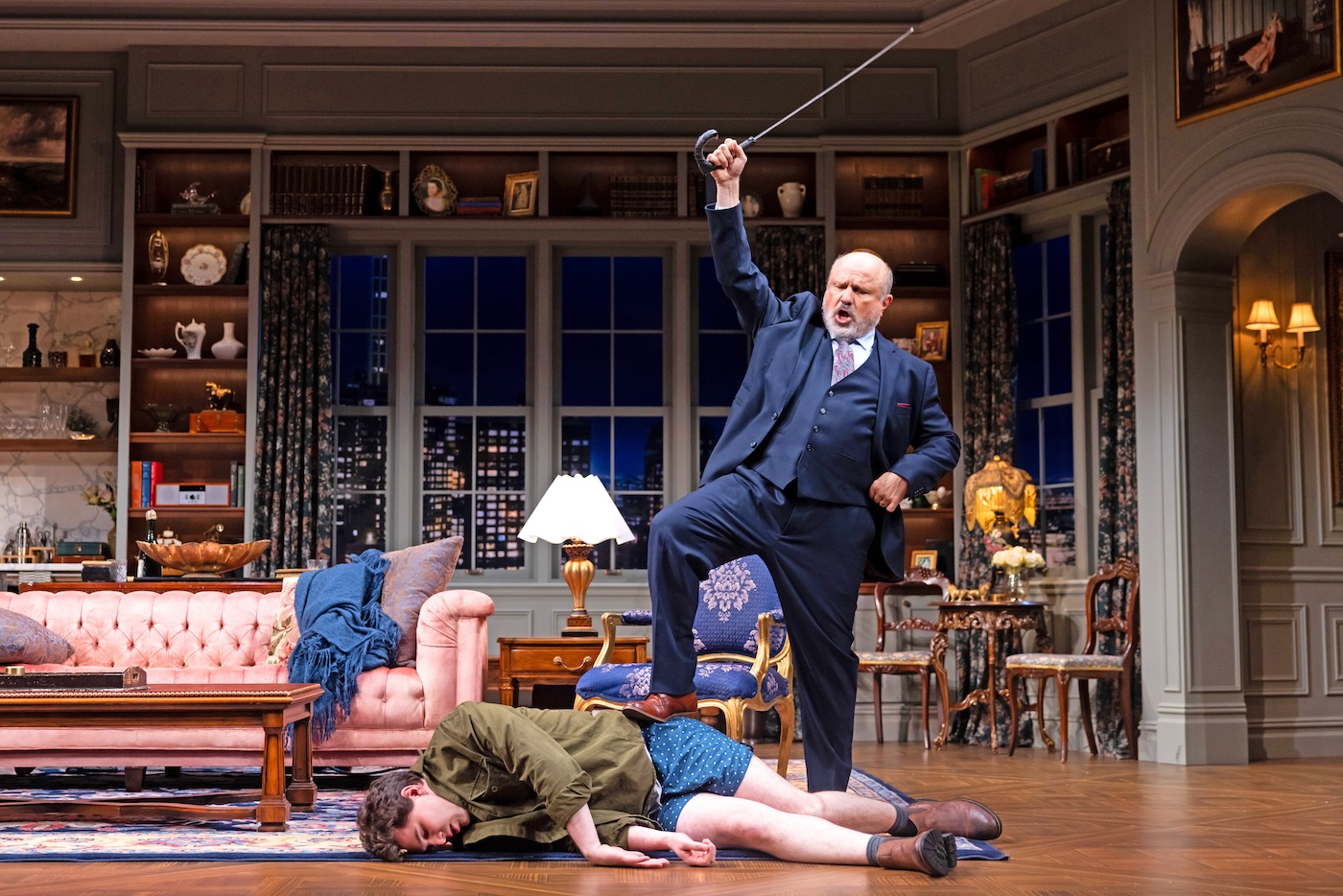
Chicago Shakespeare Theater’s “Fault” with Enrico Colantoni and Nick Marini/Photo: Justin Barbin
RECOMMENDED
Rebecca Spence’s toothy smile is the most devastating weapon in “Fault.” It reminded me of the grin of a saltwater crocodile I once saw on the Kinabatangan River in Borneo; a mouth designed not for chewing, but for crushing and strangling, sometimes quickly and sometimes slowly. Spence’s character Lucy works at both speeds, wielding her fearsomely perfect high-gloss whites through nearly the entirety of the comedy. “Fault,” now in its world premiere at Chicago Shakespeare, is the second play by Scooter Pietsch to land on a big stage after “Windfall” (not the show at Steppenwolf), which has run off and on in New York, London and elsewhere since 2016.
Like the previous play, “Fault” centers around the soulless machinations of greedy characters in constant negotiation and competition. In “Windfall,” the characters were office mates. Here the two leads are narcissistic high-powered dealmaking attorneys married to one another. They are late in their careers and apparently childless, which leaves all their love for money and stuff, of which they have plenty. Above all, they crave the high status and lasting glory they believe big deals bestow, but which have eluded them both.
The couple may or may not love one another, but they do love battling. Both complain about their years-long ceaseless repetition of the same arguments. Even so, they still revel in upping the wit and wickedness of their repartee with each iteration. Enrico Colantoni plays husband Jerry with all the energy of a corporate master of the universe who likely begins his day punishing a Peloton and pissing proudly in the shower. He has a collection of vintage weapons—maces, shackles, swords—which he pulls from the living-room displays when his sarcasm isn’t rapier enough. Many of the gags, perhaps too many, come at the tip of Jerry’s sword.
The action in the play begins in the living room of a seemingly empty, swankily decorated New York apartment with a multimillion-dollar view. Then, from behind the couch, bits of clothing, limbs and sounds of playfully rough sex emerge. Lucy has brought back a dim young man, Shaun, played by Nick Marini, after a flirtation in a nearby bar. Straddling him on her floor, Lucy slaps the younger man and demands he extol her beauty (we learn why later). Jerry arrives home early and catches Lucy and Shaun in flagrante. Jerry’s carrying champagne to celebrate his completion of a $200 billion deal which will land him $1 billion. It’s the best and worst day of his life. The play unfolds as Jerry and Lucy negotiate how to celebrate the riches and reckon with the potentially marriage-ending infidelity at the same time.
Shaun, at first, is an object of Jerry’s wrath, his sword and handcuffs. Soon, however, he is enlisted to referee the he-says-she-says argument the couple have about which of the two has been, among other things, more wronged than the other.
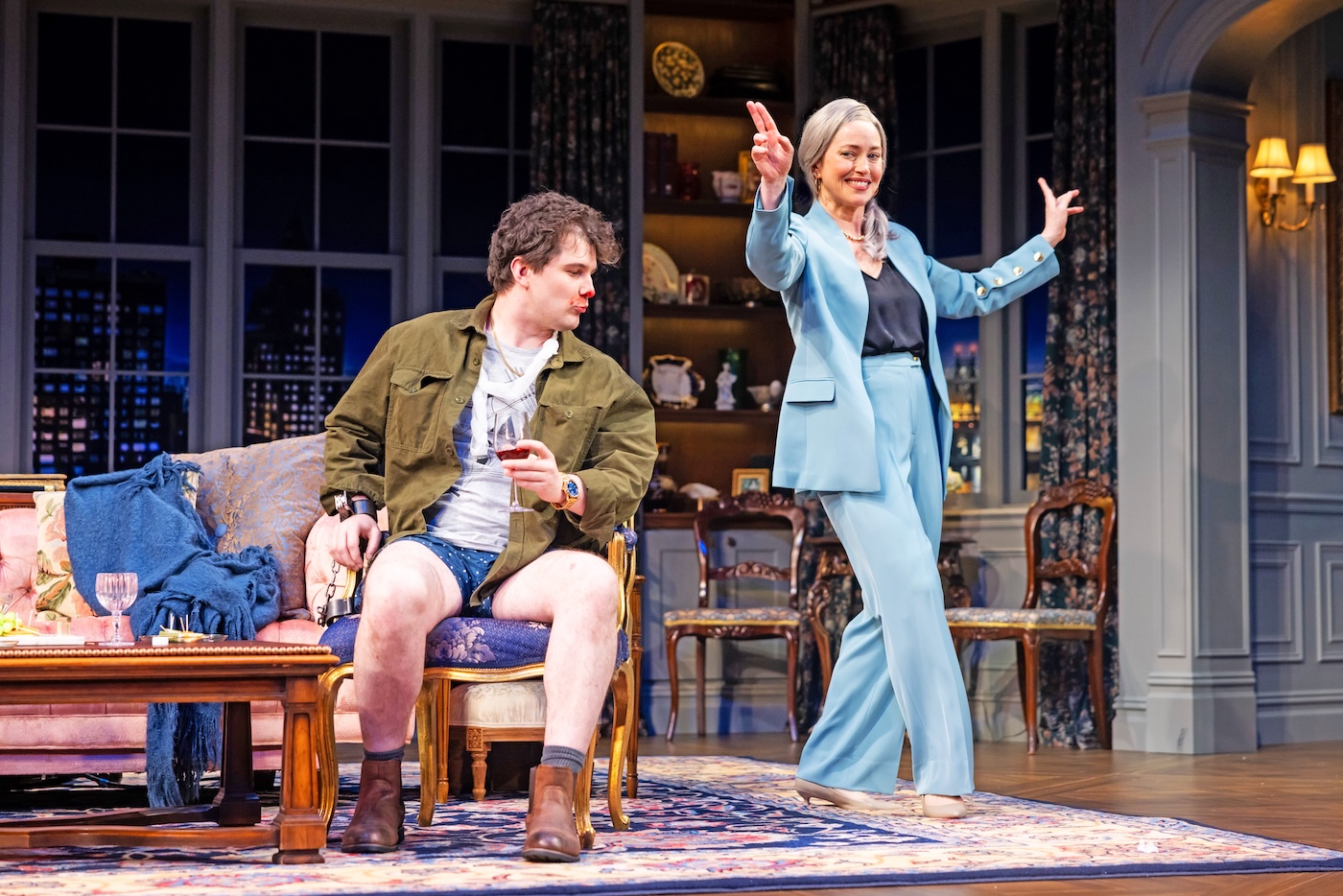
Chicago Shakespeare Theater’s “Fault,” with Rebecca Spence and Nick Marini/Photo: Justin Barbin
Jason Alexander, famous as George on “Seinfeld,” directed the play. Pietsch, who has long been a prolific composer for television and movies (“Keeping Up with the Kardashians,” “So You Think You Can Dance,” “Divorce Court,” etc.), brings an uptempo ear for dialogue. The talk rarely slows down and is usually at high volume. The dialogue offers surprises and laughs most of the way. While there’s no one to like or root for, there is usually the promise of a next insult to savor. In one very funny run, Jerry presses Shaun for a better way to refer to Shaun’s “doing” his wife.
The show crackles in the first half but loses some momentum later. There are long runs of exposition that dwell on dull business deals and failed negotiations that happened offstage. The vaguely described details of the deals and their prosaic consequences are empty fodder for comedy or drama, especially since there is little reason to sympathize with the characters, and no reason to care about the success or failure of their work lives.
Happily, Spence and Colantoni resuscitate the dead zones and do more than make the most of talk. They also inject it with physical energy and bodily wit. Fists pump, arms raise and swing, heads twirl, strident points are made with strident strides. Arguing for them is a Zumba class for two. And then there are Spence’s incisors, Kleig-light-white and grinning widest when she’s most, well, incisive. Both the Lucy and Jerry roles are unrelentingly demanding with a mountain of material to memorize. Remarkably, Spence, whose virtuosic performance gives velocity to production, was a last-minute replacement for television star Teri Hatcher, who dropped out. After seeing Spence in the role, it is hard to imagine anyone topping her.
Chicago Shakespeare has given its large, long stage called The Yard to the production. This is a “marital combat” play with tightly wound action that takes repeated shots at the intimate lives of its coupled characters. It’s a diverting example of the genre with a luxe production handsomely designed by Paul Tate Depoo III, with a mix of designer taste and Billionaire’s Row gauche. Nevertheless, the actual stage, not its design, may be overly grand for the close-quarters battle. In gems of the “marital combat” type, such as “Who’s Afraid of Virginia Woolf?,” “California Suite” and “Private Lives,” tight confines better entrap the characters and pressurize the atmosphere.
Dialogue that is punctuated by high volume in a big space, like here, can gain intensity by invoking quieter, more passively aggressive tones in a squeezed one. Perhaps the star power of Teri Hatcher and Jason Alexander urged the company to choose the more cavernous venue. Alexander’s own brand of comedy, which is so often effective because it’s so broad, might also be a factor. That’s understandable. Yet it’s tempting to imagine how “Fault” might go bigger by going smaller.
“Fault” is on stage at Chicago Shakespeare Theater, 800 East Grand, through May 24. Tickets available at chicagoshakes.com.


